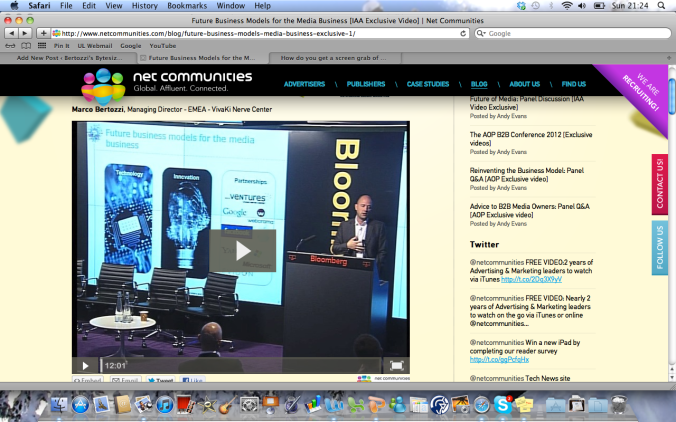
I presented for 10 minutes at a recent IAA event on Future Business models. I covered some of the areas that the Nerve Center focus on around Partnerships, Technology and Innovation. A great turnout with over 150 people attending the Bloomberg Theatre.
Some time ago I wrote a post on how impatient we are all becoming and how even email seems slow. It so happens that this week I was contacted by a guy in the US who has been working on an infographic to neatly sum this up. Take a look, some eye opening stats. Please see the originator OnlineGraduatePrograms.com here
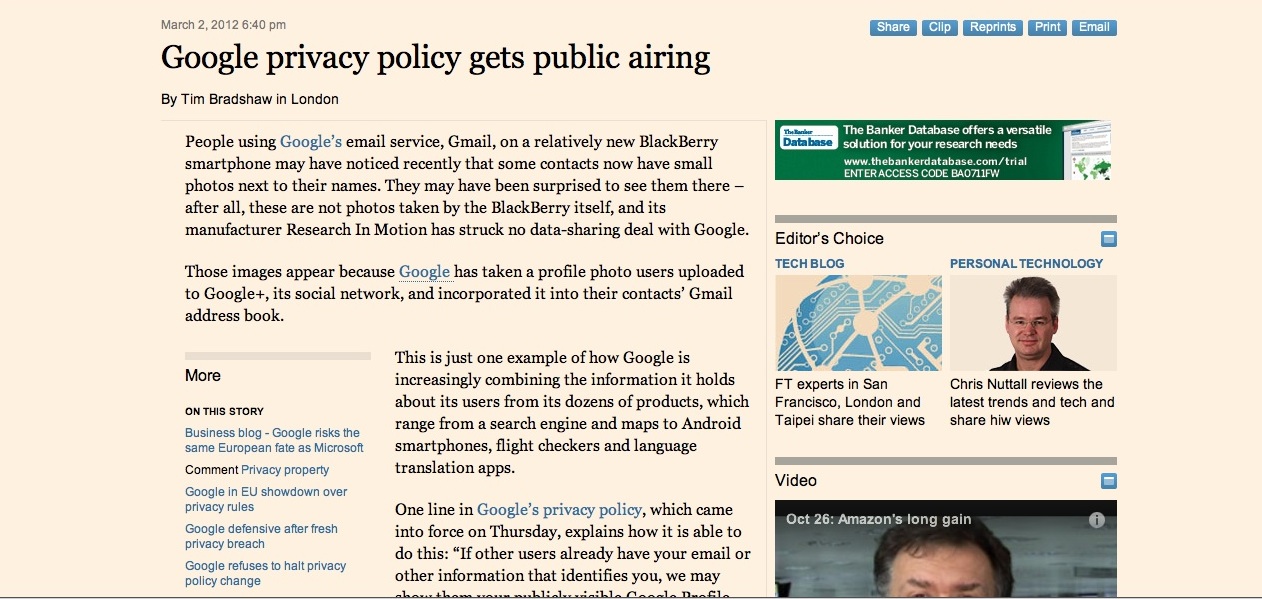
It wont change the world but as an addition to my work blog / scrapbook it is always nice to be asked by the Financial Times for comment. First screen grab introduces the piece, the second fast forwards to my bit. The Link to the whole article is here.
Intro
My two pence!
Thanks to Tim Bradshaw for asking me to comment @tim
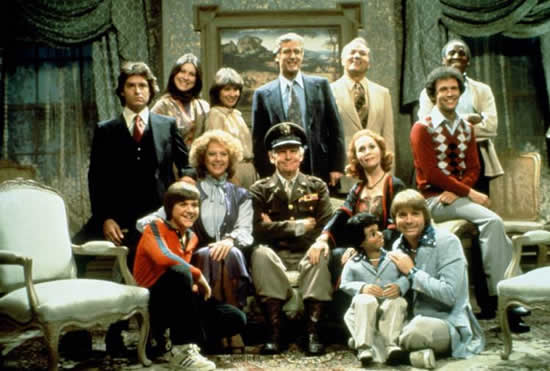
Does anyone remember the sitcom from the US called ‘Soap’? It was about a mad bunch of individuals who were pretty dysfunctional. At the start of each episode there would be an introduction recapping the previous episodes. That summation was invariably confusing and left you having no idea what was going on. The image below may jog your memories for those of you over 37 I am guessing.
Confusion reigned.
Why am I writing about that? Well recently through a combination of my own experiences and reading the press I have been thinking that in the world of tech, social and mobile we are experiencing something similar. To recap;
– Google and Apple were good friends, admirers even until Google started to like phones..and music..and books, now Apple does not like Google so much and is not keen on using their search tool on their phones.
– Twitter and Google liked playing together as Big brother Google helped the new boy get a bit of traffic, now the new boy has grown up he has decided he does not need Big brother anymore so cut the rope.
– Facebook and Google were colleagues and admired each other until Google started to like this social media thing and Facebook got the hump with that, they too have decided they want to keep their people to themselves.
– Twitter and Facebook enjoyed each others company for a while until Facebook liked the look of the Twitter approach and changed their updates accordingly, this has meant of course that they will not share anymore and never the twain shall meet
– Lets not forget some other long distant cousins! Yahoo and Facebook have not crossed swords too much in the playground until Yahoo decided Facebook had copied a lot of their IP and are now contemplating suing so that will be the end of that friendship
– Samsung and Apple have just had an all out fight all over the globe and frankly not seen eye to eye for some time!
– Even the lovely and friendly Amazon has had to get dragged into the cat fight with its entry into the tablet market which annoyed Apple who promptly stopped their Kindle App from being e-commerce enabled – surely no one falls out with cuddly Amazon?
All of this squabbling leads me to see a future where we have one of the most siloed ecosystems we have ever known. Years after we criticised AOL for its wall garden approach to media we find ourselves with more walled gardens than we know what to do with and as consumers that is the honest truth.
We are edging towards a world where Facebook, Apple, Amazon, Google, Twitter and beyond will all be managing their own ecosystems and not allowing us as advertisers or consumers to mix and match and join up all of the platforms. It is a frustrating development as a consumer as it would be nice if Facebook and Twitter could find a way of working together. It would also be a better Google search experience if we could find results from not just G+ but also the other social media players.
As I have written about before it gets worse when you move to looking at the tech marketplace with our homes being divided into either an Android home, Apple home, Microsoft home or Samsung home, we have to make a decision and stick too it as we can’t get all our toys to play nicely together.
I am not sure how this will play out, but it is messy and not particular user / consumer friendly in my view and probably going to get worse as these Big 5 getter bigger and stronger.
A good piece in NMA on private marketplaces, great to see the mainstream digital press starting to write more solid coverage on the exchange market. See full article here.
Centralising Retargeting
BY: Paul Silver, Head of Product AOD UK and Geoff Smith, Head of Activation AOD UK
Featured in Exchangewire also here
Retargeting is the core foundation of any performance display campaign. It’s something we all know now, but it’s not something we all knew when we outsourced our display buying to ad networks all those years ago. That’s ultimately because ad networks never disclosed the importance of retargeting whilst they were able to ride the gravy train. However those days are over, and there are several compelling reasons as to why we should all bring retargeting in house today.
Transparency:
Arguably, the greatest output of RTB is that it has created a new marketplace that allows it to be centred on transparency (not 100% complete transparency on every bid request but considerably better than it was previously).
Being in control and accountable of every penny a client spends means we know exactly how much contribution there is from every element of their retargeting programme, and what’s more, so now do our clients. There is no more allowing ad networks to hide behind blended CPA metrics, offsetting the poorer performance of their run of network activity with quick win retargeting conversions. Clients now understand the exact worth of retargeting and precisely how/what needs to be done to a) increase that volume but also b) drive incremental growth.
Lets not forget, in most cases, we also now have insight and transparency into where our ads are being served. Not only is this paramount from a brand safety perspective but also incredibly valuable when we can provide insight to clients that demonstrates which environments convert their target audience more efficiently, how that informs their other cross media planning strategies, and how it disrupts their traditional media planning with fresh ideas.
Price Inflation:
The impact of price inflation from multiple retargeters running on a single media plan is real, it is not just a theory. We know the effect of having to bid for a single user against other bidders. We’ve seen the data, it becomes less efficient. The message we convey to clients is that the situation is akin to brand bidding in the affiliate space a few years ago. Why would you let affiliates obtain standard levels of commission for piggybacking on your marketing investment, by bidding on your brand, whilst also inflating your own CPC costs to access that brand term inventory? It didn’t make sense then and it doesn’t make sense now.
Strategy versus tactic:
By centralising retargeting in house, you immediately remove any element of having to play ‘the ad network game’ which is designed to obtain last click or view attribution. You are actually able to start developing more bespoke, controlled strategies around first party data, integrating it into the wider marketing/comms mix and introducing separate eCRM or cross channel strategies. It becomes an extension to an integrated marketing plan, rather than simply a cheap display acquisition tactic.
User experience:
If there’s one thing that gives retargeting a bad name, it’s when advertisers do it poorly. Retargeting should be used as a reminder of the brand/product/service that a potential customer is considering, rather than giving advertisers the ability to stalk users across the Internet with the same message, no cap on frequency, and potentially showing them the same product that they bought 3 weeks ago. It sounds basic, but we’ve all seen it in action. By taking the retargeting program in house, agencies can help clients ensure that their customer’s user experience remains engaging, consistent and above all else, controlled, increasing brand advocacy rather than damaging it.
Data security:
Lastly, and perhaps most importantly, being in control of client’s first party data is not a simple game of efficiency improvements. There is also the much more serious consideration of client data protection. With publishers being able to place tracking pixels within tracking pixels within tracking pixels, can you honestly say that you know every 3rd party server call being made from your client’s site?
It is not unfair to say that practices from *some* ad networks in the past have included leveraging one client’s dataset to improve performance for another client competing in the same vertical. Why should client A help fuel the performance of client B? It reduces their competitive advantage for the benefit of their competitor’s. It’s clearly efficient for ad networks to do this, and certain agency groups are also now taking this data sharing approach, but who really gains when everyone has the same cookie pool available to them?
Data leakage became a serious issue for the industry last year, and with the e-privacy cloud looming, agencies have a responsibility as much as their clients to ensure consumers are well informed of how cookie data is being used. How confident can you be in your client’s privacy policy if numerous disparate suppliers are still managing elements of your retargeting?
At VivaKi we take this very seriously and ensure that no client data is EVER co-mingled. We also work with clients to give them transparency over which pixels are on placed on each of their sites and what they are used for. When you outsource retargeting, you loose your ability to have a holistic view on how your client’s data is being used and ultimately, you outsource control. In today’s ever-stringent e-privacy environment, that is a dangerous place to be.
My piece in M&M Global – not dissimilar to my original blog, slightly adapted so no need to read through!!
CES 2012: The world of television
19 JANUARY 2012
Last week executives from business, government, entertainment, automotive, consumer electronics and every major industry converged on the 2012 International CES to experience new ways of doing business at the world’s largest consumer technology tradeshow.
Everyone told me that Las Vegas was a crazy city and CES even more so but no one did it justice. This was my first visit to both and no one could have prepared me for either. The scale of the city and the event itself beggars belief. The buzz around the event is incredible with every major tech company represented (except Apple of course) and on a scale I have never seen before…See rest of article here
Everyone told me that Las Vegas was a crazy city and CES even more so but they did not do it justice. The scale of the city and the event beggars belief. There is a real buzz around the event with every major tech company represented (except Apple of course) and on a scale I have never seen before.
Executives from business, government, entertainment, automotive, consumer electronics and every major industry converged on the 2012 International CES to experience new ways of doing business at the world’s largest consumer technology tradeshow.
The 2012 International CES was the largest in the event’s 44 year history, with a record number of more than 3,100 exhibitors across the largest show floor in CES history – 1.861 million net square feet of exhibit space – and drawing a record of more than 153,000 attendees, including more than 34,000 international attendees. More than 20,000 new products were launched at the 2012 CES, and as we know it has become the second largest event for Agency Groups with Levy, Sorrell, OMG Board and 500+ people turn out from VivaKi amongst others. My boss Curt Hecht comments on this in an article in Adage – read it here.
Although there was an enormous amount covered at the show I wanted today to focus on the converged TV topic and the challenges we all face in this space. Let me start by giving you some of the highlights of the TV space for me and then look at the implications.
The TV is no longer lean back but lean in, it is being designed to draw you in and pull you from your stupor. The TV is being assaulted by set top boxes, App stores, satellite companies, it’s now no longer able to sit quietly in the corner of the room, it has to be your communicator through Skype, your music system, social media entry point, picture frame, cinema etc, it is also on a diet and becoming more colourful! (more on that later). Before looking at specifics, I have to say that above all the point I was left with was that the role of the main broadcasters and channels seems antiquated and slow at this stage and being left behind a very fast moving wave of tech.
The TV manufacturers are all looking for an angle on how to interact with their devices. Microsoft want you to wave at their TVs via Kinect, LG want you to speak to their machines and have created a unique remote control that acts more like a cursor, this worked for me more than waving hands etc. The video below shows the users scrolling around the TV screen between all the apps using the very simple cursor method.
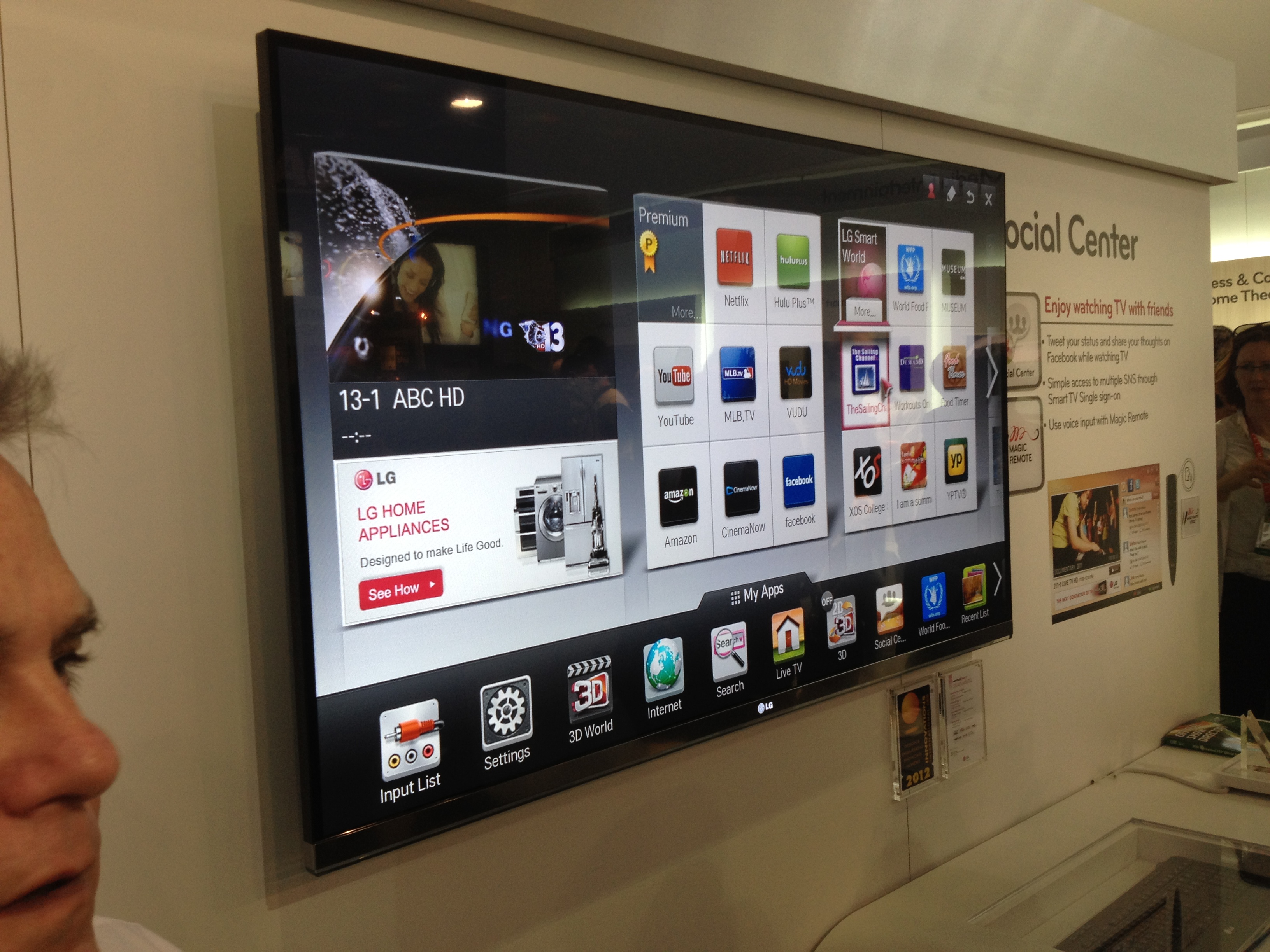
The Rise of Apps: The first thing that strikes you about the LG is that this is now all about the Apps and not about the linear TV stream. These apps remember will hold TV catchup, movie download services, Facebook, Linkedin, games etc, it will be a while before you start turning to your fav TV show at the allotted time, it is this the vast array of other ways of interacting that leaves you with the feeling that the main broadcasters have a big job on their hand. Check out this LG and it’s Apps.
In this screen you have not only the Apps but also the advertising slots available on the left under the screen, in this case Toyota, if you click on these Ads you can be taken through to full video or sites or Facebook pages, the opportunities are impressive and again this raises questions of measureability
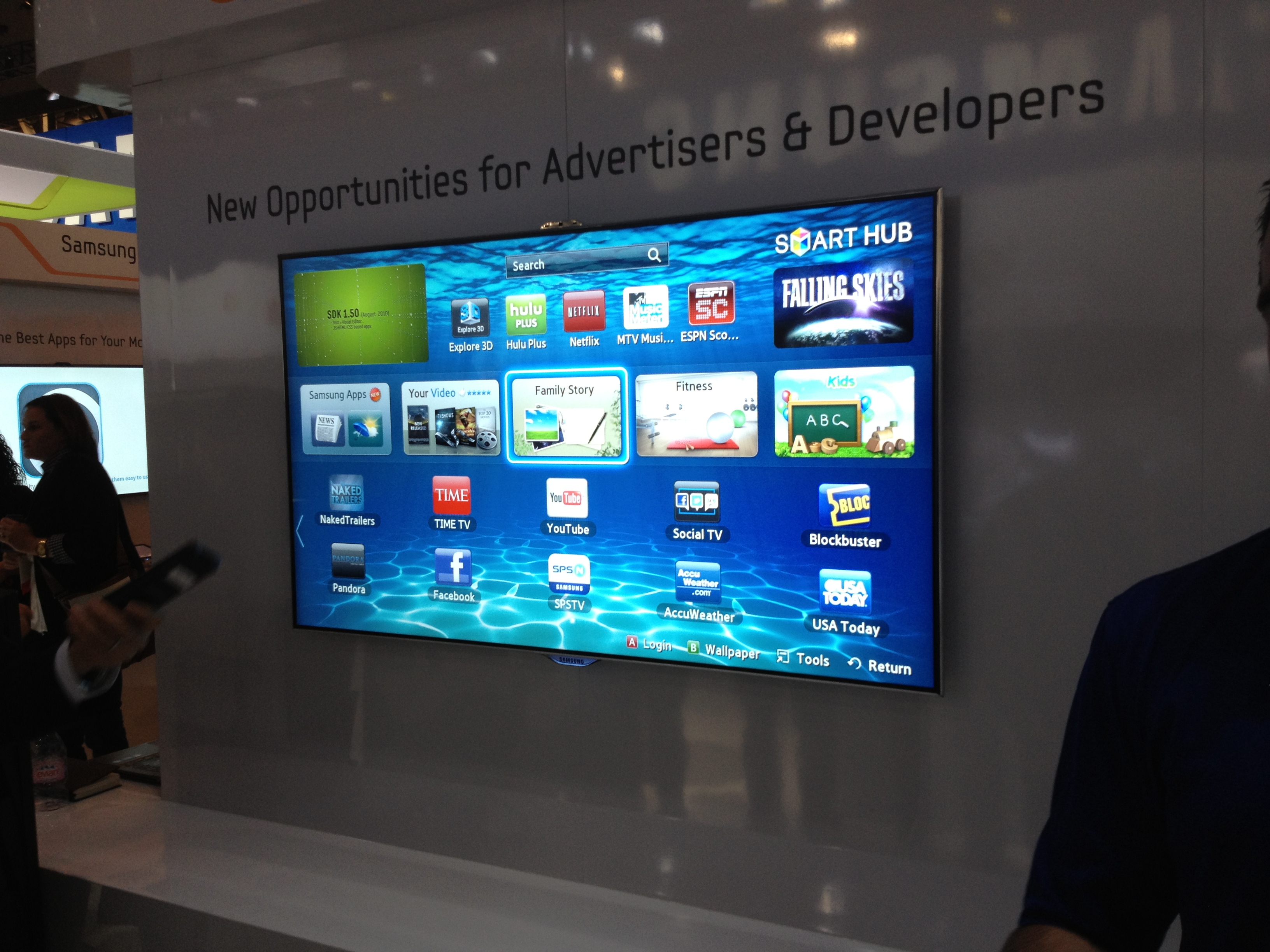
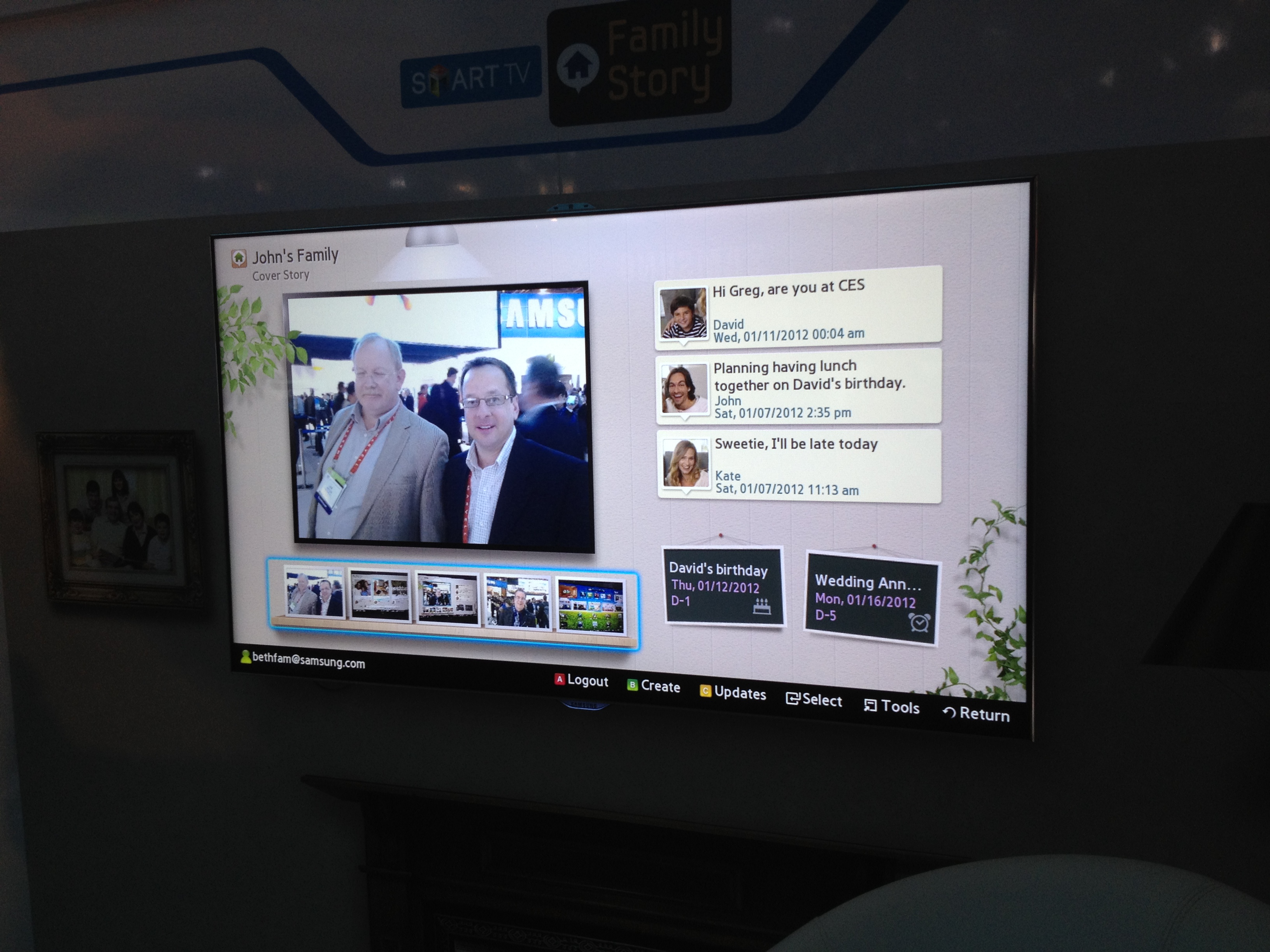
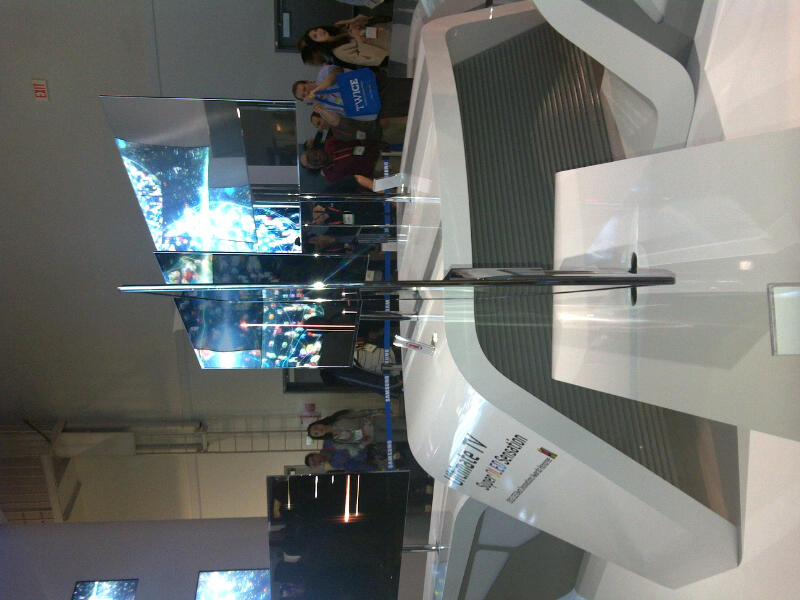
All the manufacturers have led with the App approach, take a look at the Samsung picture below, an awesome TV with incredible layout and design, again all driven by voice commands. The Samsung TVs really stood out as being very impressive both in terms of design and functionality. You will notice the social apps in the TVs, previously they have been a little clunky but now they are seamlessly integrated so you can be talking with people, tweeting or on Facebook alongside the TV programming, the second picture below shows an example of that in action. Social TV is going to be huge and will again swing the stats away from dual behaviours / screens whilst watching TV.
Facial recognition and personalisation
Right now if we want to personalise through TV it is down to the very early attempts and basic targeting alla Virgin or Sky, if we want to measure TV viewing in the family we have to press buttons or in some cases in the US people are still filling in diaries that a multi billion pound industry relies on. What about a future when the TV recognises you as you sit down, or whether you are with people, whether you are doing something else as well – are you distracted, advertiser pays less!? All this and more is coming in the new TVs. Facial recognition will be huge, imagine logging in and the TV suggesting the Sopranos episode you missed or show what your friends have been watching or even some Ads based on those you have previously watched all the way through? Facial recognition is going to transform your viewing experience and again will present you with a myriad of entertainment opps before you even get to the first channel you would normally watch!
The battle of the software
So LG and Samsung have built their own platforms for all of this to run on, so has Microsoft and Google of course, Sony was the more open minded of the manufacturers we looked at who were turning to Android to provide their operating system. Apple will have their infrastructure and others will too. So where does that leave us? Well it leaves us with the same argument we have always had – Open vs Closed. In the world of TV that debate favours closed with LG, Samsung, Microsoft, Google and Apple all running their own platforms, this is crazy in reality and a brain fade for advertisers and users. Interestingly this does not stop at the TV. Sony, Samsung and Apple in particular are all trying to wrap up your living room and online experience, trying to get you to link tablets with TV with mobile, thats the big win. What is open is the App and online companies, with all of them working to be available everywhere – email, movies, social etc are common to all, so those companies are having the time of their lives with all this innovation.
Sony went a step further by connecting their PSP to their TVs, tablets and phones, meaning as a user you can get anything everywhere. A gamer who was on the PS at home and had to run could get to the bus and then turn on their PSP and it would remotely fire up their home system and stream all the gaming to their handheld meaning they carried on exactly where they were, its a cool piece of work from Sony and needed. I felt their TV and tablet experience was behind the competition.
Measurement
We have a problem. In one TV set or should we just say large screen we have social media, photography, communication with tools such as Skype and Facetime, we have movies through all the Apps, TV shows through the Apps, the weather, an ecommerce hub and so on and yet somewhere in there people are watching TV in a linear fashion..or are they? Then on top of that we have all this on top of different platforms and players and across thousands of TVs. How as an advertiser can you a) be expected to navigate this and b) measure it in current methods. Lets face it the panels as we know they are over, they are basic and cannot fully give the advertiser a faith that they are paying for the right information. There will be ways of consolidating advertising by companies such as YuMe but on top of that everyone will be selling advertising in their Apps or via video resellers and exchanges and we have to add all this up? We need ASAP a universal tracking initiative such as online adserving etc to at least pick up a big chunk of those metrics, but outside of that the role of the TV panel either needs to reinvent itself and fast or die.
And finally..
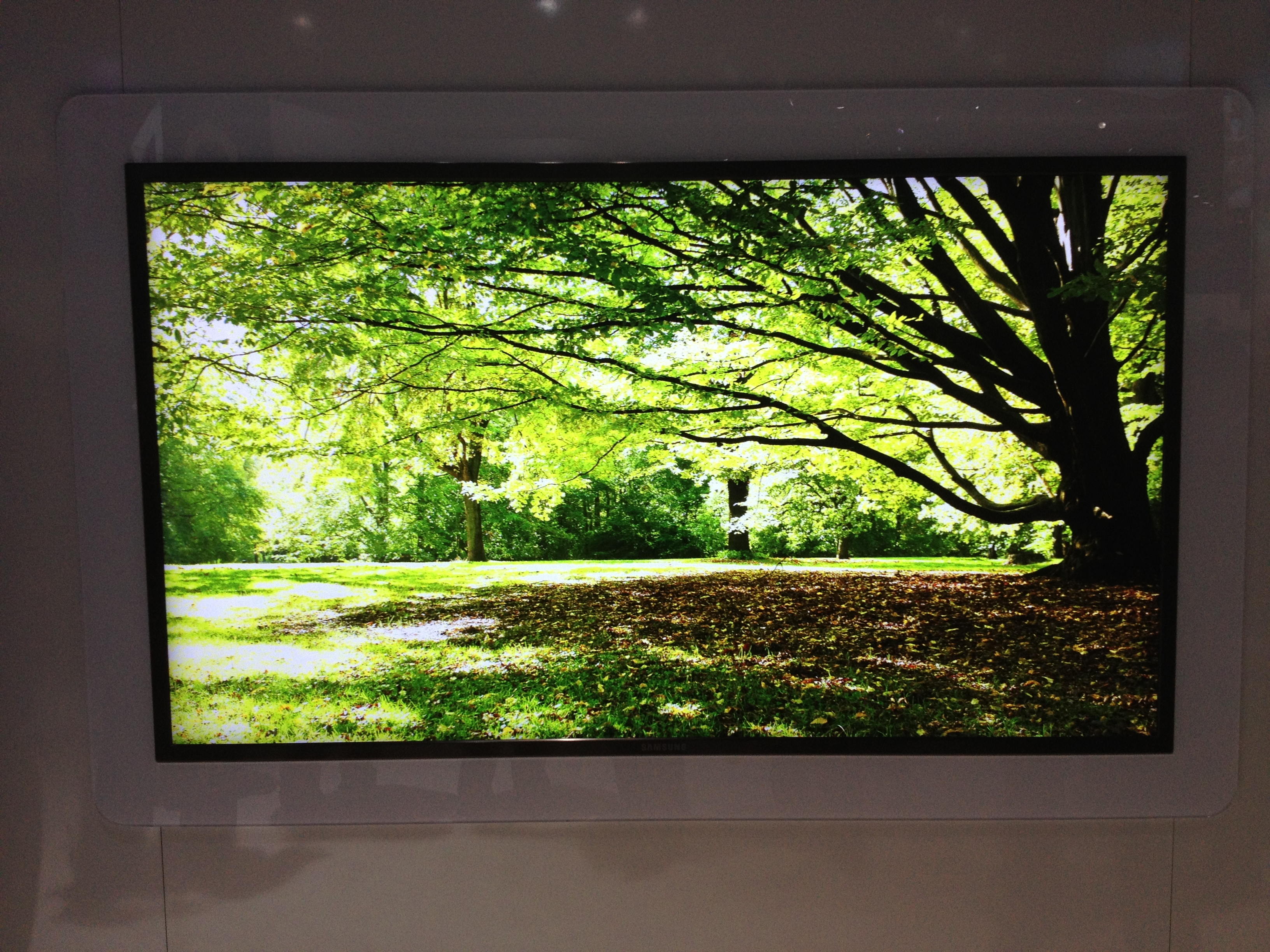
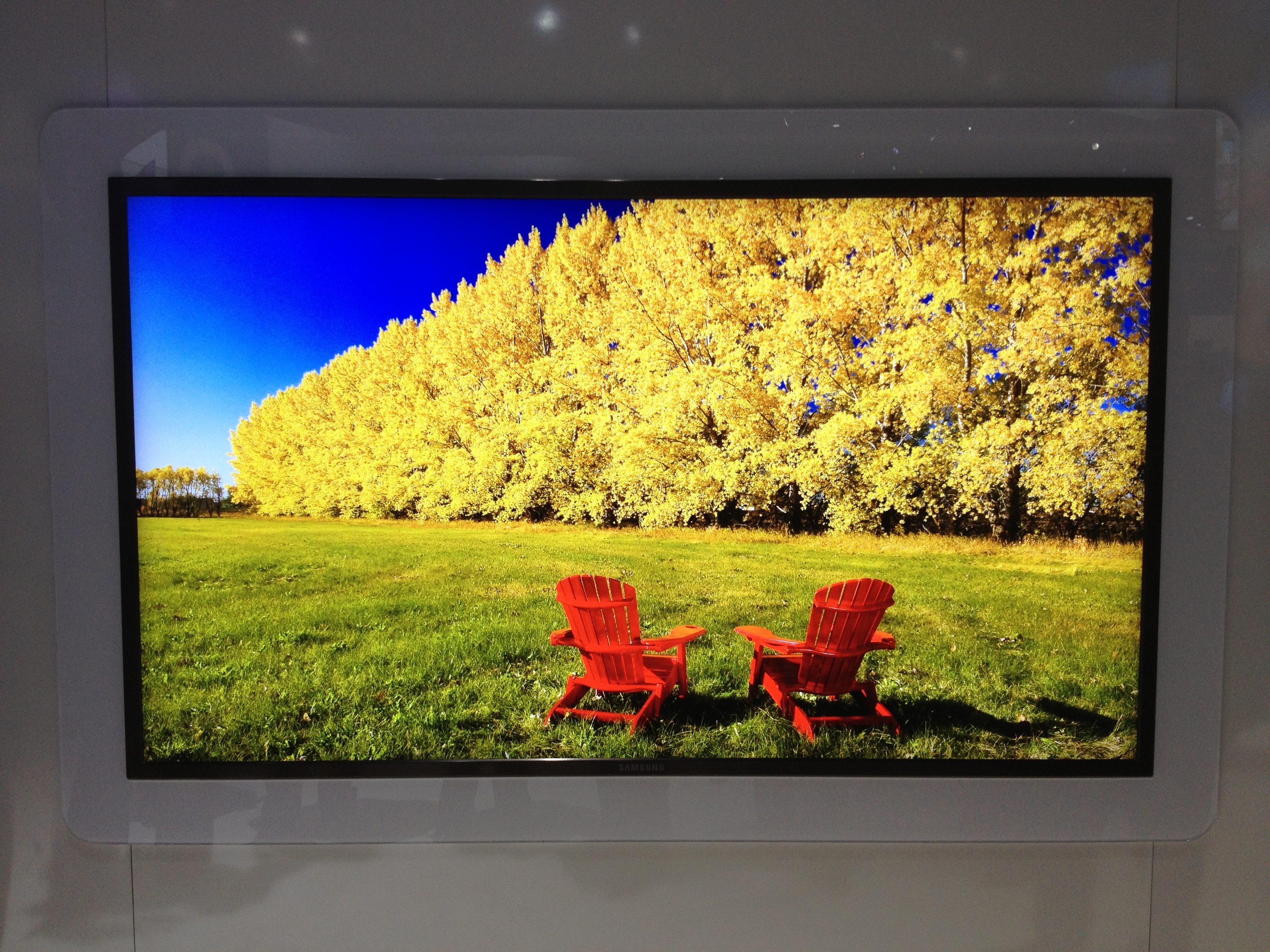
Oh my the TVs look amazing, they are getting slimmer and slimmer and brighter and brighter, see some of the images below, they dont do the reality justice but you get the idea. The colourful images are from the 4K. The 4K from Samsung basically means 4 x HD, the pictures were so real you could barely tell and check out the TV as slim as a card! The innovation is incredible and mind boggling, but I am so glad I got to see it first hand, the world of TV is an exciting one!
I quietly smiled to myself when I saw the announcement that Dataxu had bought Mexad and the press release that went with it. Dataxu buys Mexad. What an interesting start to the year in terms of consolidation. I have had relations with both companies and in both situations I / we were criticised by the companies involved for our strategy. In both cases it boiled down to driving business growth through good old fashion means rather than selling the algorithm dream.
Dataxu first of all was very down on the VivaKi partnership with Google and Invite, first was the usual Google paranoia stuff which I am used to and bored of but the second was whether or not we could succeed by using Invite, considered the lesser DSP apparently by Dataxu compared to their high tech operation. At the time I explained that to grow the marketplace and to grow my business and make a success of Audience On Demand first and foremost was to have the support of a strong partner (and a good one) with resources and scale not just in EMEA but globally. Secondly I needed consistency of offer, the finer points of the algorithm would not be the defining factor. Audience On Demand a year later is the largest Exchange Trading proposition in the world and we are delivering fantastic results and have some very smart people working for us so I feel pretty vindicated in my approach. It is therefore enlightening to now see Dataxu resort to buying Mexad to be able to deliver service and people.
Mike quotes ‘“feet-on-the-street” is becoming a key differentiator for the DSP business, because it’s not just about having the best software, algorithms and access to RTB inventory that determines success in local markets, but understanding local cultures, ways of doing business in specific markets, and the ability to advise and service local marketers and agencies in those markets.
This is exactly what I was explaining all those months ago and it seems Dataxu have also seen some truth in that approach. The other telling thing for me is around the fact that the individual DSPs are finding it hard to get into the agency groups, they have been knocking on the door for some time and the way is blocked for many of them with Invite taking the lion’s share and each of the others taking the smaller share, at least in EMEA. I have said all along that I still see this a very difficult market place for the independent DSPs, not impossible of course and I look forward to working with a number of them as we continue to test and learn, but difficult. Perhaps by buying Mexad they see a quicker way of getting through the doors, although Mexad as far as an agency trading desk is concerned is like outsourcing your TV buying so I suspect those doors, at least in developed markets, will also start to close.
Finally Mexad. I assume that even though they have been bought by Dataxu they will continue to work with multiple DSPs? I have been repeatedly heckled at industry events that working with just one is wrong and is not the way forward, that it is a flawed approach! Anyone who knows how agency land works knows that it is a large education piece and consistency of message is crucial. Audience On Demand is working well because the agency teams understand it, the publishers know we are transparent and consistent and the clients have a team of people who are aligned and focused only on delivering the best results. Perhaps Mexad will find some of the same benefits now it can concentrate on one DSP only.
This world will evolve of course and Audience On Demand will test a number of different DSPs over time, that is what any desk would expect to do, even if we retain a major partner, I hope now that Mexad is tied down to just one they wont find it too strategically difficult to handle after claiming for months that it was the wrong approach!
Aside from that Good luck to all parties and well done!
I have noticed it more recently, perhaps because I am becoming conscious of my own addiction to mobile and tablets but everyone, all of the time, is head down into their mobile. It is something that has been gathering pace as the smart phone uptake has grown (iPhone represent 55% of all mobile traffic and 7% of all web traffic) but it is now literally out of control. Human beings can no longer have a pause without the pause being filled by a pull at the phone and some interaction.
Although not what I am focusing on today, it is interesting that the advertising and media industry still seems in capable of grasping this opportunity, I would now say above all other media channels mobile dominates our life and yet ad spend on mobile and mobile optimised ecommerce sites of major brands is not where it should be. In 2010 advertisers spent £83m on mobile advertising – that’s a crazy stat when you think how attached we are to our phones.
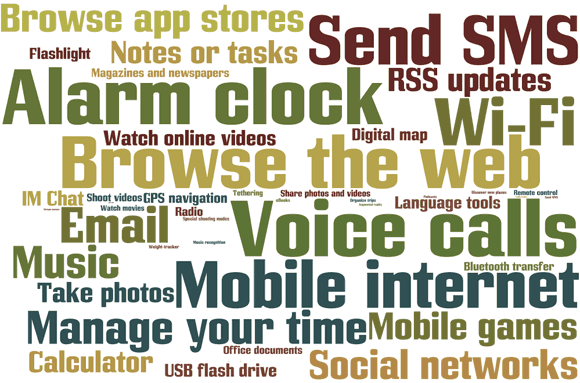
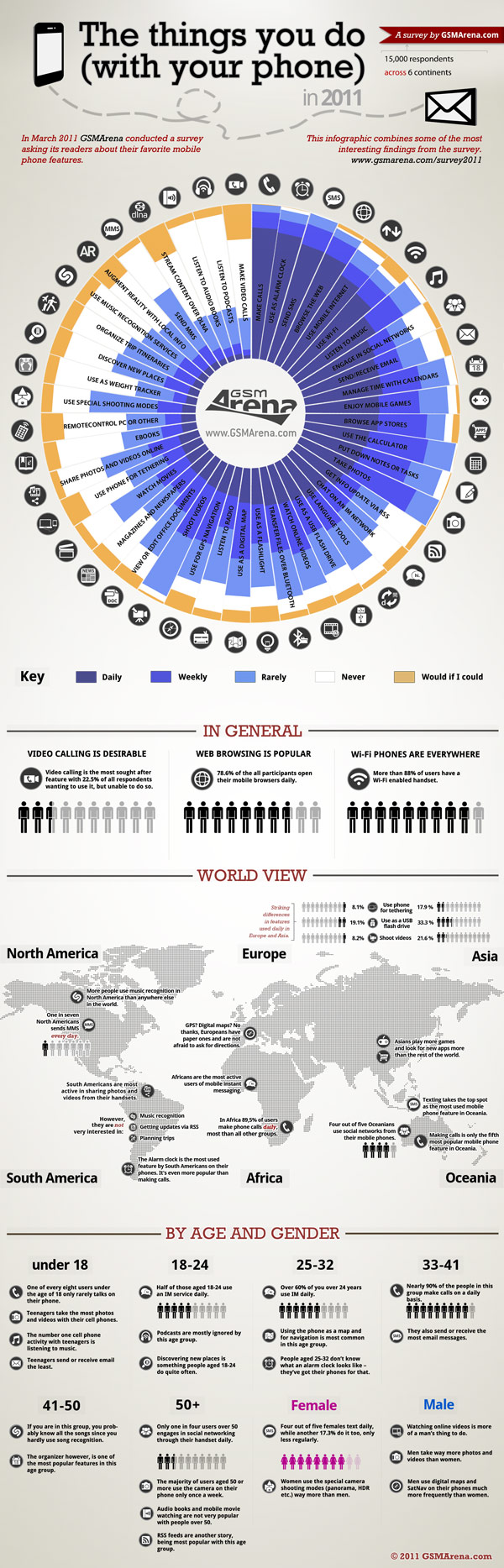
The thing with the mobile phone and in particular the smart phone is the crazy amount of things you can do with it, it is this that makes it something we are glued to day and night. GSMArena carried out research with around 15,000 people, link here and you can see the array of things people use their phone for and what was most popular. There is a word cloud and an info graphic, both below that are pretty insightful.
The detail behind those words can be found on the next infographic
It is for this reason that my phone stays with me from dawn until dusk, I am not alone in reaching for my phone before anything else, 83% of people use their phone as an alarm and so starts the day. From here when you look around you its relentless. Everyone is used to the idea of people using phones on trains etc, the commute, it’s not that which I notice the most, it’s the bits in between. As an example what is the shortest pause you need to reach for your phone or check it?
a) Would you check your phone as you wait for the cash machine to register your card?
b) Would you check your phone as you wait for lights to change in the car?
c) Do you always look at your phone while you are walking?
d) Would you check your phone in a work meeting
e) Check it when you are one on one with a friend?
It is relentless checking that I am noticing, and I am well and truly guilty of it, but I think we re beginning to erode the old rules and its acceptable. More and more people are checking phones during meetings, at dinner, at the bar, often three or four people are all checking at the same time. Big events and presentations have more people with their heads down on their phones or tablets than concentrating. The rules of politeness are being eroded. Concentrating on a conversation or a meeting is no longer a prerequisite. In fact as soon as someone leaves a conversation to pop to the gents, you dive onto your phone is you have been restraining yourself. We are all addicted.
More and more guys are on their phones at the urinals now, that is an emerging trend! Perhaps they were the polite ones not looking at their phones during a conversation and went to the loo just so they could.
I remember someone once saying that we are making time for ourselves with mobiles because we fit all our catch up conversations in on the move and so its making time at home for partners and friends, I am not sure that holds water anymore, we are always on our phones and when it was just calls it was fine but now you can basically run your life from them, they have become more intrusive. I look around me and see everyone immediately reaching for their phones at any pause in life, all of us head down not watching life go past and I feel like I am in one of the futuristic movies where we are all wired to some unseen force, I think we need to disconnect more.
VW have done it in a German factory, they have stopped their servers sending emails at 6.30pm so workers are not constantly on their blackberries – interesting! Not sure that will catch on but its the principle of it, the fact they are trying to break a cycle that is hard to break. As new members join the company and are desperate to get a blackberry I always think what a mistake that is and to stay away for as long as possible, as soon as you are wired to the work all hours is the day you will never truly have a holiday again.
I am addicted to my phones so I am all the things up there but I wish I was not, I spend too much time on it and looking at it, it makes me rude at times, and I miss things because its head down all the time.
I think Microsoft got it right in their Ad to kick start their new phone – ‘Really’ Take a look, not a bad Ad and absolutely on the mark!







 Bertozzi's Bytesize