Why Paying to skip video Ads undervalues what we do

My Opinion piece in NMA this week on the new Skipit service,  link here but behind a paywall

Image

In December 2003 a version of skippable Ads opened, it was called the M6 Toll road. Designed to make life easier for drivers they were offered the chance to pay a small fee and skip the bad traffic on the normal M6. Surely it is better to pay a couple of quid and get a luxurious stretch of tarmac without delays than have to sit in traffic for hours, especially when we are so time poor? Well the reality appears not. Demonstrating we are not as time poor as we thought. The toll road traffic has consistently fallen since opening, showing that perhaps paying to avoid inconvenience or bad experiences is not as high up on our agenda as some would have us believe.

And that is my view of the new format from Skipit where you can pay 10 cents to skip an Ad. You can build up credits through other means, by liking an Ad or interacting on some level with an advertiser, which I feel equally uncomfortable with.

Let’s stick with the principle of paying to skip an Ad though. Really? I am intrigued as to which Ad is going to push a person over the edge and make them sign up to an account. I find the idea of idly watching some content and then deciding ‘enough is enough, I am going to go to all the trouble of signing up to an account just to avoid a couple of minutes of Ads’ a stretch. As my colleague Paul says, perhaps it will improve completion rates as people are forced to establish the real cost of sitting through an Ad? Perhaps this system will improve performance on average Ads as people realise that it is not a big deal to watch them as long as they are engaged with the content.

Also, this isn’t going to pave the streets with the Gold that publishers might be expecting. To make this a meaningful revenue stream would require LOTS of video content being consumed outside of YouTube and the BBC. Recent Comscore research tells us this isn’t true. Google accounts for nearly 30 million uniques, the BBC accounts for nearly 7.5 million and VEVO (which again has most of its volume within YouTube) accounts for over 11 million. Consumers would also need to be willing to dip their hand in their pocket time and time again. Lastly, the rollout of such an initiative is unlikely to sit within the premium long form content owners. This is important considering the video Ad lengths which dominate the short form content space; am I really going to pay to skip 10/15 seconds of Ads being played on content that I am not really that engaged with anyway?

Now there are skippable Ads and skippable Ads. This approach is the caveman’s club vs. the surgeon’s scalpel where Google’s skippable Ads are the more sophisticated. Their approach is to incentivise advertisers to improve the quality of Ads by penalising bad creative; surely that is the right way round, not giving money to a publisher who carries bad Ads that people don’t want to see? VivaKi’s The Pool and their ASq® format offers users a chance to choose the Ad they want to watch, the impact on completion rates, engagement and memorability is considerable and encourages our advertisers to constantly see their video creative as something that should receive the same level of attention as their TV ads, but differently and with the end goal of their content being chosen over content from another advertiser.

Our job in this business is to make people realise that Ads pay for content, that Ads should be as high quality as possible, and that advertisers need to create content people want, whether that is an Ad or a short film or whatever. Paying for likes, watching an Ad to get something, all these models are blunt instruments and undervalue what we do. They are not what we should be aspiring to. 

Our industry loves scale. Does size matter?

The first few years of my career at Zenith Media were defined by how big we were. In 1996 we were No1! We were the biggest and that meant so much to so many people. As the years went by Zenith slipped a few places, then we merged, but then so did everyone else and we all jostled for a top 3 spot. As the years have passed the focus became digital. How big was our digital team, how much spend and we all wanted to have more than i-level back then. As time has passed though there seems a little less emphasis on it. There is an acknowledgement that it is less about the scale and more what you do with it. (Heard that somewhere else?). I would say that today it is more about what Tier you are in rather than position. 

This blog is not about agencies only though, lets take a look at clients. As a client if you are big and have a large Ad budget you expect some benefits with that, more team, cheaper prices, preferential treatment, better ideas and so on. As above though, if you are a clever advertiser or work for a sexy brand you can get the same even with a small budget, so again its how you use it.

Even a VC has a view on this, today we had a talk with the very engaging Scott Ferber or Ad.com and Videology fame and his summary of how the VCs approach business is better to have a business growing with big revenues and less profit, than high profits and less growth, they also want more and bigger and need numbers, why? Well if they invest in 50 maybe a few will come off so again Scale scale scale.

What got me thinking was the effect of Real Time Bidding on our media landscape especially video and eventually Connected TV. Is scale so important? As a media owner of course you need audience but we are scaling niches not trying to buy big one off audiences in Real Time Bidding so that scale is less important to us in the single hit and if that is the case then does that mean we want to fight as hard for these one offs? It is something the ITVs are most scared of, as Scott talked about today ‘unbundling’ they would rather sell a huge 18-49 female audience to an advertiser than have it unbundled through data and technology and reveal that in fact that the big 18-49 female audience was actually only 40% and that actually it had a lot of men and people outside that age. Is that not an opportunity though? surely they have just maximised their commercials, get each audience commercialised to its max – why does that not work? Because of scale and the lack of its importance to the buy.

But then is that not the same for advertisers? How does a £100m advertiser benefit from Real Time Bidding vs a £5m advertiser? The answer is they may get some extra team, some extra inventory arrangements but on the whole they pay the same price as the shop on the corner, just like search and API. So with exchanges, API and Search you are basically saying that a 50m digital advertiser on 70% of their spend gets no price advantage – thats a different world, and not one auditors will like either. Who does that scare most? We actually have a business where there are many vested interests to keep things as they are, big advertisers will always want to be treated differently in the markets, big media companies will always want to have the highest rating programmes, the most unique users, the biggest single readership and so on, the problem is in display and eventually in video we may have unlimited supply, if we have unlimited supply then we can reach scale one impression at a time, social media has helped us get there with its vast audiences. Finally of course agencies also want the rankings and the positions so this is all going to take time but I believe we are now on a journey that ends with scale, size and clout being less important than purity and exactness around audience buying and delivering the right ad to the right audience. Whether it is DSPs, Media Ocean or the next tech around the corner it is just a matter of time before there are more questions asked of the scale players ( generally the least willing to move into the new world of RTB)around the purity of their audience sells they are delivering and whether it is valuable or diluted and over priced.

Now I will caveat all of that with size of organisation delivering all these solutions probably does have an impact, I work for a big organisation so scale of expertise and experience does matter to be able to do a proper job of delivering Addressable media. You need infrastructure, you need rigour and you need investment but once you get to what you are buying and who is buying it, it is a slightly more of a level playing field.

My Media Week

My Media Week: Marco Bertozzi

Hayley Pinkerfield, 21 March 2012, 3:15pm

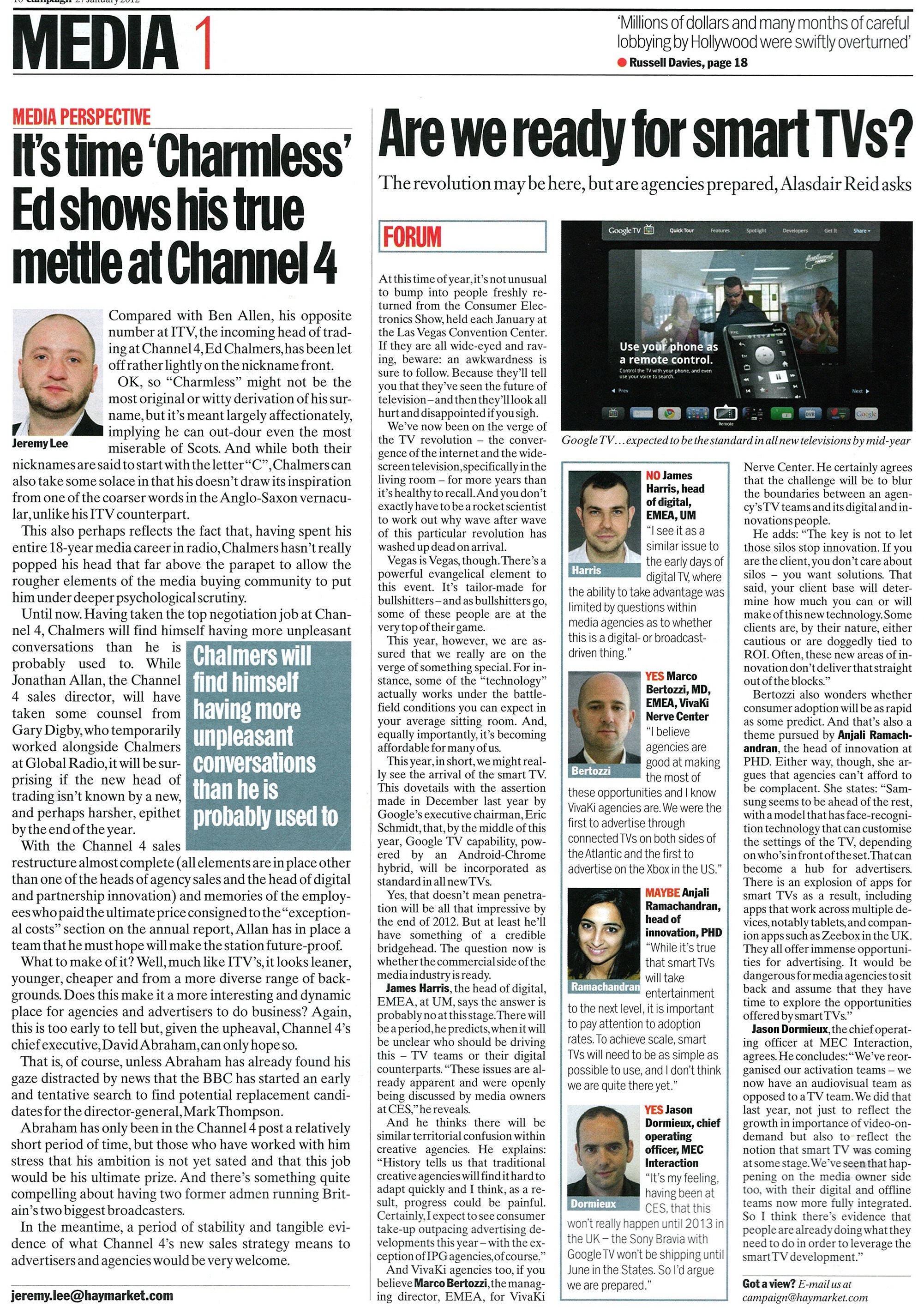
This week Marco Bertozzi, managing director EMEA for the VivaKi Nerve Center, visits Spain, plays squash with Greg Grimmer, and teeters on the wrong side of The Thin Blue Line. Link here

 
Image

Monday

Every day starts pretty much the same as every other day, and has done for the last two years. Baby cries, cats miaow, I wake up and reach for the BlackBerry or iPhone to check what my US colleagues have been emailing about through the night, or to see how late people have been out and posting messages from all corners of Soho Land.

From that point in though, every day is very different. Which is a good thing, as variety is one of the things I enjoy most about working at the VivaKi Nerve Center.

I start today by catching up with Publicis’ global Google lead Simon Birkenhead to discuss what’s going on across the business. In fact, today is a day of meetings with our global partners, as I later met up with our new global lead from Microsoft, Nicole. It’s a tough gig understanding such a complex business and I wish her luck.

An afternoon of calls and a couple of quick meetings, then it’s off for my weekly punishment in the form of a personal training session.

Tuesday

I am down to present at an IAA event on the ‘Future of Media’. I expected it to be a relatively small affair, but it turns out to be a big event in a grand venue at Bloomberg (I make a mental note to thank my head of communications, Claire, for the heads-up.)

I think it goes OK, although I might have alienated all of the women in the audience when I described women as waste in the context of a specific audience targeting example – I was misunderstood!

Jump on my scooter to have a catch-up with Steve King, worldwide chief executive of ZenithOptimedia, which always turns out to be an interesting and entertaining discussion.

After about a year of organising, I finally managed to have a quick lunch with Chris Mellish of Razorfish. As well as working with ZenithOptimedia and Starcom MediaVest Group, the Nerve Center works closely with Razorfish and Digitas, and it’s always good to hear what they are up to.

Later on, I also catch up with Olivia Yabsley who runs content for Digitas, to round out the group in a day.

With a couple of client sessions fast approaching on the world of exchanges and some prep for our regular EMEA AOD (our proprietary addressable media capability) call, I sit quietly at my desk and nail some work before home time.

Wednesday

A sickeningly early start – I’m up and out of the house by 4.30am to go to Madrid with my boss Curt Hecht, global chief executive of the VivaKi Nerve Center.

We have a full day of meetings with the management of VivaKi, ZenithOptimedia, Performics and Starcom MediaVest Group, to go through the VivaKi plans. The Spanish guys are always open and enthusiastic and a pleasure to work with, they also lay on a great lunch in the office. It makes our spread look pretty shoddy.

We’re close to launching the results from the UK rollout of The Pool, a global research project to identify the industry’s optimal online advertising model, and I share progress with everyone. The results are in line with the other markets, which is hugely encouraging.

So six hours later, we run for the airport and get back on the plane. I have done a lot of travel over the last two years and it is still enjoyable, but I guess one day it will drag. I never enjoy being away from my wife and child too much though.

Thursday

A morning thrashing Greg Grimmer at squash. Sorry, I should say getting a thrashing from Greg Grimmer. This week, however, I have bought a new racket and trainers – so his days are numbered.

Later today, the UK leads for AOD Activation, Geoff Smith, and AOD Product, Paul Silver, and I have our monthly catch-up with the ZenithOptimedia and SMG trading guys. It is usually part presentation, part piss-take of each other. Mauricio Leon and John Baylon are not wallflowers, so you have to give as good as you get!

We’re celebrating today as AOD has achieved an incredible milestone and delivered 100 billion impressions. And that’s just in the US and UK. No mean feat given it didn’t exist at the beginning of 2008.

In the evening I head to the leaving do of my good friend Phil Christer, who has recently moved to Google. Phil has kept me sane on many occasions and I know he’ll do great things in his new job.

Friday

Today does not start brilliantly. I am pulled over by two police motorbike riders who have been tailing me for the last mile. Shame I hadn’t noticed them in my mirrors sooner because I realise I’ve just performed some of my most reckless scooter-riding of the last few years.

Mounting a pavement, running a very close amber/red, doing 40mph on Tottenham Court Road, with some weaving thrown in, all mean I am up the creek.

After immense contrition from me and puppy-dog eyes, they unbelievably let me off. I get into work pretty happy and thankfully things pick up after that.

I have a good catch-up with Iain Jacob of Starcom MediaVest Group around the VivaKi Nerve Center and SMG progresses across the wider EMEA region. It’s important to make sure that we are lined up with the senior agency regional and global leads as we expand in terms of products and scale.

Lunch is with our tech partner on Audience On Demand video (AODv) and another expansion discussion as AODv rolls out into more European countries. Creating publisher uptake of this new way of buying video is top of the agenda.

It’s a great lunch, but I’m glad to leave – the downstairs of Navarros always smells of bleach. A productive afternoon of clearing emails and a bit of Twitter banter and my week ends with a very cautious scooter ride home. I’m determined not to get pulled over by the police again – well, at least for a couple of days.

AOL may have had it right all along!

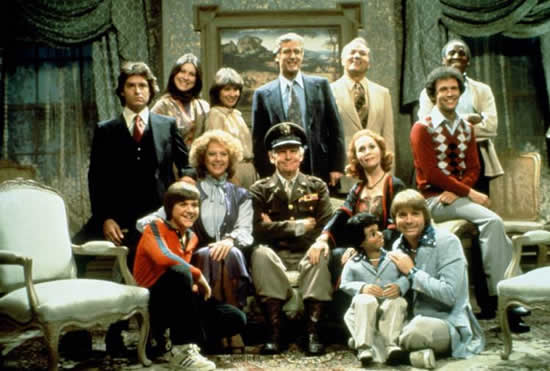
Does anyone remember the sitcom from the US called ‘Soap’? It was about a mad bunch of individuals who were pretty dysfunctional. At the start of each episode there would be an introduction recapping the previous episodes. That summation was invariably confusing and left you having no idea what was going on. The image below may jog your memories for those of you over 37 I am guessing.

The Soap cast

Confusion reigned.

Why am I writing about that? Well recently through a combination of my own experiences and reading the press I have been thinking that in the world of tech, social and mobile we are experiencing something similar. To recap;

– Google and Apple were good friends, admirers even until Google started to like phones..and music..and books, now Apple does not like Google so much and is not keen on using their search tool on their phones.
– Twitter and Google liked playing together as Big brother Google helped the new boy get a bit of traffic, now the new boy has grown up he has decided he does not need Big brother anymore so cut the rope.
– Facebook and Google were colleagues and admired each other until Google started to like this social media thing and Facebook got the hump with that, they too have decided they want to keep their people to themselves.
– Twitter and Facebook enjoyed each others company for a while until Facebook liked the look of the Twitter approach and changed their updates accordingly, this has meant of course that they will not share anymore and never the twain shall meet
– Lets not forget some other long distant cousins! Yahoo and Facebook have not crossed swords too much in the playground until Yahoo decided Facebook had copied a lot of their IP and are now contemplating suing so that will be the end of that friendship
– Samsung and Apple have just had an all out fight all over the globe and frankly not seen eye to eye for some time!
– Even the lovely and friendly Amazon has had to get dragged into the cat fight with its entry into the tablet market which annoyed Apple who promptly stopped their Kindle App from being e-commerce enabled – surely no one falls out with cuddly Amazon?

All of this squabbling leads me to see a future where we have one of the most siloed ecosystems we have ever known. Years after we criticised AOL for its wall garden approach to media we find ourselves with more walled gardens than we know what to do with and as consumers that is the honest truth.

We are edging towards a world where Facebook, Apple, Amazon, Google, Twitter and beyond will all be managing their own ecosystems and not allowing us as advertisers or consumers to mix and match and join up all of the platforms. It is a frustrating development as a consumer as it would be nice if Facebook and Twitter could find a way of working together. It would also be a better Google search experience if we could find results from not just G+ but also the other social media players.

As I have written about before it gets worse when you move to looking at the tech marketplace with our homes being divided into either an Android home, Apple home, Microsoft home or Samsung home, we have to make a decision and stick too it as we can’t get all our toys to play nicely together.

I am not sure how this will play out, but it is messy and not particular user / consumer friendly in my view and probably going to get worse as these Big 5 getter bigger and stronger.

TV viewing used to be simple..now it’s a nightmare


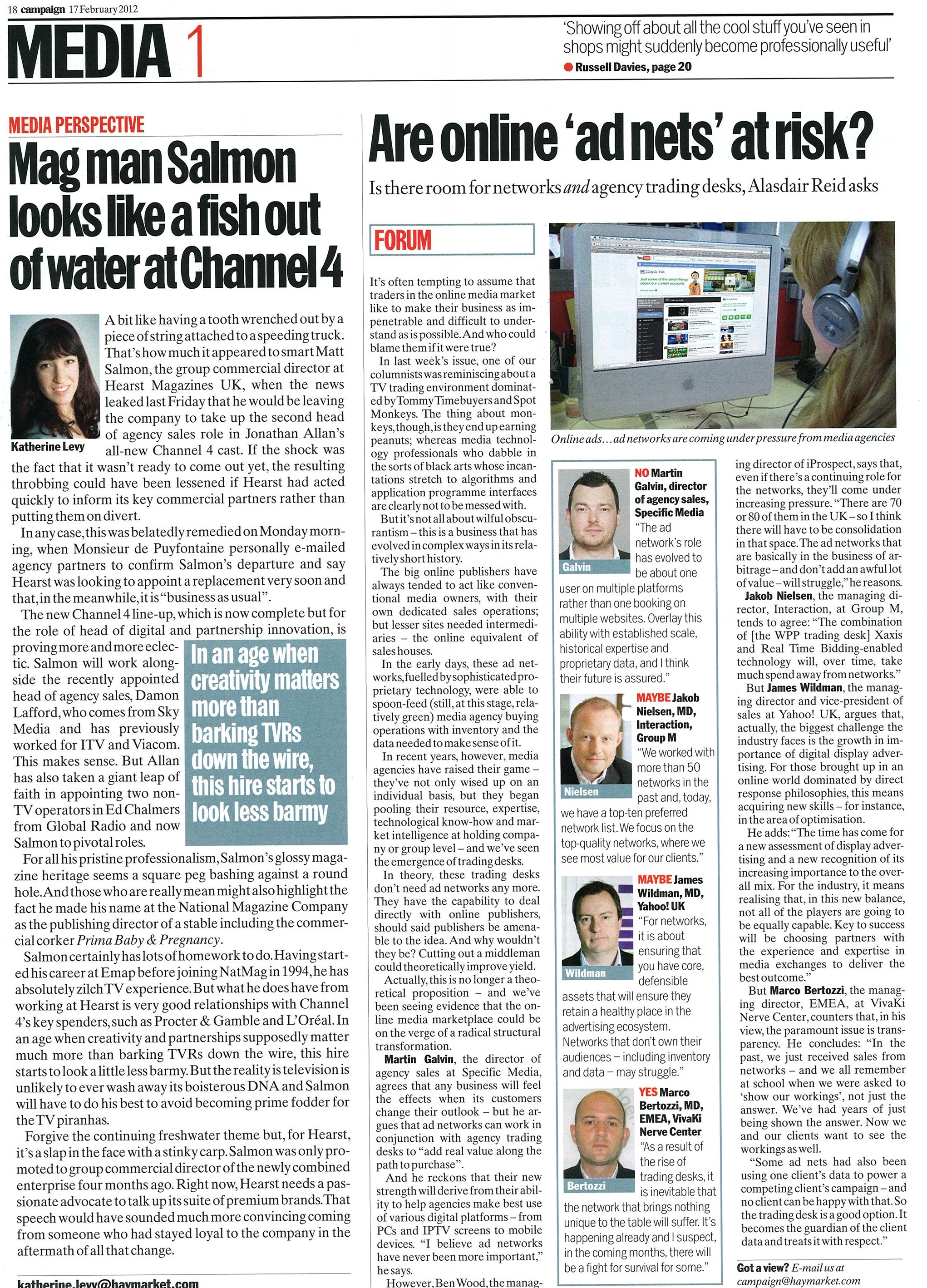
I am interested in gadgets for those that did not realise and for that reason this blog post is probably more relevant to people like me. I received a Roku box recently, a video streaming box that houses content from a number of companies such as Netflix and HBO etc. I always enjoy receiving new gadgets of course but it struck me as just how complicated my viewing experience has become.

I now have an Xbox that I can access social media, stream movies and play games. If I want to watch a movie I have the choice of Apple TV or the iPad to stream to the TV via Apple TV, now I have Roku which gives me more selection or more of the same, this time in a different room, my living room was just too busy to cope with another box!

Even when I isolate a single vehicle such as the iPad I then have more options. I can stream movies from lovefilm, I can download from iTunes I can catch up on TV from the iplayer, 4OD, ITV or watch live with Sky. If its a programme I want then I could download from iTunes, Roku HBO channel and Netflix will hold the same programmes – I could even look at my EPG on Sky and find it in there somewhere, or maybe I Sky+ it. I can’t remember really, perhaps I should check in Sky Anytime+ or The Planner or trawl through 300 channels?

It is a mind boggling amount of options and choices and this will only increase as Google and Xbox continue to grow their product offerings in the UK. There is another important factor in all of that – no Ads. All of the above is driven by micro payments and subscriptions and it is this that makes the TV model look so ill defined as we enter 2012. The Roku box asks me to subscribe at every turn for every service and at that point I hesitate..can I get this somewhere else, is it worth it?

I noticed this week a video from Microsoft that talks about similar changes in our consumption behaviour so I thought I would post the link here

Added to that the measurement becomes ever more confusing and understated. John Baylon, Head of Digital Trading at SMG commented in an article about how the research Barb are doing is just not up to the task, indeed in my opinion its actual measurement is looking outdated and needs an overhaul. The NMA article and link can be found here.

Just sometimes it would be nice to have less rather than more, that said next week it will be more rather than less. Next week I am off to The Consumer Electronics Show in Las Vegas and I am extremely looking forward to it, maybe there I will see something that highlights the major future change in this arena, I suspect however I am going to see a myriad of new devices and boxes that will just make things ever more complicated. One thing is for show in the TV space, the TVs will all be connected, big, pixel-tastic and likely with a few Ds but it’s the connected bit that will be the game changer. Already Skype integrated TVs are being produced so you can sit and Skype through the TV, nice touch and makes perfect sense..

More from CES next week.

Happy New Year!

A very Happy New Year to all the followers of this blog and anyone else who comes across it in the coming weeks! It has been a fantastic 2011 and I am looking forward to 2012 starting with a trip to CES in January!

We are all addicted to our mobiles

I have noticed it more recently, perhaps because I am becoming conscious of my own addiction to mobile and tablets but everyone, all of the time, is head down into their mobile. It is something that has been gathering pace as the smart phone uptake has grown (iPhone represent 55% of all mobile traffic and 7% of all web traffic) but it is now literally out of control. Human beings can no longer have a pause without the pause being filled by a pull at the phone and some interaction.

Although not what I am focusing on today, it is interesting that the advertising and media industry still seems in capable of grasping this opportunity, I would now say above all other media channels mobile dominates our life and yet ad spend on mobile and mobile optimised ecommerce sites of major brands is not where it should be. In 2010 advertisers spent £83m on mobile advertising – that’s a crazy stat when you think how attached we are to our phones.

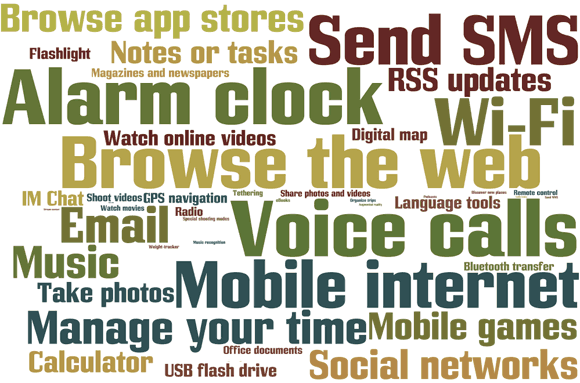
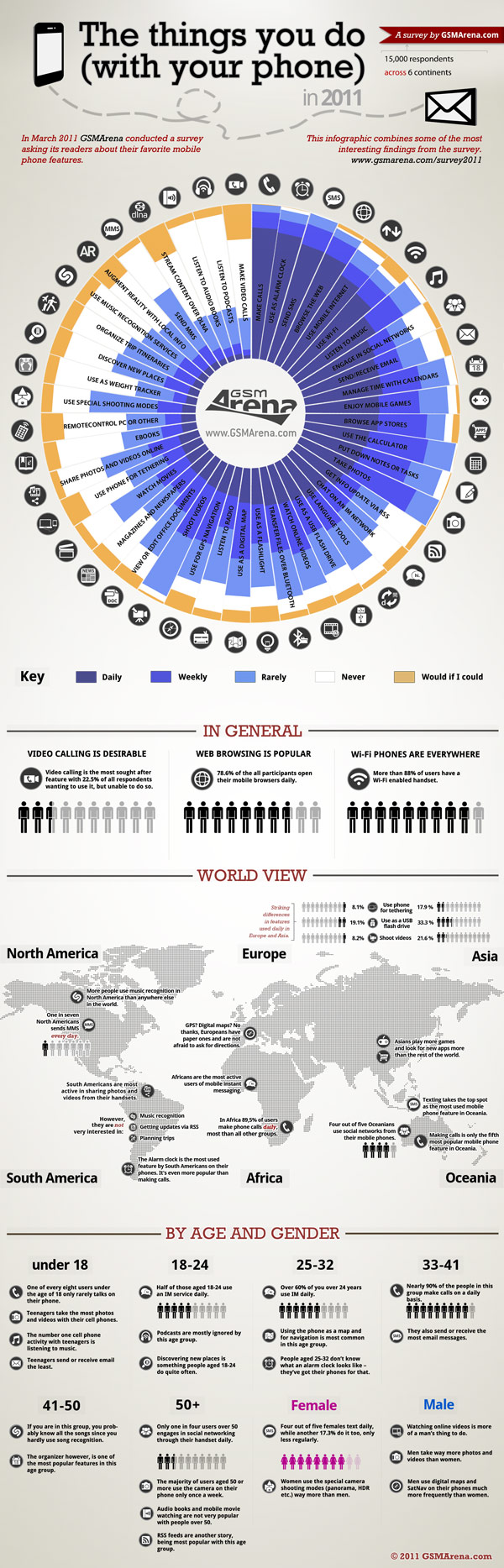
The thing with the mobile phone and in particular the smart phone is the crazy amount of things you can do with it, it is this that makes it something we are glued to day and night. GSMArena carried out research with around 15,000 people, link here and you can see the array of things people use their phone for and what was most popular. There is a word cloud and an info graphic, both below that are pretty insightful.

The detail behind those words can be found on the next infographic

It is for this reason that my phone stays with me from dawn until dusk, I am not alone in reaching for my phone before anything else, 83% of people use their phone as an alarm and so starts the day. From here when you look around you its relentless. Everyone is used to the idea of people using phones on trains etc, the commute, it’s not that which I notice the most, it’s the bits in between. As an example what is the shortest pause you need to reach for your phone or check it?

a) Would you check your phone as you wait for the cash machine to register your card?
b) Would you check your phone as you wait for lights to change in the car?
c) Do you always look at your phone while you are walking?
d) Would you check your phone in a work meeting
e) Check it when you are one on one with a friend?

It is relentless checking that I am noticing, and I am well and truly guilty of it, but I think we re beginning to erode the old rules and its acceptable. More and more people are checking phones during meetings, at dinner, at the bar, often three or four people are all checking at the same time. Big events and presentations have more people with their heads down on their phones or tablets than concentrating. The rules of politeness are being eroded. Concentrating on a conversation or a meeting is no longer a prerequisite. In fact as soon as someone leaves a conversation to pop to the gents, you dive onto your phone is you have been restraining yourself. We are all addicted.

More and more guys are on their phones at the urinals now, that is an emerging trend! Perhaps they were the polite ones not looking at their phones during a conversation and went to the loo just so they could.

I remember someone once saying that we are making time for ourselves with mobiles because we fit all our catch up conversations in on the move and so its making time at home for partners and friends, I am not sure that holds water anymore, we are always on our phones and when it was just calls it was fine but now you can basically run your life from them, they have become more intrusive. I look around me and see everyone immediately reaching for their phones at any pause in life, all of us head down not watching life go past and I feel like I am in one of the futuristic movies where we are all wired to some unseen force, I think we need to disconnect more.

VW have done it in a German factory, they have stopped their servers sending emails at 6.30pm so workers are not constantly on their blackberries – interesting! Not sure that will catch on but its the principle of it, the fact they are trying to break a cycle that is hard to break. As new members join the company and are desperate to get a blackberry I always think what a mistake that is and to stay away for as long as possible, as soon as you are wired to the work all hours is the day you will never truly have a holiday again.

I am addicted to my phones so I am all the things up there but I wish I was not, I spend too much time on it and looking at it, it makes me rude at times, and I miss things because its head down all the time.

I think Microsoft got it right in their Ad to kick start their new phone – ‘Really’ Take a look, not a bad Ad and absolutely on the mark!