Do we do enough to change our advertiser’s business?

Image

Since the dawn of advertising and media our business has been evolving and adapting to the changing consumer landscape. Rishad Tobaccowala, our own Chief Strategy Officer described agencies as cockroaches for their ability to survive against the odds. It is not just agencies though, publishers, tech firms, Ad Nets have all pivoted to some extent or another, it is in our DNA.

We have been focused on our own internals and what the consumer has been up to but the advertisers we work with have more or less stayed the same. Yes they have embraced new ways of reaching their target audiences and moved at varying paces to use digital and so on, but give or take they have the same or similar teams, structures and demands.

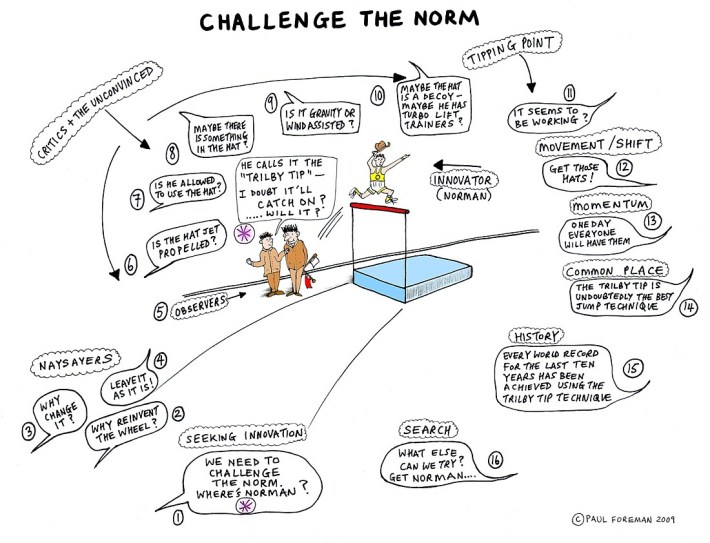
It strikes me that we as agencies don’t do enough to challenge that, we are happy making sure our own businesses are future proofed but how much time do we spend telling the clients that they need to change fundamentally? Why are we restructuring, creating new businesses, skills sets and yet we don’t spend much time explaining to the client that they should be future proofing. Would we suggest a new structure to their media team, propose that they need new skill sets or a new unit? I am not sure we do and it is not our fault in many cases. Everyone has heard of the jumping flee story, if you keep putting the lid on eventually they stop jumping and I think we are all a little like that at times, we have ambition to change things with our advertisers but often it is rejected as too difficult or their incentives are not aligned.

In this new world of RTB, programmatic buying and data where all our businesses have evolved to a greater or lesser extent, in some cases creating new businesses and structures, what are we telling our clients? Are we suggesting they carry on the same or should we be telling them to think differently? Do they need a centre of excellence in this space, how can we get established and sometimes entrenched brand managers to adopt these new philosophies quicker? 

If we are all future proofing – what are we asking our advertisers to do other than buy media differently? We need to think bigger and challenge our very important customers to do the same.

Did Apple not get the memo from its customers?

So $50 billion wiped off the company value and multi quarter underachievement. As an Apple fan boy of many years, I have started to change my views on Apple. The Galaxy and Android combination is becoming evermore attractive. Multiply me by many as well as the younger generation not seeing them as cool and none of this should come as a surprise to Apple.

If Apple did bother to listen to the customer base they would have heard some exceptionally loud and clear sentiment about where people felt Apple was going and what they needed to change. So if they had of come down from the ivory tower and talked to me, they would have heard a few things.

First they would have heard that we were all pissed off with the 4S vs 5 debacle, all the hype and build up that was allowed to swirl before dumping a 4S on the customers. They would have heard loud and clear that the customer base wanted more innovation and not an S. They are also less and less excited every time a new product appears.

If they had spoken to us and done some market research they would have seen that people wanted bigger screens, they wanted bigger screens for sometime but Apple did not listen. The headlines screamed innovate faster, consult with us more, but Apple ploughed on regardless. The new iPads came and went and then we saw the start of the Apple fall. They responded to the ask, but because it was late and a reaction to competition, their halo dropped.

The iPhone 5 was underwhelming above all else. Where Apple have gone wrong is in thinking that a big megapixel number or screen resolution will excite the user, not true, they should be additive. Apple has won on design and reimagining design and in this area they have singularly failed. The iPhone 5 was boring and frankly looked the same as the last two and that was a mistake. They had a chance. The iPad mini is a great product, I bought one, but the shine was taken off it because it was in response to the Nexus and other tablets. I would hold iPad mini as an example of where design was first and foremost and came with less tech spec, but noone really cared.

If they had listened they would have heard the rumblings of discontent about constant need for buying new and different chargers and new and different sims, the rest of the world was standardising and it is what people wanted and yet Apple thought that we would swallow the relentless change over and over. We do of course but the cracks are showing in our patience.

Apple should have read the signs and acted faster. Noone is perfect of course, even Samsung have had to admit that perhaps the S3 screen is too big for most people and have now downsized for those who want it, they listened pretty quickly after seeing the signs.

Overall with Apple my overriding sentiment is boredom. They bore me now, they make good products and I like them, but they have not got me excited for some time and I dont think I am alone, so in my view Apple need to start listening and innvating more if they are to regain their crown.

We will laugh when we tell our kids we had to watch Ads!

ImageWe will laugh at the idea of having to sit through an Ad we didn’t want to watch in years to come. The likes of CBS, who recently downgraded an award to DISH for their Hopper product (a product that allows the viewer to skip Ads) by influencing the CNET panel, will need to change their views and fast.

 Perhaps people have not noticed but the beginning of the end for being forced to sit through Ads is already underway. Google is building a business on the back of skippable Ads. It is a mere skip and a jump before that model is rolled out to TV. It’s not just Google though. We have all got used to fast forwarding through Ads on our PVR’s. There are companies like DISH, with their Hopper product, making it a central offering.  Even online Apps usually have a premium or Ad subsidised version. Other companies, for example SpotXchange, have rolled out account based solutions where users can pay to skip ads. The concept of not watching Ads you do not want to watch is entering our ecosystem like water pouring through a leaking dam. No matter how you try and plug the leak, the tide is turning and before we know it the idea of forced Ad viewing will be a thing of the past.

 Consumer opinion eventually is paramount. This is not about not watching ads, it is about watching ads that are relevant and entertaining. As viewers get used to skipping ads and companies offer that as an option in a new medium, like TV, consumers will turn there first. The DISH example in the US will be an interesting one to follow. When PVR’s were first launched, the whole industry was very nervous about them and the implications. But we coped. Google’s skippable Ads is a fantastic model for them with incredible CPM’s on ads that are watched through to the end. It works for them. Advertisers also like the idea of paying for real user viewership. The challenge therefore is for advertising to improve (please no more perfume Ads following the same old, superficial format) and for the delivery mechanism to improve.

 This is all fine for online, but TV? No way! Well in case anyone had missed it, TV is changing. The mechanisms through which we watch TV are changing and the way content is being consumed and distributed is changing. Addressable advertising across multiple devices is already under way in Alpha and Beta tests. Ads will become adserved which will allow better targeting and if targeting improves, the response will be better and consumers will appreciate the relevance. If we can do this well then who is to say that the Google business model will not suddenly look attractive to broadcasters?

 Importantly we will question this idea of ‘extra value’ in TV, which is code for wastage as opposed to actually buying the audience we want. An Audience On Demand offering could quickly be applicable in TV. So if we can combine adserving technology, with proper targeting and importantly measurement (let’s not get in to that today!) and sprinkle some consumer boredom with relevant advertising, we are well underway to a world where we tell our Children that; ‘yes they made us sit through five pre-roll ads before we were allowed to see the programme we wanted to watch’ – ‘and at a time dictated by them’! A crazy notion.

Blog also ran on Digiday – http://www.digiday.com/agencies/skippable-ads-are-a-good-thing/

CES My overview: Content and technology at odds when it comes to mobility

CES never ceases to astound, not least because the sheer scale is incredible. Over 150,000 people gathered this year to see the onslaught of new gadgets and software, with over 20,000 new products being launched. However this year I was less surprised by the products being launched.

Yes there were bigger TVs, thinner TVs, TVs with the most incredible picture quality, more tablets, more phones, more games and even fridges that talk to you. Loads of great stuff. But not loads of surprises. The focus as far as I could see was in making all of these things talk, connect and share with each other.

It struck me at CES just how much technology enables a seamless, frictionless ecosystem for us and our consumption of content. There were some fascinating examples on the show floor that all point to the consumer being able to do exactly what they want to do, when they want to do it. I can guarantee that our children will be demanding a completely open proposition when it comes to media consumption. They will want and expect it in a non- linear fashion as well.

A prime example of this was DISH, who is trying everything to help us do that. First they allow the recording of every primetime network channel automatically on to your set top box and then they have enabled the transfer of this content to your iPad for later viewing on the go. A brilliant idea which fully utilises the tablet / PC and TV.

AF4B994F-C377-4F31-B142-1B659B7C7DC1

Intel and Comcast are working to make sure that the average home can have a number of different devices wired up so individuals can watch and do whatever they like in whatever room of the house they are in. This allows the consumer a seamless movement of viewing / playing around the house.

And with Intel’s Microsoft Windows 8 laptop come tablet devices users can play with based on their mood – laptop for work, tablet for play. There is no one device that has come to the fore here and I am sure the best route will take a while to play out, but it will.

Samsung’s interactive TV’s continue to delight with the ability to talk with friends via Twitter, Skype etc… and indeed there are now competitors challenging the idea that adding these interactive services does not need to push up the price tag so considerably. Hisense is democratising these services and has entered the market with an affordable Smart TV for everyone.

Interestingly, the superstores in the US are also trying to push this out of the preserve of the lucky few. Both Walmart and Bestbuy will now only sell Smart TV’s, trying to drive further adoption of these ever connected devices. Intrinsic to growth in the connected TV area (there are 35 million connected TV devices in the US) is just that, getting them connected.

The Wi-fi revolution has meant that it is now so easy to connect a new device and adoption rates are high in the Smart TV market. All of this means we are very quickly going to arrive at a world where the lines between your TV and mobile devices are seamless.

This is being accelerated by a need to can the wires, a greater desire for social TV and a realisation that the TV can be a great central hub for all content wherever it comes from, and indeed can be the starting point for finding content and sending it outwards. In addition, on demand services and social apps also mean that people will be looking for Smart TV’s as a matter of course. Driving further adoption.

The key issue, however, is that the devices are seamless but the content is not. Broadcasters in particular are trying to manage a market that is shifting rapidly around them. In my home where I don’t have an aerial and the digital aerial does not work I turn to Apple TV. Apple TV is great for streaming to the TV, but who are the people that won’t let you do it – C4, ITV, Sky etc. How limited and short sighted are they? What are the alternatives? I don’t watch their programmes, or I do?

My Samsung TV has no 4oD, the result is I don’t watch this channel as much as I would. Comcast in the US is not letting people stream programming from the likes of HBO Go, it is being artificially restricted. This strangulation by these broadcasters needs to adjust and fast as viewers will not put up with it for much longer.

One huge irritation I have is the fact that Sky won’t let me have unlimited devices to watch SkyGo on – we live in a world where people often have an iPad, an iPhone, an iPod and perhaps even a Nexus 7 – I want to watch SkyGo anywhere I want,  at any time – that drives loyalty.

How technology will impact advertising

So, we have a seamless technology ecosystem developing, let’s look on the bright side and suggest that broadcasters do give up their old school methods and let us all do what we want. There will be two implications for the advertising business. The first is that measurement of viewership will become an impossible task without some improvement in the technology tracking it – a big ask. And that leads neatly to the second – addressable TV advertising.

DISH is currently piloting zipcode targeting – basically they download ads to the set top box and then fire them to the appropriate household and hopefully in time, person. How can they do that? Well, if a household is governed by a central console like a Comcast box, then we could be in a position to more easily identify who is watching what content and serve them relevant advertising.

Simulmedia recently released numbers that suggest that as much as 75% of TV ad impressions are reaching just 20% of their target audiences. If this data becomes verified, advertisers will be looking to alternatives and addressability will be paramount.

So, after a few days in Vegas we did not see a great deal of change, more a rapid progression of technology that was present last year – more tablets, more Smart TV’s, interchangeable laptops and tablets, sharing technology, social technology. As a result our industry also needs to rapidly progress. The consequences for the media will be far reaching and affect all of us.

Marco Bertozzi is executive managing director of Publicis Groupe’s VivaKi

My 2012. Perpetual motion.

Perpetual motion in more ways than one. Change is the only certainty in life and we certainly experienced it this year. Travel wise it was the year of going to the US, Palo Alto, Chicago, Las Vegas, San Francisco, Los Angeles. But let’s not forget the best that Europe has to offer with Madrid, Moscow, Milan, Cannes and Monte Carlo, Paris x 10, Amsterdam, Prague and on it goes. It is something I love to do and simply the best way of getting to know the network but can also take its toll.

I got a new boss this year and said goodbye to my first VivaKi boss in the form of Curt Hecht who left to join The Weather Channel. Curt was an entirely new kind of leader to those I have had in the past. He inspired me to look at our media world differently, he was himself in perpetual motion and seemed to never run out of energy for this business of ours. He pushed me, supported me and at times put a few European noses out of joint on his visits, importantly he taught me that travel, events, meeting bright people is worth something, it makes you more worldly, and helps you form a different view to those who listen to only those around them. Curt will and I know already is doing a great job. Enter stage left Kurt Unkel. Old Curt, new Kurt as they were for many months!

Thanks in part to all this change I was invited to Paris, Publicis Groupe HQ to meet Maurice Levy for a brief one to one. It was the very pinnacle of my career, if you would have told me as a TV buyer in 96 that I would get to meet Maurice I would have laughed – in fact I would probably have not known who he was! It’s funny how some of my external colleagues in the likes of Google meet him all the time (relatively) and yet it is so hard as a part of his organisation, but anyway, it was a privilege.

New Kurt as my boss can’t receive too many positive comments here for fear of brown nosing abuse, but suffice to say that he is a good guy, smart and looking forward to working with him in 2013. It’s been a crazy work year so much growth and development, part of a team of people now overseeing the new VivaKi proposition I am expecting no let up in 2013. But 2012 has seen us grow to 11 markets live with Audience On Demand in EMEA, the latest being Russia in December. We have worked tirelessly to create this EMEA wide expertise so that our advertisers can have a genuine centre of excellence wherever they are, it has been down to a lot of hard work from the VNC leaders across Europe – particularly Bea, Lothar, JB, Sara, Danny, Geoff as well as Becky for getting me around!

I reduced the sitting on Exchangewire panels of 2011 in 2012 and did some interesting and varied panels and presentations. I presented a digital overview at the IAA earlier in the year. A session at the FT around B2B comms and the future developments. A fantastic panel at Monaco Media Forum with Brian from Digiday – you can see that here. and have actually written more solid content for media publications. My first one of those was a sum up of CES and the impact of connected TVs..it’s long but if you want it – click here.

As usual I got into the odd scrape, although a lot less. My blog on the Dataxu purchase of Mexad called ‘Mathmen just turned back into Madmen’ went down well with some and less well with others. Siding with the Google view of ‘a frictionless Web‘ also brought a few a google haters out but as we showed in December with the World first search retargeting campaign, it was a great development.

Google Zeitgeist, Client Advisory Board in California, Monaco Media Forum, Cannes, CES – all great locations and events and yes you can and do have a lot of fun but at the same time, I have learned so much from so many bright people through these events, it is a very fortunate and a not to be taken for granted opportunity. The pace of change right now is break neck and these events help us stay in touch or at least try to.

Just as you think you are in a groove enter VivaKi 2.0. New structures, new propositions, all change again, but it is exciting and nerve racking at the same time, 2013 starts very quickly when we are back and I have a feeling won’t stop until that last working day of 2013. The team I work with and for is an incredible bunch, so bloody bright and enthusiastic. If anyone can create and steer change it is them and that gives you a lot of confidence. The guys I sit with right now in London have all worked their skins off and done a great job, it is these guys that make it happen and I look forward to a new year with them all.

Perpetual motion, managed by my awesome PA Becky has been mainly work focused but just to add a bit more into the mix we moved to Beaconsfield from Balham in May, another life change for us, one we have enjoyed thoroughly, not least it allowed me to buy that Yamaha T-Max 500 scooter I had been coveting! I grew up in the country and so I return (sort of). Sad to say one advantage is being near Heathrow!

The last icing on the cake came with being asked into Campaign A-list in December and judging Media Week Awards both for the first time (late developer!) but one question I was asked was ‘how have the last 12 months been for you?’ My answer was that they have been the best of my entire career. I am so pleased that after 16 years of work I have been given the opportunity to say that and I will be working doubly hard next year to make sure I can say it again this time next year.

Thanks to everyone in my team, to friends and colleagues and to all those companies we work with, I wish everyone a very Happy New Year.

It’s late. Good night and HNY.
VivaKi and Audience On Demand take first mover advantage on Google’s DDM

The thing that most inspires me in this role is the constant ability to innovate ourselves, as well as work with leaders in the technology space. As of this quarter, VivaKi and the Audience On Demand team in London are paving the way and entering a new era of activating search advertising data in the display ecosystem intelligently. Below find our internal release.


A collaboration between VivaKi and Google sees a global first for the organizations – the launch of a remarketing from search ads campaign. Audience On Demand (AOD), the market-leading addressable media buying practice for VivaKi, leveraged Google’s integrated technology suite to deliver a display remarketing campaign optimised around traffic on search ads on behalf of their client, a leading automotive services provider.


“As the leader and one of the first entrants in the RTB marketplace we work tirelessly to ensure our clients benefit from first-mover opportunities” says Marco Bertozzi, Executive Managing Director for the VivaKi Nerve Center. He continues: “Since launching AOD we have worked closely with Invite [now DoubleClick Bid Manager] as our primary partner and it has been an incredible mutual growth story. We saw back in 2010 the amazing opportunities for AOD and our clients in the Google product development roadmap and display remarketing from search advertising was absolutely top of the list.”


This feature enables the use of search ad clicks as a signal in optimising client’s display campaigns, re-engaging consumers with display ads across billions of ad impressions available on global ad exchanges. The integration between DoubleClick Bid Manager and DoubleClick Search 3 provides the ability to split referring keywords into specific groups based around different levels of interest and exercise bid strategies appropriately, re-igniting the potential of clicks that did not deliver an outcome in the first instance. This maximises the efficiency of search investment and boosts the performance of display campaigns.


Geoff Smith, Head of Activation for AOD comments: “This technology allows us to identify and differentiate consumers with greater intent to purchase, depending on their behavior with search ads. This granular insight allows us to alter our bid strategy accordingly, thereby maximising the efficiency and effectiveness of the overall campaign.”


This will add yet another layer of power to our offering and shows that Audience On Demand has yet again delivered innovation in the exciting marketplace. We had a choice – follow the pack and let