Call centre ineptitude from RAC and AA negates good advertising

For many years I have sat opposite brand managers asking us to deliver more sales, conversions and the ‘right kind of customer’. This was often in the face of poor offers in market from those same Brand managers. The privilege of being the client, when asked how competitive a product is for say insurance or mortgages, the answer being, very uncompetitive, but don’t let that stop you. This is daily life for many agency performance planners in the business and is what makes performance remuneration so tricky.

But lets say the offer is good, lets say the creative is great, acquisition is still difficult and customers are hard won. So I want to understand why businesses allow thousands of call centre people to allow potential customers walk with no attempt to keep them or common sense.

I want to talk about my experience with break down cover. Three players in this space. RAC, AA and Green Flag. It is a battle royal and I have worked with two of those three so know how difficult it is to keep up acquisition at a good cost.

So this weekend my son got in my car and turned on the radio and left it like that for 24hours so that the battery became dead, dead, dead. So dead I could not even get under the bonnet to charge the battery(electric switch). So I call the RAC who I have been a customer with for around 7 years. It turns out that my cover did not auto renew because my debit card had changed at the same time I moved home and my address was not updated. This actually is a side issue but they had my number – no text or message to alert me?

Instead the lovely lady on the phone tells me I can renew but I have a surcharge based on my ‘usage’ last year ie called them twice AND a £70 extra charge for sending someone out at the same time. So I said ‘thank you RAC, its been good but you are now losing a customer.’ Again a side issue but there was no attempt to keep me, no discussion, no sweetener, just a ‘OK thanks.’ What a shame. How much media to now replace me?

So I go online to AA and start to book with them, all going well until I click the button ‘are you in a breakdown situation?’ The AA then add £130 pounds to the booking. Angry but in need of support I call the AA to proudly tell them I am leaving the RAC after all these years and I am ready to book for a year upfront for two people, £150 of cover and could they see clear to not adding the charge. No chance. In fact the guy sounded like he enjoyed saying no. And here lies the issue. Their rules suggest that I become a bad customer if I claim the minute I join, but what about if I stay for 7 years, and I would, that’s a minimum 1000 pounds they lost and the opportunity to cross sell, to try and gain £130. It is crazy.

The banks will negotiate overdraft fees, the insurance companies offer discounts but clearly that has not reached the breakdown companies. Worst still is the complete and obvious lack of flexibility, training and initiative that the bosses provide for call centre workers.

Well RAC and AA. I managed to get the bonnet open, and charged the car and now I am going to book with Green Flag and all for £70. Don’t come asking your planner to increase sales when your call centres and commercial practises are so flawed.


Putting the RTB in B2B

Since 2000 when I started to work in digital there has been a constant learning curve for agencies, advertisers and publishers alike. The fantastic part of working in digital but also the greatest challenge is that it rarely sits still for long, leaving people constantly chasing the next level of knowledge. If I look back over the last thirteen years there have been some key milestones. First we got this whole thing off the ground around 2000 in a real manner. We then saw the rise of Search as a real revolution of the digital business. The dot com crash and overall stagnation saw little innovation until Youtube, social media start up around the middle of the decade. Just as everyone was comfortable along came Real time bidding and exchanges.

Each sector of our business has responded differently to each of the challenges and seen different challenges and opportunities. In the last 12 months I have been asked to talk at a couple of B2B events on the subject of RTB, it is a business that was traditional in nature and could understand digital from a search and targeting perspective, mainly because they could replicate the very industry specific offline approach online. Many websites, content specific and so on. The trouble is RTB is not about the content. It can be part of the equation, but it is not the driving force. The driving force is Audience and reaching that audience.

At first that felt wrong to people but actually I have had many conversations over the years where we wanted to target small business owners or IT professionals and the conclusion was that these professionals ‘were just people’ and we should target them not just in work specific environments but also in their spare time, catching them where you would expect them to be. How many campaigns run on Golf sites in the hope of attracting C-level execs?

At the heart of the issue is that, how do you target very specific audiences without being in very specific content. Reaching the investment community, IT hardware budget holders, small businesses, you name it. Well RTB has some answers and the marketeers of B2B and Publishers alike need to start testing and creating their own very bespoke audiences. The data is there, as an advertiser you have visitor data, registered user data, you have data from your social presence and more. Publishers collect information all the time and there is even more they can do as sophistication increases. Planning is not what it used to be, planning starts by creating profiles and target segments using your data, publisher data and third party data. Start to create and test, RTB allows you to switch on and off in an instant and so the opportunity to learn is immense.

I sometimes have this impression that people still see RTB as the remnant of the industry on long tail sites. This is a misconception so I advise a marketeer to go an investigate. The world’s leading content is now in the exchange ecosystem, whether through private marketplaces or public. If the FT, Guardian, Telegraph most IT sites all see opportunity then the marketeer should also. The technology and the data can now be applied intelligently to all this premium inventory and combine that with intelligent use of dynamic creative and you have a powerful opportunity. And after all of those benefits you can apply the macro benefits of RTB – you dont buy upfront, you buy what you need to buy, one impression at a time. You can frequency cap, single reporting and achieve transparency of what you are buying. These are vital in the new digital ecosystem marketeers should be demanding this as standard.

I often spend time explaining to advertisers that we have changed our agency model, the publishers have adapted or are in the process of adapting to this revolution in digital, but many times we dont challenge the advertiser to change. That would be my core message here, dont do what you have always done, you should change and if you agency partner is not challenging you to do that then you have the wrong agency.

Time to reinvent the Global Chief Digital Officer

A head hunter sent me a job spec recently for this role. The thing that struck me about it was that it was designed from the same script I would have read when I was assessing the UK Head of Digital role at Zenith many moons ago. It had the same ring to it. Basically it asked the applicant to be a God of all things digital, drive digital strategy, pitch and win business, develop a content role, run teams and be a social guru amongst other things.
The fact is even since 2008 life is a lot more complicated. The demands are greater all around. Since then the word strategy actually means something, we have added a real need to develop a social and content strategy, search has become evermore complicated, advertisers want a Youtube approach, there is RTB more recently and the top of the pops – Partnerships. We only have partners now, with that however comes work on both sides. All of which our heroic Global chief digital officer is meant to keep and eye on.
The reality is something very different, running from one global pitch to the next, spending less and less time on strategic direction, becoming more and more removed from each of the specialist topics and ultimately not having any control of anything as your scope is too wide to even know what one country is doing from the next, and when it comes to the US one city to the next.
The one thing that digital promised and never delivered was efficiency through technology, in fact the opposite happened, it created carnage amongst organisations. Multiple adservers, platforms, bid technologies, tag solutions, DSPs and so on. The organisation and consolidation of tech has not been achieved by any of the media groups. This is not just a problem of technical and data driven turmoil but also wasted man hours. There are analyses of technology solutions going on all over the world, evaluating tools country by country at any one time. How many adserving reviews across EMEA across any given group. This all takes time and stifles the opportunity to create efficiencies and economies of scale. Why is this happening? It happens because no one has the true authority or bandwidth to control it. I use tech as an example but could be a number of other areas.
I am reminded of a meeting I was in with Carolyn Everson as she joined Microsoft, OK may not be the best example but I wondered how you join an organisation like that and succeed with so much going on. As it turned out that was too much for her too but I liked her first stab as she made it clear the three things she was going to focus on. And that was it. Three things. I believe the Global Chief Digital Officer needs the same. There is too much for one person to be all things to all subjects. You become generalist to the point of irrelevance, better to focus. And more than ever be commercial.
There should be less KPIs and more focused on bringing about business benefit to the organisation through a commercial approach and that means driving a few parts of the business in directions they might not like but will benefit the whole. Strategy needs strategists not CDOs, let them be part of the team. People clamour and claim that digital is at the heart of the business, and you know to some extent it is, at least compared to ten years ago, but what is not is a global, commercial and focused digital business plan, that needs work and a lot of it. I would argue that teams of specialists need to grow in this mould with a CEO of digital, A team focused on achieving less, but better, running a business that delivers to the bottom line through creating a commercial framework focused on scaling and consistencies.
Last and focused on one individual point in the title, the role should be global. That works in both directions, if it is a US role then don’t forget the rest of the world, and no that is not a cliché, and if it is a European lead, you better spend a lot of time in US, ASIA as well as EMEA. If you focus on global and a few things, you can achieve a lot.
I look forward to seeing the first Global Digital CEO, that comes with the same weighty KPIs as any other CEO role.

Scale is suddenly out of fashion

What a weekend of news. An incredible, history making moment when you realise you are part of an incredible piece of business. These two incredible men have done the impossible. They have created the largest Ad group in the world by some way and with no-one finding out! Hands up who wants to work in a stagnant, stale business that does not evolve or change? Not me. That is why I joined VivaKi and it has been a roller coaster ever since. Now this. Publicis Omnicom Group. It was one of those announcements where the descriptor WOW worked.

I think the coverage has been intriguing, some sensible, most negative but to be expected I guess as this merger touches so many, some utterly small minded, ludicrous and opportunistic.  

As regards the coverage the one thing I have seen time and time is the discussion on scale and how many commentators comment ‘ advertisers will not benefit from this increased scale.’ I find this fascinating for a couple of reasons. The first is that advertisers, media auditors, pitch consultants and every agency pitch document starts with how big they are, at least if you are in the top 10. It has always been so and will be for some time but all of a sudden we have everyone saying scale does not matter. I just don’t buy it and most advertisers don’t either. Scale as I have written in a previous post is not just about buying, it is about resource, depth of pockets, it can be many things, but lets stick with media buying, it will count. Anyone saying otherwise has an angle.

Connected to this is the fact I have grown up by an industry telling me about Group M scale. Media owners, my own agencies in other markets, middle men, pitch consultants – ‘Group M scale counts and is a big deal’ year after year this has been the message, so I am intrigued that suddenly I read that this is not the case and there will be little to gain from this merger in that sense. You can’t have it both ways – either it does count or it does not, because that is not the message we have been giving or receiving for the last 20 years.

I am hugely excited about this merger, we are a small part of history and whatever the future holds, I love being in it rather than looking in on it.

Media freebies..black, white or grey?

Image

This is the point at which I confess that I once increased an IO on the back of some fancy lunch..sorry not going to do that because I know I have not, but in fact that is too simple an example. There is no black and white, just grey.

The recent Digiday post about a planner in the US writing to multiple publishers asking for them to buy food and drinks for a leaving do, click here for that, sparked some conversation on this topic which came from both sides of the fence. The long and short of it was that the request was outrageous and what a cheek this guy had. In this instance they were right in my mind to be offended, what went wrong with this particular request was it lacked respect, lacked a reason and was delivered to  a group ie anyone will do.

That said, where did this all start? Did it start with the agency asking for free things or was it always the approach of the sales person, lets not just focus on media, this happens in every industry to some extent or another. In every industry the opportunity to build relations has started with hospitality. Now what this story does not tell you is how many of the recipients had previously showered this team with gifts and so lead them to believe this was all possible. And if they did? And if they helped their business, can they now have issue with the request being thrown back at them. Grey throughout.

Generally speaking hospitality is a legitimate way of doing business because we are a people business and the more time we spend together the more we understand each other and then more likely the business gets their message across. People buy people at the end of the day. BUT and a big but, it should not lead to obligation and where friendship becomes darker and things are twisted to personal financial gain. The level of that hospitality also needs examination – I believe the person who offers should always be present ie don’t just get me tickets but take me. I also believe that situations where couples and families are being hosted on ski trips etc pushes the boundary.

I saw an email once, intercepted by an agency person (who was on the exchange accidentally and not involved) between a re-targeting company and a direct client that basically said ‘thanks for the contact introduction, your camera is in the post’ That kind of thing should not be allowed to go on, or a now defunct agency whose Head of media gave the search business for an account to his friend’s independent search agency and by all accounts was paid well for it. This is the dark side of the business and hopefully a smaller and smaller part of it.

The final side of this is when a publisher or tech company is asked to sponsor an event which can come in many ways but its is a clear value exchange and they are ‘paying’ to be part of that event, again that could be food, drink, prizes etc etc but the relationship is clear.

This episode in particular was unfortunate and ill thought through and that person needs to be clear on what is acceptable and what is not but to publishers and media companies this is a cost of business and with all business there are people who do it well or badly. Written entirely differently the media owner could legitimately decide that it was a good opportunity to be in front of 90 media buyers and that is a business decision for them.

Big Sales orgs are spending $30million+ a year on marketing and so they have accounted for the 90 bacon butties, what they had not accounted for was the way the guy asked for them.

Anyone meet me in Pret and grab me a cheese and ham sub?

Should advertisers pay more to keep agencies inefficient?

With every year that goes by the advertising community continues to look for more and more opportunity to drive down pricing and increase value from agencies. No one can blame them, a whole auditing and procurement business needs to exist and why should good work or good people get in the way of the procurement officer hitting their bonus? 

There is some irony that the companies advertisers use to drive efficiency also create more and more work for agencies through a pitch process to also justify their role. Meeting after meeting, tests, projects, hands on sessions, formal pitch meetings, digital focus, more forms and oh some pricing at the end. It means that agencies continually come under the strain of having to find new opportunities to earn or save money. Their only their options.

In the camp of saving, we talk a lot about making things more efficient. The whole Trading Desk model has been put under that camp, but you know, perhaps we should look to our media channels that have come with the most history. I find myself wondering why we need different TV buying departments in today’s world. We have teams of people in agencies that all do the same thing, give or take, their roles are clearly defined, they all work on the same systems, there could be no finer example of an opportunity to streamline a business. This is not just about my group but all of them. Do we need multiple buying departments by agency?

I think that if we are to keep up with the relentlessness of procurement and pitching we should do a couple of things. First lets re shape the businesses so that there are some key trading people in London but consolidate the buying into single group operations, based somewhere cheaper, where you train people to come and do a 9-5 job, they get paid, they go home having worked bloody hard.(God forbid you even employ people without degrees?)  Would advertisers be happy with that? Could they stomach the fact that agencies do as media owners do and have multiple conflicts and teams all working together across agency silos? Well that I guess is the core of the issue, if they are fine, all well and good, if they are not then they should pay more for making the agency groups run in a less than efficient way.

Second, lets start challenging the advertisers to change their business for the better rather than be lap dogs and respond to whatever they want. ‘I can be whatever you want me to be?’ We should try more along the lines of ‘your business is structured really badly, you want some good advice?’ Consultancy comes cheap in advertising and media, the advertisers should take more advice, it is designed to help on reflecting the changing landscape. I had a refreshing meeting where an advertiser asked me to challenge him more on how he should structure his business for the new world of RTB and Data. How nice it was to have a decent debate on that, and imagine the possibilities. If only there was more of that.

Our latest recruits – Their views, one month in at Audience On Demand

Image

I thought I would ask our three latest recruits, all graduates to give me their view of our industry just one month in. The message is clear, we are big and complex and we love TLAs but that is what makes it fascinating. Backgrounds of economics, maths and marketing show that regardless of diverse backgrounds, all roads lead to RTB! Sorry Real Time Bidding! I am always excited when we have new people joining and so let’s hear from them..

Trisha Halai @trisha_halai

Having done a maths degree I never thought I would see myself taking on a career in the digital advertising industry. After being approached by a recruitment agency and being told about the role and company – I can say I will never look back. My first month has been very much a learning curve and a very interesting one. Understanding the technical aspect of the role in terms of getting to grips with the platform and the systems has been one thing and understanding the hundreds of jargon used in advertising is another. Initially, I was completely thrown back in my first week when I heard acronyms such as DSP, SSP, DFA, DFP, DBM, MPU and PMP to name a few. However, as time has gone on and the more I have heard these terms, they have become second nature to me and now not using them would be slightly absurd.

Coming from a maths background, I developed many transferable skills and I can say I am proud to have the opportunity to apply these analytical, problem solving and logical thinking skills into my current role.   Working in a dynamic and creative industry, one that is so measureable and trackable in every aspect is exciting. It is great to be exposed to the industry at a point where it is constantly changing and advancing. Communicating and building relationships with highly respected technology and data providers and some of the big publishing names as well as agencies is what makes the day-to-day role so varied.

Being part of the AOD team at Vivaki has been an insight in many ways. It is very exciting working in a team that helps brands to deliver strong, highly targeted messages to very niche audiences across many channels such as display, video, mobile and social media. Working in a team that takes great pride in what it does and is passionate about its day-to-day management of campaigns is inspirational.

I look forward to learning new skills and developing a deeper understanding of my current role and I look forward to any challenges I may be faced with in AOD.

Claire Hobson @claireHobs

My first month as a member of the AOD team at VivaKi has been both exciting and eventful. I’ve had the opportunity to meet so many new people and have learnt a great deal about the dynamic industry of digital media in such a short time.

As a Marketing MA graduate, I had developed an interest in digital marketing and was keen to get into this area as a first step in my career. However, I had never come across agency trading desks or real-time bidding and as a result I found the complexity of the real-time bidding ecosystem quite overwhelming when I first started. RTB, DSPs, Ad exchanges, ad networks, ad servers, SSPs, PMPs… it was all like a foreign language to me, particularly with the frequent use of (appropriately named) TLAs.

Four weeks on, what seemed complex to me back then is now much clearer, having benefitted from being amongst the hugely knowledgeable AOD team and from meeting the various external teams that represent the other vital pieces of the RTB puzzle. I have noticed the difference in levels of understanding and views of RTB across these different teams, whether it be media planner/ buyers, publishers, data providers or technology platforms. This has been useful for me to gain a more holistic understanding of how RTB is viewed in the wider media industry and has helped me in developing my own opinions.

Part of the reason why I wanted to work in digital after graduating is that it is an industry that is growing and constantly changing, making for an exciting and fast-paced environment to work in – my first month at VivaKi has definitely confirmed this. However, it has also highlighted that there are often challenges, difficulties and problems to solve around these changes, something that I did not previously fully appreciate but have come to see how this is key to the development of such a dynamic industry.

A good way to sum up my first month is perhaps not to reflect but to look at how it has given me both an eagerness to learn more and a strong desire to be a part of the future of RTB, whether it be in display, mobile, video or even connected TVs. I look forward to my second month at VivaKi in the exciting world of digital media and RTB.

Nick Brown @NickPhBrown

PMP, IO, SSP, DSP, KCT, vCPM, KPI, ABC1, GRP, MPU, RTB are just a bunch of letters… However, I have come in to contact with them such remarkable regularity that I find myself thinking what a laborious task it would be to have a conversation using full, un-acronym-ed words. Since, I started work at VivaKi, the AOD team has performed massive brand blasts, won over some great clients, tested cutting edge industry inventory, even achieved a world first! The list goes on… We work closely with companies like Doubleclick, VisualDNA and large pubs like eBay and Amazon, all to our own varied ends.

Point being, there’s so much to Real Time Bidding; too much to ever come close to having a shrink wrap solution to it. On top of that, it is constantly morphing and progressing. Not only are Mobile and Video making leaps and bounds forwards, but the platforms we work with on a daily basis bring in a whole host of new features almost weekly. It’s a crazy trade to be in and my first month has overwhelmed me with a phenomenal amount of information. I would love to write all about the diverse, highly affable team I’m working in, and on how much fun I’ve had in the many social events that have already taken place but if I tried to it would fill pages and pages. Suffice to say that my first month has been a whirlwind tour of the immense and fascinating world that AOD is right in the centre of: RTB.


Have Publishers learnt from the past?

I was recently prompted to think about the sales policies of publishers when Criteo approached us to buy their inventory through a Criteo network. On the face of it one could argue it would be a good buy for us, potentially unique inventory, sourced through publisher deals that by many peoples opinion is good quality and high up the adserving priorities of the publisher. Obviously after about 1.5 secs I decided I was unlikely to contribute to the clever business model of Criteo by filling their coffers so they can then go pitch direct to our clients and move the business. That is not what this post is about but it set in motion some ideas that I think publishers should consider.

Companies like Criteo, have created a good business and are doing well in their niche but they got there through persuading publishers that they should sell to them quality impressions, in some instances first look, even above direct and brand channels at a low cpm vs those direct channels but high vs the RTB market. They deliver good business for them and everyone is happy.

Problem is that they buy a lot of it and need to get rid of it and so they want other people to buy it from them ie trading desks and potentially Ad networks / Managed DSPs. The demand in the exchanges has increased significantly since many of those deals were done and so cpms for quality inventory like this will likely create a higher cpm than they bought from the publishers. So that means then that trading desks are buying good inventory from Criteo rather than direct from the publisher? Is that what the publisher had in mind when they sold or agreed to the positioning of the sale?

I think it raises questions that publishers yet again have to face, is it better to sell at a flat cpm or find other channels to monetise. A lot of big names are doing this and for me makes no sense, if you want your inventory to be monetised, come see us rather than put us, your direct buyers second to someone who is re selling it to us? It is time to ditch the flat cpm and embrace the auctions and private market places.

We can also offer transparency to the publishers as to how well their inventory is performing and we can partner to create improvements for them and us. The alternative is sell and see no insights. In my view that era has ended. Publishers, come talk to us we can help you with that.

Do we do enough to change our advertiser’s business?

Image

Since the dawn of advertising and media our business has been evolving and adapting to the changing consumer landscape. Rishad Tobaccowala, our own Chief Strategy Officer described agencies as cockroaches for their ability to survive against the odds. It is not just agencies though, publishers, tech firms, Ad Nets have all pivoted to some extent or another, it is in our DNA.

We have been focused on our own internals and what the consumer has been up to but the advertisers we work with have more or less stayed the same. Yes they have embraced new ways of reaching their target audiences and moved at varying paces to use digital and so on, but give or take they have the same or similar teams, structures and demands.

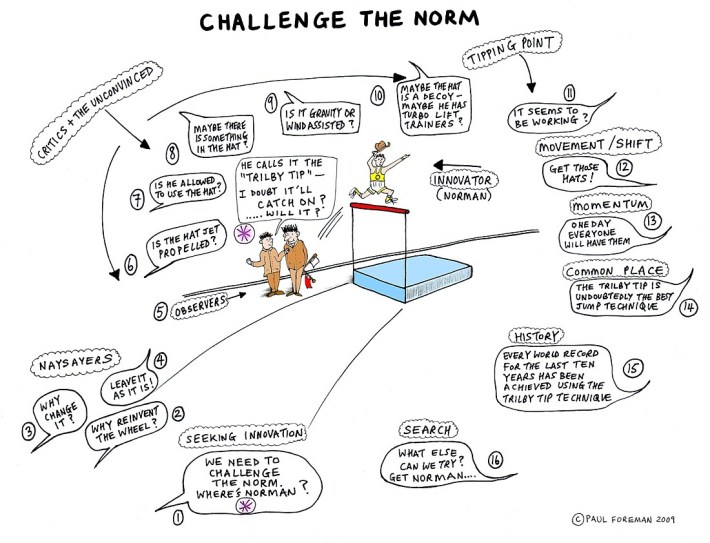
It strikes me that we as agencies don’t do enough to challenge that, we are happy making sure our own businesses are future proofed but how much time do we spend telling the clients that they need to change fundamentally? Why are we restructuring, creating new businesses, skills sets and yet we don’t spend much time explaining to the client that they should be future proofing. Would we suggest a new structure to their media team, propose that they need new skill sets or a new unit? I am not sure we do and it is not our fault in many cases. Everyone has heard of the jumping flee story, if you keep putting the lid on eventually they stop jumping and I think we are all a little like that at times, we have ambition to change things with our advertisers but often it is rejected as too difficult or their incentives are not aligned.

In this new world of RTB, programmatic buying and data where all our businesses have evolved to a greater or lesser extent, in some cases creating new businesses and structures, what are we telling our clients? Are we suggesting they carry on the same or should we be telling them to think differently? Do they need a centre of excellence in this space, how can we get established and sometimes entrenched brand managers to adopt these new philosophies quicker? 

If we are all future proofing – what are we asking our advertisers to do other than buy media differently? We need to think bigger and challenge our very important customers to do the same.

We have reached a new level of self harm in digital measurement

ImageAh the Ads are on – cup of tea anyone?

Digital media will eat itself then be sick all down us. Viewability is the latest craze to hit those who must have historically worked offline with frustrated metrics and now want to take it out on digital. When I moved to digital in 2000 we beat our chest with just how much we could measure. We could measure every time an Ad was shown! Every time someone clicked on it! Every time someone bought something! On and on it went, glory times. Until we realised that just because we could measure it, it was not necessarily a good thing.

Digital tracking issues started with no reach and frequency metrics! Everyone has been scrabbling to replicate the TV world. I am often asked how we measure brand metrics – well we can look at certain key numbers like engagement etc but ultimately if you want to track brand engagement then measure it with a survey, just like you do on every TV campaign. As we have evolved so have our measurement approaches but we are entering a new era of self harm. Viewability.

I am not even going to get into the fact that the tech is ill tested and nascent and needs some really thorough analysis. Or that the measurement can be carried out by any number of different companies each with a different way of tracking, so no consistency whatsoever. No lets look at what we are doing to the industry vs the offline world.

Could someone explain to me how marketeers (and / or agencies) are starting to nail digital on something like viewability and yet TV and Press are sat laughing at our complete stupidity. The TV market has it sorted. They came up with a plan 40 years ago, they got everyone to buy into it. Ratings, indexes, context, reach, frequency and a brand survey. Nuff said everyone liked it, pretty simple – lets not dig too much further or upset the nice little market place we have going. Otherwise how can you explain that in digital there are people clamouring to only pay for viewable impressions when a multi billion pound TV marketplace trades off people leaving the room, making tea, talking, texting on Twitter when the Ads come on. Press? Lets not go there.

If we are not careful in this digital business of ours we are going to measure ourselves into the ground. In TV the metrics are broad and deliver against some key criteria that they plan against, the industry has made it simple for advertisers to spend money and not question the fact that a 20,000 person panel in the US powers $65b TV market . Viewability is a classic example where we are setting a bar so high vs the other the channels because we can. For those who are challenging the industry from an advertiser perspective – should then turn the spot light on their other media expenditures. I would ask that we take some time to establish some very clear guidelines and transitions and not go in like a bull in a china shop just so we can show off at the next pitch. Lets do things right, for the good of the industry, not just the next sell.