Agencies and publishers are polarising structures based on the perfect storm

Technology killed the admin star.

One of just many debates raging around the new world of programmatic buying and exchanges. Are we seeing the death of the buyer? The death of the seller? Has the world of computers stripped advertising of all its creativity? Lots of big questions and debates but over the last six months, one common thread has become apparent; there is no value in execution in the long term.

Two or three big themes have converged in the last year, they have been around for longer of course but they have been lit up by the tech debate. The first is that in my view too many businesses sold their value on execution and delivery. These are necessities and you can’t not have them but is that where the value is? Is that what you charge more for? I don’t think so, the agency world in particular suffers from focusing a lot on service and delivery and execution over real value add strategy and quality creative thinking.

In itself that is not the end of the world, many advertisers want perfect execution of course, but what it ends up being then is an easily quantifiable, discountable service that becomes very commoditised – tell me the difference between two media agency TV departments? Secondly lets combine that with the fact that the world of Paid, Earned and Owned means that clients are now not only trying to squeeze costs and fees they are starting to see these new approaches as a gateway to spending less. I have just finished doing preliminary judging and of about 40 entrants at least 37 boasted / moaned (not in so many words) that they had little or no budget to make their campaign work.

So we have smaller budgets based on the social buzz doing the heavy lifting for us and we have fees for service and execution being cut – that leaves us with only one alternative – start to charge for ideas and creativity, for strategic guidance so that the execution is less crucial to the revenues. This works more now than ever as to make the social buzz work for you, good ideas and strategy are needed to do it..it is no coincidence that the non traditional media planning and buying teams in agencies are the fastest growing divisions. Big sponsorships, events, social strategy, performance strategy, content, these are where the future lies backed up with technically led brilliant basics.

To gain traction strategically you need to invest in good people. You also need more of them. Investment  in the current climate is not straight forward so you need to rebalance the organisation. The investment in time and people from a strategic perspective needs to increase and at the same time you need to make execution more efficient allowing you to free up people and resources to focus on intellectual capital. So Enter the third factor  – programmatic buying.

Ask a customer if they want to pay for a load of people bogged down in admin, or people actively thinking about how best to run their business and make it a success, the answer will invariably be the latter, but that’s what we all do in the main at the moment. Clients pay for people and hours spent on too much Admin and not enough thought, this situation needs to change. Technology and programmatic buying/selling is now allowing all companies to achieve efficiencies. Whether it is publishers like the Guardian or agencies through trading desks technology is freeing resource to focus on value rather admin.

Publishers are moving fast now, after a stuttering start, they are moving rapidly, trying to find ways to move more and more into programmatic sales, now with words like premium and brand being attached. They are opening parts of the site, previously sacrosanct such as home pages to the evils of tech. Trading and execution is taking a back seat as Partnerships, strategy, event type words come to the fore – BIG ticket sales are now the focus.

Some recent people decisions are a reflection on that with people like Vevo choosing Partnerships people over sales people and Yahoo re-evaluating structures and there are many more. I am sure The Guardian will be looking to Tim Gentry to help them achieve better margins and a more efficient approach to the market, the signs are there..

So for me the message is clear – we all need to find a way to make money from clients and customers who want to pay less for service and execution and spend less on advertising. Armies of people pushing excel around is not going to be the answer.

Creating change – it is not all plain sailing

20120531-152600.jpg

Two days in Chicago at the VivaKi Nerve Center Management meeting and one thing really struck me, that change even when it is really needed is pretty tough. Key to getting through it though is by having a plan and sticking to it. The VNC started in 2008 and we were laughed at, Curt Hecht who leaves us this month was there at the start and he recalled some of the comments at the time. That plan though has been sturdy and continues to be at the core of everything we do and it is resistant to country whims and individual blocks and that change we are bringing can not be stopped now.

VNC was a slow burn Internationally but in recent times things have accelerated rapidly. Over the last two days we have had people from the VNC from US to Australia and everywhere in between and each person was ringing the bell on the old models, it is time to step up and be prepared to change. Only two years ago we had VNC in US, UK, Dubai and Spain. Add to that now Italy, France, Germany, Australia, China, Russia and more to come, amazing growth.

Trouble with change is that it unsettles and some people don’t want it and are willing to slow things down and say ‘it’s not like that here’ and excuses to that effect. The encouraging thing though is that those people are becoming far and few between now and most people have started to embrace. I met recently with Maurice Levy and it was clear where he expects to see development, what areas should be moving faster and that is the biggest encouragement of all when it comes from the top.

Change your mind or change the people was a phrase mentioned by someone recently and I agree. I have always loved change, it is so exciting and creates so much opportunity so I assume everyone will but I am afraid that is not always the case. The VNC over the last two days has presented some amazing work and propositions and it is no wonder it has been copied by most of the other groups – whether it was market leading Partnerships, the worlds first and largest trading desk, driving innovation through The Pool, VNC has lead and shown the people laughing behind their hands that in fact it has become a blueprint.

The work we are doing with our agencies is moving so fast in many many markets and the ambition in the room has been palpable so expect to see more and more from this group over the coming weeks, months and years.

See you Chicago, it has been a pleasure (apart from your terrible airport).

Trading Desks are in for the long haul, not the sale.

I cant decide where to start on this post, there has been so much going on in the hectic world of ad exchanges in the last few weeks. Top of the bill was an excitable debate between an Audience on Demand employee and a disgruntled DSP. The key issues raised around conflict of interest included agencies being forced to put spend through their trading desks, lack of impartiality etc etc.

Interwoven with this debate was the fact that so many companies are approaching us at the moment, DSPs, Data targeting companies etc all with interesting premises I suppose but all with one thing in common, they all need to make as much money as possible, as fast as possible. Lets talk about conflict of interest..I use the DSP marketplace including Triggit which was involved in the above debate. How many shall we say there are, that are currently aiming for Trading Desk revenues – 4? 5?. Everyone is coming to town, everyone wants a piece of the action, but when they get into town they realise that a couple of those 4/5 have been busy for a few months / years and pretty much wrapped up the business. Its not to say thatagency groups will not test and learn, we do in the US and there is definatley room for more than one or two but for some, the market’s not big enough. What happens then? They need to fight for revenues, they need to say why they are better than each other and especially better than Invite to try and find the big ticket, except I am not sure there is a big ticket at the moment. So then they resort to the last option which is to try and undermine the credibility of a trading desk to try and open up some cracks of opportunity.

The conflict of interest for those guys is they have to make money to keep the VCs happy. The agency group trading desk model is not in the same boat. Audience on Demand’s sole purpose in life is to navigate on behalf of its clients a very complex market place and deliver great results. They are in it for the long haul, they have much more to lose. AOD messes up on a client it can jeopardise the whole business. Yes there is pressure to deliver..but its to deliver results not revenue first and foremost. In a competitive marketplace as the agency landscape is, the more things you do well and right, the more chance you have of retaining the client.

So whats better then? An organisation like Audience on Demand that has a remit to make sure it is working with the best, understanding strengths and weaknesses – and believe me all these tech companies have them – or a heavily invested tech company struggling to make ends meet. Who is actually going to have the interests of the client? I can tell you, it’s us. Anyone who thinks that agencies and clients are naive enough to accept sub standard strategy and results just because its in house is a) clearly lacking in understanding of how an agency works and b) underestimating the clients and Account people. If a client asks about our impartiality we can show them the full vetting we do of all DSPs, I can show them the data compliance methods we have in detail for every supplier, I can show them the results in detail where an acceptable flat cpa or cpc is not acceptable as it encourages the supplier to focus on growing their margin rather than delivering the lowest metric. I will show you 100’s of people who live and breath this space and understand it better than any individual tech company thats trying to undermine it.

Conflict of interest is doing what you have to do to stay afloat in one of the most competitive eras of all digital times vs doing what’s best for our clients. Finally it is always worth analysing who is throwing the mud, its often one of those people who came in to town too late and cant find anywhere to hang their hat.

Did someone at the ICO get pissed at lunch? Privacy lunacy

So the story so far..after many years of neglect the governments of US and UK decide we need to manage better the laws around privacy. The US agrees that we don’t need a law but the relevant bodies should show clear guidance and management of the issue, proving that the industry will be responsible. The US have done that, it’s still a little disorganised but it’s getting there.

At the same time in the UK we were doing the same. Everyone working together and moving towards an acceptable solution. It was loosely agreed that cookies required by a company to deliver a service, think about how intuitive Amazon is or how your bank remembers you etc etc. Everyone was happy with that approach. At the same time the advertising and targeting industry was looking, similar to the US at another self regulation approach. There was a number of options but it was going in the right direction.

As I had mentioned before, based on information from Evidon, consumers had shown not a fear of being tracked but rather a desire to be represented appropriately and therefore receive the most relevant advertising and or slick process through ecommerce websites. This to me is crucial, absolutely crucial and the government needs to understand this point further.

So all was going smoothly. Then someone went to lunch and got pissed at the ICO because when they got back they decided to throw all that out and do a number of things:

1. You need agreement from the user to cookie them, before you start to do it
2. They tightened up the rules for advertisers as to what is a crucial cookie and therefore exempt vs one that just makes your life easier.
3. They then left all that hanging with no actual solutions.

It is absolute lunacy, we are left with chaos, are we really suggesting pop up boxes and drop downs and virtual signatures before being able to drop a cookie? Perhaps we should just go the whole hog and ask for permission in writing as one European country is discussing.

This approach is a major departure from where the Government was only weeks ago and has caught everyone off guard, ecommerce is at risk as is most of the digital advertising business and hence why it is lunacy. The point in this blog however is simple, the only reason they could have had this short term turnaround is because they went to lunch and got pissed because frankly there can be no other explanation.

This needs of be sorted out, I am sure it will be and I know everyone is working closely together as agency groups, advertisers and industry bodies, so nobody panic. If all else fails get down the pub with the ICO boys and try and persuade them otherwise.

Why Ad networks can’t become agencies but the reverse is not true.

The latest debate in the display space is whether or not ad networks are going to have to become agencies and go direct to clients to sustain their business. It’s a fair assumption, the likes of Specific and others will hire agency people, create better strategies and approach clients. The latest article can be found here on exchangewire.

It’s a believable concept but one that is out of sync with the way the industry is heading. Although there is a lot of hype around ad exchanges and targeting / data opportunities, within an agency, exchange trading remains a line on a schedule, albeit a complicated one. The exchange space asks many questions of agencies but that is around change and adapting, once its all settled down, it will revert to being an important channel like search and crucially will be integrated into all the other channels.

Over the last few years clients have been on a journey where in the main they have consolidated channels, first digital overall and then they have dragged search in where specialists have held on for some time. It’s not only channels but they are integrating their media agencies both within countries and between countries with more and more international pitches. Anyone in a major agency will have lived that in the last few years. So after all of this integration I think it is unlikely they will want to start farming individual channels out again, especially when it may be big news in the exchange world but within agencies, it’s just another new channel. Time and time again through research, better coordination and integration has shown better results for the advertiser so there is no reason to split out exchange trading.

There is also some realistic areas to take into account. Clients spend 80% of their budgets on offline, 60% of their digital budgets on search, the rest is split all over. So its fine for an adnetwork to go direct but they will never fill the roll of an agency. The agency roll is more than buying and is across all media channels, its events, experiential, etc etc, it’s also highly people heavy and Ad networks have been used to high margins, low headcount.

So direct is fine but will struggle in the UK marketplace, however I think with time the agencies could start to deliver an ad network experience and product within the context of their huge global corporations. Of course there is middle ground, some chameleon organisations that act as an agency or a network, but their offer only goes so far to be a real threat.

I dont think we need to start a war between agency groups and ad networks, I am sure we will all find a way, but I know what side I would want to be on.

Cannes Lions Festival – You dream it, we deliver it

Monday to Thursday was the plan, but then work got in the way! So instead we went for a Tuesday afternoon flight, one that I of course missed by one minute, one minute that cost me 8 hours! I eventually arrived via Amsterdam and immediately got out into the thick of the event, it’s an impressive set up, there are not many places where you can meet up with all of your work colleagues from across the industry in one single city which is buzzing with both work and play conversations.

Down at the Gala event it was heaving with people from across the business, the business being very varied. Media groups, advertising groups, content companies, digital, film, music you name it, all here. A lot of drunken idiots as well to be fair, in fact some people were such imbeciles I was amazed they had been let in the country!

It was a fantastic evening, I met with Christian and Kate from AOL at their own party on a roof top, very civilized and a great ease into the evening, obviously as a reciprocal arrangement from zeitgeist, who should I see there but Damian Burns, Global Head of Agency Relations and Ben Faes from Google. Later in the evening there was Tom George from MEC, Stephen Haines from Facebook and a few other golden oldies. Although of course most of the talk is social, there is some interesting conversations about what has been seen and heard during the day. Apparently the Ben Stiller/Yahoo event was a little weird and did not entirely work, that said by then we outside the cleverly Yahoo sponsored ‘gutter bar’ which was the end destination most evenings and stayed open until way beyond you should have been in bed, luckily it was next to the Martinez where I was staying, so that worked!

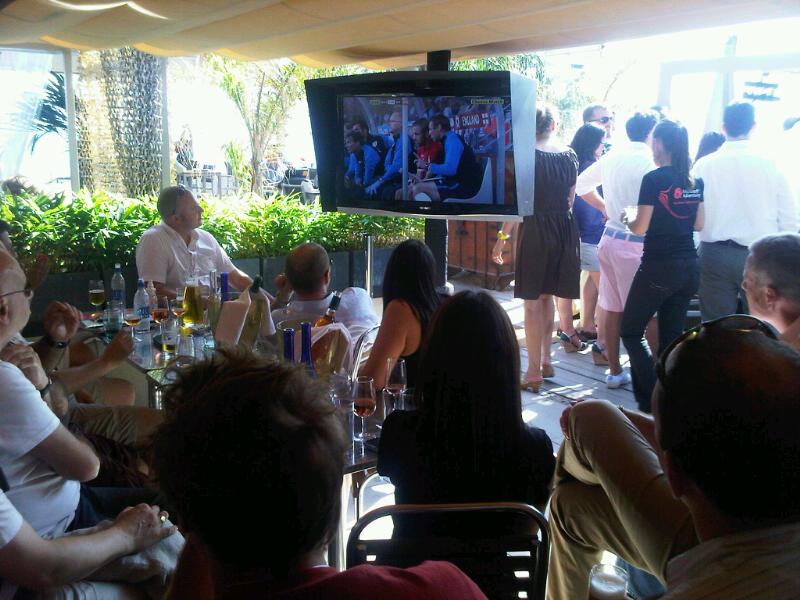
The next morning after 2.5hrs of sleep Vivaki and Microsoft had their ‘steering committee’ meeting which lasted for some hours and covered the state of the nation between our two companies, an interesting meeting with some grand ambition which I am looking forward to working on in the coming months. After a lovely lunch a couple of meetings around ad exchanges (my topic of choice at the moment) and then on to the football. Microsoft hosted a great event with all of the UK people seemingly choosing their beach club to watch, great atmosphere not least as the US were playing and the Americans were getting very excited about their game too, we exchanged cheers through the afternoon, although i suspect they were less sure what they were cheering for!

Later at the awards I took my seat, waiting to see what award winning work looked like, there was some great stuff, I loved the recruitment work from one agency that distributed a calendar with a resignation letter for each day, waiting for the day you had had enough. The Aides campaign from TBWA France was also the rudest thing I have seen on the web, a willy chasing a vagina round a homepage and eventually having sex once safely inside a condom was pretty risqué, but brilliantly done.

All the winners can be seen here

An evening spent with Google was very entertaining and good to be on the inside when they win a big lawsuit with CBS! It also appears that I was sat down to one of the men who has contributed most to the uk digital scene, our own Bruce Daisley, winner the next night at the NMA awards for the accolade. I am very pleased, if disbelieving for the lad, he is a great practitioner and a great guy, he is just no good at hosting jollies as he reminded me of our jaunt to Germany for the football.

The next morning I got the chance to see the Microsoft Experience centre, packed full of their three screens, windows 7 phone, Xbox and Kinect. All of them looked amazing and full of potential for an advertiser. As I went round though It just reminded me of how little of this stuff the average planner or advertiser has seen or experienced. There is a gap between the possibility and the reality, I don’t think advertisers see how a touch sensitive table could drive their crm or sales. The Xbox is a home entertainment system with connectivity, content and games, do advertisers see this? I don’t think so and even worse I don’t think the agency folk are much better. If you get a chance go experience it!

As my trip came to an end and I got a chance to catch up with some other agency friends on the way home I thought to myself what a fantastic event, yes there is a lot of fun and drink and socializing but it’s a chance to bring a lot of very interesting people together and the opportunity to see some great work and technology.

A 4 hour delay on the way back, rounded the whole trip off. Thanks to Microsoft, sorry I did not make it on your video blog, I must have been as dull as my blog. When I got home I had an iPhone 4 waiting for me, that’s my next post..

Au Revoir

My Q & A with Exchangewire on Ad Exchanges / Agency models

Marco Bertozzi is the Managing Director, EMEA, VivaKi Nerve Center. Vivaki is a strategic unit within Publicis Groupe that helps agencies leverage the scale of the group’s media and digital operations to improve campaign performance for its clients. Marco took time this week to speak to ExchangeWire about the Vivaki operation in more detail, the industry’s move to automated audience-buying, and the evolution of the agency model.

There’s much confusion about what Vivaki does? Is it buying platform? Is it a crack exchange trading unit? Can you explain the Vivaki proposition in more detail?

MB: Vivaki is the strategic entity created by Publicis Groupe to leverage the combined scale of its media and digital operations, which represent nearly $60 billion dollars in global ad spend and influence. VivaKi aggregates the marketplace influence of five autonomous brands, including: two global media agencies, Starcom MediaVest Group and ZenithOptimedia; two leading digital marketing agencies, Digitas and Razorfish; and a premiere futures practice, Denuo.

On behalf of its agency brands and their clients, VivaKi faces the market to help identify and build technology, message distribution, audience aggregation and content solutions for the future. VivaKi also includes a “Talent & Transformation Practice”, which leverages the scale of the VivaKi brands to develop and deliver tools and approaches designed to attract, develop, train, motivate and reward the world’s best people.

Sitting at the core of VivaKi is the VivaKi Nerve Center, which serves as a think tank, R&D centre and testing ground to activate new pathways for clients to connect with consumers in an increasingly digital world.

The key objective of the VivaKi Nerve Center is to help deliver better solutions for our clients as the marketing landscape continues to evolve and accelerate at a fast pace, collaboration within the VivaKi family, and across the Groupe, is essential.

To succeed in our mission, the Nerve Center will focus on some key areas to empower our VivaKi agency teams and clients:

Global Platforms & Products: Developing global platforms and proprietary products that help our agencies differentiate and compete in the marketplace. Products will be supported by an advanced underlying technology and data infrastructure that delivers speed and scale.
Industry-Leading Partnerships: Creating strategic global partnerships that provide tangible value for our clients and partners, while differentiating against the competition.

Innovation & Thought Leadership: Investing in innovation and next generation emerging opportunities, like The Pool, which will validate our leadership position in the marketplace.

Our ad exchange solution is called Audience on Demand and is therefore a key strand in the global platforms and products category above and indeed innovation. It’s one of the most exciting areas to touch all agency groups in recent years and needs to have a defined and aggressive focus put upon it. Vivaki Nerve Center has worked very collaboratively with the brands in delivering the Audience on Demand platform to their clients. We are live with Audience on Demand and really excited by the performance of the solution.

Can you elaborate a little more on your role within Vivaki?

MB: My role in is Managing Director of The Vivaki Nerve Center in the EMEA. I report into the Global President of the VNC, Curt Hecht. The VNC has made significant progress in the US and my role is to work closely with the brand management and digital teams to establish how the VNC can help them in delivering the future-facing digital solutions that our clients are asking for everyday. Ad exchange trading through Audience on Demand is a significant area of work for me.

What’s your perspective on automated trading and audience buying through exchanges and other demand sources?

MB: I have been blown away by it. I may be biased and perhaps my background lends itself to making this exciting to me but when you see the potential of automated buying you can’t help but be impressed. It’s worth saying that automated buying is a little misleading. It requires clever optimisation strategies and insights that the agencies need to lead through talented people. I would not want people to think that you a press a button and it’s all done. Anyone who thought search bidding would be automated would testify that is not the case – it is search bidding times ten so definitely not just automated.

The trading platform allows you to target exactly the individuals you want at the price you want. You are buying one impression at a time which makes a CPM approach look outdated although it is not the death of the CPM buy just yet, not least because media auditors would not know what to judge us on! I believe it will ask questions of every agency trading model to some extent or another. It will also challenge auditors to stop judging agencies on an arbitrary discount off a pool metrics, and force everyone to consider more performance related contracts. I think for now it lends itself more easily towards the performance models but down the line I can see far more being traded through this method.

Do you think that large European holding companies like Publicis are now seeing ad exchanges as an efficient channel to buy ad inventory?

MB: I think the large network groups get a hard time for not changing enough and being slow to react. In some ways that may be true but agencies today are very different to those of 15 years ago. They have completely transformed: agencies realise change is inherent in what they must deliver year in year out.

Ad exchanges are just another media / trading / targeting opportunity that have come along, and agencies will embrace it and make the most out of it on behalf of their clients. My experience so far is that all the groups see the benefits of it but that will vary by group as some are more advanced than others. You will see who believes in it the most by how quickly they grow their ad exchange spend because once you start to see the results, clients and agencies alike will want to move their budgets into new the model.

Do you think that trading on ad exchanges makes it easier to leverage agency and client data to deliver better campaign performance?

MB: Trading on ad exchanges will allow data to become more important but actually it’s not the exchanges where the benefit lies but with the use of DSPs like Audience on Demand. It is this technology that allows us to best use data to enhance the performance of campaigns and target only those users that are most likely to deliver a beneficial response for our clients.

The combination of our clients being able to retarget their visitors but on a much larger scale with the introduction of third party data means we can turbo-charge our schedules to deliver at the right cost and at the right level of volume. Those third party vendors need to move quickly over here. We already have demand and they are a little slow to get going. I was pleased to see Phil moving from Yahoo to Quantcast, perhaps a sign of things to come.

Does Publicis have an exchange strategy for Europe, and if so will this be headed up by Vivaki? Are there plans to devote more resource to developing this area of the business?

MB: This is not a UK or US only market place. It will become important across all major markets so of course we will grow our business in those countries. Many of our major European markets are already testing different models and gaining from the insights. Vivaki Nerve Center will take the route that drives the consistency and ability to learn as a group and not at a country/agency level. We are in the very formative stages of this area so it’s important we all learn from each other.

Resources will evolve over time. Some people will re-skill into this area, some will be recruited. But we have time yet to get into that. Rest assured though that the number of people working in this area will grow substantially!

What do you think are the key difficulties in moving an agency toward automated media buying? Is it the lack of technology and data skills that exist within the agencies? Or is it a lack of technology?

MB: It’s not a technology issue. We have the technology and it works. I am sure all of our competitors have their technology too. Some will work better than others perhaps, but generally I don’t see that as an issue. Technology should not be the differentiator for agencies, it’s the people behind it and what it delivers that counts. Clients do not want pitches where we all get our technology out and wave it about; they want to see insights and results.

In Vivaki there are pools of people who understand this new area and those that know less about it but is that not always the way? Over time we will train people and recruit people so that we have the right level of understanding and evangelism in the business. Look how agencies changed around search. We had the same discussions back then and we now have these amazing skill sets around search in the agencies, so I don’t really see too many issues. If you think the opportunity is a good one, you can make things happen.

Do you think the arrival of DSPs into the European market will help agencies bridge this technology and skills gap?

MB: DSPs will allow agencies to build campaigns across multiple ad exchanges, create data pools, and control frequency etc across the whole playing field rather than at a site or network level. They will also provide us with the largest search area when we are trying to find the elusive consumers who have visited our client sites previously. DSPs are enablers so of course it’s a great innovation in the marketplace globally.

I would say that I believe a true DSP is one that’s only interest is in providing technology to do all the above. It should not to try to resell inventory or have morphed from an ad network. There are many blaggers out there and it’s important that people choose carefully in who they work with as you may discover that the systems they provide are not as future-facing as you thought. The market place is very grey around the edges!

What’s your view on real-time bidding? Is it a game changer for the display market? Or are there still fundamental problems that need to be worked through (such as the computational costs) before we see the benefits?

MB: It works. Our campaigns are delivering great results on the RTB strands of the campaigns. I think RTB will be affected by many different elements not least volume of competition, which will only increase. But this is where the clever use of data helps you in RTB: only you know what is deemed a valuable cookie. Hence you will be bidding on it, not the rest of the world. This is different to search where everyone knows that if you bid on home insurance you will sell insurance. This is a huge benefit for ad trading – the agency knows who is valuable not the publisher telling us what is valuable.

Overall I believe that RTB will be a game changer. Suddenly impressions are valuable again in the volume game. Interestingly though, they are valuable from a data perspective and not so much from a context /channel perspective. The rules have changed. What’s premium now?

How do you see the European exchange space developing over the next twelve months?

MB: I think you will see many of the major players in the US getting people on the ground here to push into big European markets. The ecosystem is developing rapidly in Europe, and it will not be any different than the US. There are already companies up and running in Europe, providing ad serving and other services, and they will try to steal a march in these markets. The DSP pure players will soon be driving a more objective approach across Europe. I also think we will see the likes of Google really ramping up in the markets here, which in itself will drive liquidity.


Ad exchange development mirrors that of paid search

Marco Bertozzi: 08:03:2010
The battle for the ‘ad exchange’ dollar is hotting up. It reminds me of how things were with search. It crept up on people / media agencies and before they knew it the specialists were doing well and making good money and winning pitch after pitch in the specialist area.

As it went on we debated whether search was specialist or should be just another channel forming part of an everyday media plan and finally we ended up with a couple of serious search independent players and the main agency groups pretty much on top of things and integrating and coordinating search into wider marketing plans.

Here we go again! Anyone who went through that must be getting a sense of Deja Vu. Everyone is talking about Ad Exchanges and DSP’s, the specialists are springing up and making hay and claiming they are the only ones who know how to do it. The debates rage around best practice and who has the biggest and best capability, its an incredibly similar scenario – does anyone else feel it?

The big difference this time is the agency groups to a greater or lesser extent saw it coming and started to gear up for it, as you can imagine I am biased in that area as to who has done it best to date but in a way that’s irrelevant, the point is the people in the know in agencies are all working towards this revolution. It will be a revolution, it is the next phase in media communications and those that ignore this will be looking as silly as those that thought search was a fad. This transition is moving so quickly though and only the brave will really make the most of this wave.

I am enjoying being part of this new wave of communications and trading and have been so impressed by the work that has gone on, this is exciting stuff and it is just going to explode.

My new role at Vivaki Nerve Center , EMEA

Marco Bertozzi:03.03.2010
After a break of three months I have very recently secured a new role at Vivaki Nerve Center. I set out to find a role that was at the heart of the world of digital and I am pleased to say this role 100% achieves that. I am also excited about the fact that we are still at the formative stages for the Vivaki Nerve Center and that I will be part of the definition and growth of the unit.

http://www.mediaweek.co.uk/news/994625/Marco-Bertozzi-hits-nerve-VivaKi/?DCMP=ILC-SEARCH

In the last three months I have spoken to many agency folk around the market and its been a fascinating view on the market. All the major agency groups are investing in their parent group offerings, seeing the benefits of aggregation of skills, knowledge, technology and of course media investment. I hope that as part of the VNC I will be working in what will be the future for Publicis Groupe and help lead the change.

As I have written about previously I believe that the one thing that is for certain is that technology and changing trading methods will alter the way agency groups structure around digital planning and buying. The role of the ‘media schedule’ will be less relevant when in fact we should be buying audiences regardless of their location or site they are visiting. Trading will be about buying at the best price to deliver the relevant ROI not about the fact you bought 10million impressions at a set price earlier in the month and that will combine search and display in all its formats.

On top of that we are of course dealing with the huge changes coming from mobile, social and video, three huge topics that we have to make a success of in our marketing solutions. I am constantly on my iPhone and Nexus one, I surf, blog, update and find information and there are many like me so our solutions need to be making the most of that audience. I believe we have a way to go in that arena as an industry, I look forward to working with Phonevalley and others in implementing these new strategies.

Whether it be social media, mobile or straight forward impression buying we also need cutting edge tracking and reporting solutions and I look forward to working with our partners and Groupe companies in helping us to deliver intuitive, useful and accurate reporting suites to help us across Search, display, video and social.

Having just spent a few days in San Francisco its clear there is an enormous amount to be getting on with, some tasks more straight forward than others but all equally exciting. Our strategic partnerships are going to really create some amazing opportunities for our clients and there will no doubt be more to come. I work in a group of amazingly talented companies including Razorfish, Digitas, Performics and many others so this should be an exciting times and I cant wait to start.