Dmexco – powered by professional energy

Perhaps a surprise to some but this year was my first year at Dmexco. Every year it has clashed with something or other, but this year I was there, well for a night and a day at least. It is usually the happenings around the conference that garner the most interest but at Dmexco it IS the conference. Dmexco is a REAL trade show, a place where companies come to show off their goods and hope that the circling hoards will come buy.

There is something refreshing about that, it felt a lot more meaningful, a place where business came first and rose second. Don’t get me wrong I have no issue with rose and I am certainly not one of those bitter nay sayers that write about the pointlessness of Cannes, no siree, I am a fan, but that said Dmexco felt solid and meaningful. There is no other place that so neatly distills the lumascape into a real environment, where you get to see the colossal competition for the buck all in one place. I think it is that which really struck me, just how many people are out there in the martech, adtech space and all with their piece of the action.

I did not get a chance to truly get around everything but I sensed there was a pecking order with the smaller stalls gathered in one place. They are all looking to grow of course and move into Yr2 with the big guys. Big guys they are as well, over the years the stalls have apparently grown and grown and it appears to be like Yachts with everyone weighing and rating each other up based on size and how many people fit, after the size comes facilities – does yours have a coffee machine? Meeting rooms? TV centre – shower? Swinging dicks aside it is an amazing array of companies all sat alongside each other from Adobe and Oracle to MediaMath or the agency lounge. It was great to see all the Publicis agencies there, not too big, not too small. GroupM were clearly out to make a statement on the other hand, commercially powered by Xaxis.

What I have been impressed by is the level of seniority of attendees, Global CEOs, Group CEOs all attending an event that is relatively new. All around the event you will find leaders from every corner of the business and with that brings some gravitas and focus and less feel of a jolly that comes with Cannes.

I hope to go for longer next year and attend more of the actual presentations, but for a first trip I was hugely impressed and will definitely prioritise. The event ended on a high as I managed to hitch a lift with the lovely (am I allowed to say lovely?) Nikki Mendonca who had a cab waiting for me even as I stood in a long queue.


Adblocking – I am going to make you an offer you cant refuse

Italian organised crime started with men ‘offering’ to protect the olive groves of Sicily from the roving gangs of people who ‘might’ burn them down at any point. It was a slightly one sided offer in that they had little choice as to whether accept that or not. As I have been reading and listening to publishers I have started to see some parallels with the Adblocking industry, especially as you delve into the commercial relations behind the scene.

As a publisher, under so many different pressures, probably the last thing you were planning for was a slick salesman roll up and make you an offer you could not refuse. Pay us some money and we can make this ‘adblocking thing’ go away or if you don’t give us a cut, we are going to let the adblock software loose on your site. Of course the publishers are not the only ones being shafted. The customer who signed up to the software may be surprised to find that he or she is seeing Ads again because the publisher paid the protection racket.What you need is a saviour of course and so enter stage left the guys that come and offer the publisher an option to block the blockers. Now of course they are not quite out of the Superman annuals as you have to pay them as well but I guess its better than not getting any ad revenues and they are working to some extent in their interests.

download

Overall the whole landscape is very messy, very challenging and right now seems to be a little too much like the Sicilian olive groves of yesteryear.

Youtube ADEX closure – Is the future a closed ecosystem?

Originally written for Digiday – link hereimages.

I have watched with interest the backlash against the Google decision to pull its YouTube inventory back from DoubleClick Ad Exchange. It got me thinking about the past and the present and the fact that there is this view that all companies must make everything equal to everyone. Google has disabled something that represented 5 percent of its total YouTube sales — is that really worth all the fuss?

While it is an issue insofar as many businesses are built on the back of disruption and filling niches and a multitude of other business models, Google has no obligation to make life easy for them. Indeed, Google is not alone. Facebook locked everything up; Amazon would rather shut sales down that let you get hold of its data; AOL, Yahoo and others hold all their best inventory back so you can only buy it through their platforms.

Welcome to the future. These companies have invested billions into their product, and they have no obligation to make other competitive businesses rich on the back of their investments. It is called competitive advantage.

Holding on to the Google debate a little longer, five years ago it had a poor ad server and limited display business. It was seemingly going backwards in terms of innovation outside of search and video. And then a few things happened: Some smart people made some smart decisions. Google bought companies, it invested in their stack, it invested in data, and before you knew it, it was dominating display. It did the same in video, so if it chooses to limit the access to just three entry points from four, then that is Google’s business. If AOL, after investing in content, tech and data, wants to only allow access to the best of what they have via its platform, that is its prerogative.

It was only five or six years ago that we were all forced to work like this. If you wanted inventory from The Telegraph, you rang up The Telegraph, likewise Guardian, ITV and so on. We were forced to deal with hundreds of walled gardens. We have improved the situation with technology, so now we have many fewer entry points to inventory, but when we started down this road no one ever said everyone had to sign up to this new way of working, the deal was that we could buy inventory through platforms and use data — not — be able to access all inventory through any platform.

As an example, AppNexus is the self-proclaimed independent solution outside of Google. It is doing well. But should Google then help AppNexus or worry about whether it can get access to YouTube inventory via AdX? Of course not. The same would go for many other demand-side platforms that would issue complaints on the topic.

Now, as a buyer, we would prefer to see an ecosystem where we can access whatever we want from wherever we want. And we do rally against the approaches of Google, Facebook and Amazon. But at the same time, we have options. We can work around most of this, and we will create solutions that help us navigate and deliver against the utopia we were once searching for. That said, this is business. This is about companies investing and then looking to make returns off the back of it. YouTube is not the BBC, and it can decide how you buy its content.

Annual interview with Beet.tv in Cannes – entering good times in programmatic

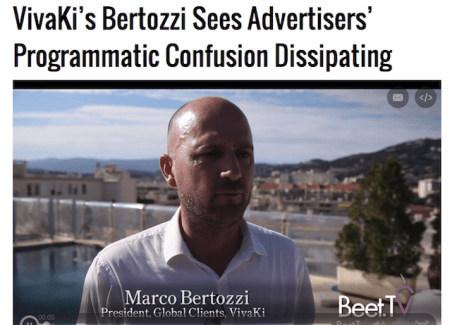
Every year at Cannes before the Rubicon Panel we discuss with Andy at Beet.tv where things stand in the programmatic industry and this year we discussed a brighter future. 2014 was the lost year to the topic of transparency but I sense we are over that now and have moved on to programmatic strategy and all the possibilities.

This year also marks a big step for us as we see the completion of the move of campaign planners and buyers into the agencies out of VivaKi and I hope will be the start of a new age in the agencies.

Programmatic in Cannes

Will media owners and tech vendors be scrutinised by procurement?

25-30 Billion dollars of spend up for pitch. The whole industry is alive with comment on it. What does it mean for the agencies, who is up to lose the most and so on. The reason for it has been unclear, could it be digital capabilities, transparency, a stagnant commercial marketplace meaning advertisers have to extract more from their business, there have been many suggestions. Perhaps it is a simple as no one wanting to miss out.

All that said, the blog is not about that topic per se, more what impact all of this is having on the whole industry. There has not been too much of a knock on effect to the world of technology, technology that is now powering so much of the agency media landscape. Across the whole landscape deals have been done, tech fees agreed and contracts signed. The tech companies and tech/media companies are sitting back and watching this all play out with little impact to them, at least for now. But how long can that continue?

As all these pitches play out one thing is for sure, media fees will have reduced across the board, one way or another. Not to say that with increased billings they can’t find other offerings and models to make it up but at a media level, they will be squeezed. So those fees are reduced but the tech fees remain the same. The managed services and RTB networks and even one could argue Facebook and Google margins remain solid and published. So at what point does the advertiser start to turn their attention to those parties?

If the squeeze continues then how can an advertiser be happy that Criteo and Rocketfuel are taking 50+ of their IO and turning it into revenue for themselves (published numbers). Is the only answer to that ‘they are not an agency of record?’ If you can squeeze a percentage point out of an agency, how about 10 from the people your dollars eventually end up with? The topics of taking it house and aggressive sales tactics direct to advertisers such as Tubemogul and others also means that they are trying to take the role of the agency and so would surely have to make sure that their every transaction, their every margin on data and tech be revealed.

I think we are entering interesting times and auditors and procurement are going to run out of room on the agency approach, something has to give. In my eyes their valuable media dollars being passed to tech and inventory players will have to come under scrutiny a lot more than today, and if you want to be the partner that dis-intermediates the agency then you will have to answer to the same scrutiny an agency does, not just commercial but standards of protection, payment terms and all the other lovely stuff that goes with it. But first lets start with the 50% of the advertisers dollars that don’t make it into media.

My press round up from last couple of months.

Rather than copy and paste individual sections of my commentary in the press, here are the links to the latest hot topics, starting most recently with the Google buying Inmobi news. Basic summary was a necessary if not perfect acquisition target.

Published in Business Insider – click here for article.

A couple of weeks back, Marketing published a post on programmatic TV and how things were developing by Charlotte McEleny. Overview was we needed to unlock the data if things were going to progress.

Published in Marketing Magazine, please click here for the article.

Campaign published my article in the magazine on the joining of creative and programmatic and how both creative industry and media industry need to up their game.

Published in Campaign – please click here for the article.

Digiday story on the evolving story of trading desks, where VivaKi are leading the way in transformation in this space. Written by Emily Siegel.

Published in Digiday, click here for the article.

Drum coverage of VivaKi announcing restructure where programmatic buying skills move into the agencies. Written by Jessica Davies

Published in The Drum, for the article click here.

CampaignLive US article on Advertisers missing the prize of programmatic

My piece in CampaignLive publication in the US – to see click here

How did it come to this? You can’t mention programmatic without talk about transparency, trading desks and advertisers taking it “in-house.” A part of me that would likely get fired says “Go on, then” because it will mean that advertisers spend considerable time understanding the space, in order to appreciate what is required to do this well. They will also be doing the right thing with their media — I don’t mean taking it in-house, but rather the likely improvement in execution and management of their media using the latest technology.

While in-house has been a hot topic this year, all we have right now is a lot of noise. Companies stirring up the ecosystem trying to make hay while the sun shines and consultants with minimal experience in this complex space suddenly getting the light of day. It is a real shame. I spend so much time talking fees and transparency with advertisers and so little on strategy that I truly believe they are missing the chance to make the most of this incredible opportunity.

Advertisers setting up their own programmatic operations is as sensible as Google deciding to set up an agency business and go direct to clients. “They do that,” I hear you cry! Not really. They chase revenue, and if they see that being taken by competitors they step in. Google also has tens of thousands of free sales people — they are called agencies. Clever businesses stick to what they do best. Even brands that have been working away at this for some years are still struggling to keep up.

I recently read that taking it in house was expensive upfront but you get payback over years. I have never read such incredibly ill-informed, ill-thought rhetoric in all my life. It infers that programmatic expertise in agencies after the first couple of years runs on nothing. The reality is people need paying; tech companies need paying; innovation needs to evolve. Nothing goes away after initial set up; it only grows. It is this kind of crazy talk that is distracting advertisers.

Let’s start with talent. Programmatic now commands some of the highest salaries and brightest brains. This creates multiple challenges for employers — motivation, retention and a lack of insights from outside the immediate business. Technology evaluation skill sets, data analytics and audience insights knowledge, data warehousing, contract negotiations, legal, creative, partner management – these all are essential for a successful programmatic business. Spare a thought for the team doing it in-house — two, perhaps three people. They will not be immune from the same standards agencies have. Brand safety is still brand safety. The CEO will be no less unhappy when the Wall Street Journal reports a fraud blow up and an in-house team has been managing it. The same effort needs to be applied in or out of the house and that costs money.

Why would an advertiser want to take that on? Because they are unhappy with transparency? Because tech fees are high and they want to find ways of saving? It is a false economy. “Buy cheap, buy twice” is a phrase I am a firm believer in.

The companies who have managed to do this well are few and often pure-play digital, online businesses with very specific KPIs that are easily tracked and measured and with a culture of digital innovation. Netflix is one example. Moneysupermarket in the U.K., another. Almost all, including the most famously quoted however, are relying on third parties to do the work. That is not taking it in-house, it’s just not using an agency. And they are right not to, but if a little less time was spent on the angst of transparency and fees (easily solved by talking with your agency operation) and more time on the strategy, then the fees will make sense. More time also needs to be spent talking about the amazing case studies of clients that have embraced this space and are turning their media investment around – there are many.

Advertisers who empower their agencies in the programmatic space and invest the time to really partner with them will dramatically change how they do business and the results they achieve.

As a final note on this, While hundreds of millions of advertiser dollars are spent on blind, low-CPM, long-tail ad networks that are taking 60 percent margin, I find it very difficult to believe that an advertiser is achieving the most they can from programmatic or indeed asking the right questions about their media investment, whether that is taking it in-house or not.

Marco Bertozzi is VivaKi’s President, North America Client Services and Audience on Demand EMEA.

Read more at http://www.campaignlive.com/article/programmatic-taking-in-house/1317802#Rwl3QzVofffQABqe.99