How audio is changing lives for the better.

This post was originally posted on http://www.spotifyforbrands.com

At Spotify, we understand the power of audio. Music and podcasts bring joy to millions all over the world, and we see audio taking center stage as a result of our day-to-day screen burnout. And at this year’s CES in Las Vegas, we saw more clearly than ever how audio is changing people’s lives for the better. 

There is nowhere better than CES to see where technology is headed. Spotify was there all week, seeing the many — and sometimes surprising — ways technology is being used in every aspect of our life. This central role of technology is leading towards a big macro trend known as the “quantified self.” This trend is all about how we are using technology to understand ourselves better as humans — and how we are diagnosing, reporting, and creating tools to enhance people’s lives. 

One key trend of the “quantified self” is the number of applications that have audio as central to the solution. Audio is now helping people live a better life, supporting when screens are not relevant or indeed, individuals can’t see the screens because of visual impairment. I wanted to highlight four of the interesting solutions we saw, some incredibly sophisticated and life-changing, some more for fun!

Take OrCam’s MyEye 2 — a wonderful piece of technology for visually impaired or blind individuals that scans full-page texts, money notes, people and more, then reads it back to the visually impaired person through a small device worn on the ear. If there is a product in a shop, the person can scan the barcode and the product details will be read back to them, translating the visual world into speech. 

In a similar vein, there is Addison Care, a virtual caregiver who monitors in the home, making sure the individual’s vital signs are strong, while assessing their movement to look for signs of trouble. The system calls out reminders to take medicine and is mainly voice activated, something that is more intuitive to many older people. It is yet another exciting use of audio and technology that is changing lives for the better.

Not everything is serious and life-changing. We saw a lot about how voice assistants are being incorporated into every device imaginable. One of particular note was built into showerheads, giving you the chance to catch up on the day ahead, the weather, commute and traffic as you shower and of course, call out your favorite Spotify playlist or podcast! As a marketer, thinking how to connect in a world of screenless devices and screenless moments is going to be vital — how could you take advantage of Alexa in the shower if you knew that’s where someone was streaming?

Finally, we saw how voice will play a prominent role in the future of the auto industry. Auto brands announced massive screens for the driverless cars of tomorrow, and more cars announced integrations with voice assistants. Per Axios’ Sara Fischer, “one of the big themes at CES this year has been the race to own the media experience when cars go driverless.” Fischer noted that Lamborghini’s Huracán EVO will be adding Amazon’s Alexa voice assistant this year, while Amazon and Exxon also announced a deal to allow voice-enabled gas purchases. Meanwhile, Anker and JBL both revealed new Google Assistant-equipped devices that can plug into cars new and old. It’s clearer than ever that our voices will be the remote controls of the car — ultimately shaping the future of how we listen.

Thanks to continuous innovation happening with earbuds, connected speakers, cars and more, audio already surrounds our daily lives. Even still, all of these developments at CES showed just how much the role of audio will grow in our daily lives in the future. Of course, as we at Spotify aspire to become the world’s largest audio network, I’ll be keeping my ears open as more new devices, gadgets, and integrations are launched in 2020. And exploring and executing creative ways to bring brands along the journey. Here’s to another year of listening!

Is kids mental health being left behind?

I sent a tweet last week that seemed to hit a chord. It started with a chat in the office about school homework with Sam Hicks and the pressure that builds around doing it, who does it, tuition etc. It is something that is a regular conversation with all parents of kids at a certain age. Parents will pretty much universally agree that as kids they did not have to do as much at a certain age, around 9ish. No one remembers the same level of activity, homework, after school activities, weekend stuff, it’s frenetic for a nine year old. The most important thing for me, it’s seven days a week.

The thing is, it coincides with the sea changes going on in society and in the work places. Just look at the ‘interruption’ to BGT the other night? At our work place and many others over the world companies are working hard to support people who may be suffering with mental health. There are very visible initiatives like Mediacom with Josh pushing the agenda very hard, at Spotify we have Heart and Soul at its core with lots of opportunities for support and to talk openly which some of our team have been doing. It’s all so important that these issues are discussed.

Beyond ‘corporate’ acknowledgement there are smaller initiatives. My leadership team have agreed that we should not be emailing the teams after working hours, at weekends and not have fifty emails waiting for them at 6am Monday. We have been really working on this over time, when my directs are on holiday I have a hard rule that says they go on holiday and switch off. It sends shivers when people say ‘yeah I am off but will be on email.’ Don’t do it, don’t do a poor job of your holiday and a poor job of working and at the end or it all, not properly relax. That’s no use to me. All my directs know how I feel on this and I encourage them to do the same. A break is vital.

So all good, we are on it as adults. We know however that education moves slower than industry, schools can get stuck in old fashioned ruts, they do not adapt fast enough. So here is the thing. Why is it good for us to switch off when the kids are getting homework on Fridays for the weekend, why is it ok for kids to come home and work when we get to take a break in the main, why is it ok for kids to have to work through holidays when we don’t. Have we forgotten that their minds are more fragile than ours, we are setting behaviours, we add to that stress with arguments about how hard they are trying or how well they are doing? Pressure, lack of rest, lack of relax, arguments and more. If we were to set this as our approach to the work environment we would not hold on to a single employee.

The worst of this is that it’s tough to say here is what we do about it..stop doing homework gets reprimand at school and depending on schools will leave kids behind. So it’s open ended but feel like we should keep talking about it and asking schools what they intend to do. Certainly my next parents evening, it will be my first question.

Recipe for a successful conference

Back after a few days at my Sales Academy in Evian and have been reflecting on what makes a great sales conference. My team and I had been working so hard to make a success of this event and I feel like we made amazing progress. Of course nothing it’s perfect but 2019 has been the best yet and I started to think about how and why that was the case.

1. The first thing for me is a purpose. Following our high performing teams training we settled on our purpose as a management team being ‘Setting The Stage for Success’ what did we mean by that? Simply put, our job is to be the roadies for the team. Put everything in place to help them to succeed. This is what we carried through to the Academy as the theme. Too often leaders are the front men, the ones on stage, our view is that our teams should be up there.

2. Inclusion. This year we really involved a whole range of teams, individual sales teams from every market and division to create ‘Adbreaks’ – 5 minute case studies through out the few days, amazing opp for teams to present best work to a big crowd. We involved speakers from diverse backgrounds, a long list of amazing female talent in the business and both internal and external. All briefed to talk Setting the Stage for Success.

3. Safe space. As the team has grown and collaborated over the years, we have created a very safe culture – led by my wonderful directs with all team members happy to ask questions even to the most senior of Execs who we asked to come over, including our Global CFO and Head of Free Business, as well as the founder of Gimlet. The level of trust in the group has been amazing.

4. Fun.  Not too much, not too little. This year we were in a relatively controlled environment and so bed times were not too late. Lots and lots of fun but not too late and that has a lot of benefits. People were sharper the next day which meant they added more and interacted more. Tiredness leads to stress which can build when you are pulled away from your day job, even for the best content. Hangovers are so 2018.

5.Environment. We chose a venue that was calm, beautiful views and partially isolated and it was wonderful. Our meeting space was light and airy with views over lakes. We had lots of space and we built in time to breathe. Longer breaks, longer lunch, time at end of day to unwind and catch up, all meant people could concentrate and put phones and laptops down. The engagement was amazing.

6. Time to think. Often the goal of these events is based on packing as much in as possible ‘since we have everyone here.’ We have tried this and it does not work. If you want to drive attention during the sessions then making sure people have time to work and relax is vital. So longer breaks, time to unwind at the end of the day before any evening activities are all vital to a good mindset through the week. I was blown away by the attention of the teams this year because we engineered better timings. We also made sure that we ended on a Thursday and not a Friday so there was a working day left.

7. Prepare to be gone. A small additional note to this, prepare for absence well in advance and give air cover. If a business can’t operate with out irate clients for two and half days then we have an issue. Warn clients that you are having a massively beneficial team / learning experience, you won’t be around as normal and anything else should be managed around the event. I would also hope our clients would show consideration, lets face it, everyone does it at some point during the year.

I could not be happier, it takes work, it takes a small army of people to pull it off but the results will show. Don’t start with revenue as the goal, start with behaviours and your people and the rest will follow. I am so proud of the leads we have across EMEA, they bond, they get on, they work independently and as teams. We are in such a good place and the people are everything.

My Presentation at Dmexco about Spotify Culture Next Global Trends Report

Just back from Dmexco and a pretty hectic few days as usual. Spotify was in demand this year and we were lucky enough to hit the stage a few times through the two days. I was asked to present our Culture Next Gen Z global trends on the Debate stage which you can see below.

Exciting trends amongst this audience and Spotify sits right in the heart of what they care about, music and podcasting are huge for them and so our work with Culture Coop combined with our first party streaming intelligence has really helped create some clear insights.

Diversity is more than just Gender.

How can we adjust how we think about diversity? Diversity is currently dominated by gender, and there is so much going on in that space, which is fantastic, long may it continue, but there is a much wider issue we have to face together.  It has been some time that I have been going into schools and talking to students and seeing just how different our working environments are from all of these back grounds.

It is an area that for me is important we begin to focus on more, we pay lip service to it right now, so here are some thoughts about where we can all start to adjust and plan for the future. We should ask ourselves the difficult questions about what we all stand for and whether we really want to drive change.

As a group of companies we need to set some new rules of engagement for the industry if we are going to initiate change. Some of the scenarios that would be fantastic to see change are the following:

  1. Hiring has to come from outside of Grads, every business should be creating plans to hire a number of school leavers every year and from non white middle class backgrounds, and definitely not related to the boss.
  2. Every organisation should think about the make up of what they are doing, my latest observation of MediaWeek judges all being white middle class people is an example, I am certain that someone ticked the gender diversity box but nothing else.
  3. Think about the sub sets of organisations – if you are promoting female diversity and there is a room full of 500 white middle class people, we should not be content with that, we should be supporting diversity within gender.
  4. If you are creating a List of important people then it should not be the same old, same old, there are talented people out there, we have to find them and create inspiration.
  5. If we look at panels, events etc all you see is the gender discussion – we need to think outside of that, we need to think about how the panels are made up to represent the world outside.
  6. Kill two birds with one stone – if you focus on helping under privileged schools rather than the usual grad schemes, you will naturally drive diversity of thinking and people.

It is at the grass roots we are failing – we are not bringing in enough talent early on, when we do it is really fulfilling. Our work placement programme is in its infancy but it only pulls from state schools to make sure we are creating opportunities. It is something I am hopeful we can continue to grow, I would encourage everyone to start these opportunities if you have not already.

Whether it is mentoring, helping organisations that are trying to do this, the industry press, the Twitter commentators, can we all start asking our self the question of whether what we are doing is either bringing in diverse talent, or inspiring it through highlighting the talent we already have in the business. This is not a rant, it is not a preach, it is a gentle call to arms. After my last blog and twitter engagements on mentoring, I know there is so much appetite to do better on this, but it feels on the fringe, so hoping mainstream industry can lead the charge. I am excited to try and do more after engaging with some of the organisations that contacted me earlier in the month, hopefully we all can do our bit.

My Shiny new object podcast & Interview with The Drum

A first for me on this blog is a link to a podcast I featured on with Tom Ollerton a few months back.  Here the Drum has a summary of the interview, first published Here

The podcast itself can be found here on Spotify

Spotify’s European sales chief, Marco Bertozzi talks about the latest marketing technology on the Shiny New Object podcast with Tom Ollerton, AI consultant and the former innovation director at We Are Social.

“No-one is going to remember my career” states Marco Bertozzi , VP of Europe Sales at Spotify.

Despite this seemingly self-effacing statement about his career, Bertozzi bubbles with positivity and is powering a mini-movement that celebrates the wonderful parts of our industry in the form of the #LoveAds campaign.

Despite his hippie ideals about adland, Bertozzi is one of the most successful sales guys out there – but getting there wasn’t easy. He confides with the audience that he once sent his pitch team to the client’s office for a pitch whilst simultaneously asking the client to come to the agency for the same pitch. This kind of gaffe would send me into a spiral of self-loathing but Marco seems to draw strength from his miss-steps. He happily chirps that “I’m really good at not worrying about things I can’t do anything about.” He tells us that in the evenings and at the weekend there’s not much he can really do to change anything, so why worry?

However, life isn’t all about work for Marco and he was keen to talk about his love of running – though he warns of doing “junk miles.” where a person repeats their regular exercise and don’t push them self. If this behaviour becomes the norm then it tends to hold back their development.

When asked about how he finds time to run sales at Spotify and keep fit – he insists you have to go to the gym during the working week – forcing people to go at lunchtime is an “archaic model.”

Marco’s shiny new object is “Marketing in a Screenless World” – and he’s on a mission to draw marketers attention away from visual marketing. He claims that “The marketing world is obsessed with video” and tells us of the seismic changes in the industry that Voice Tech and Audio will bring.

I agree with Marco that “People are looking for opportunities not to look at their screens” – with connected speakers, podcasts and audiobooks quietly changing the media landscape. But what is the opportunity for brands in this screenless world? In a word – intimacy. When a consumer is listening to audio on headphones cut through is guaranteed with no distractions. Spotify’s ad suite is taking advantage of this – giving brands the opportunity to make dynamic audio ads that are responsive to the audience in real-time. Snickers used this to powerful effect by spotting when a listener’s music habits took an unusual turn – and served up an ad that called this behaviour out.

If you get the chance to meet Marco then I urge that you do. Or of course, you can just listen to this podcast on Spotify.

The reason behind #loveAds at Spotify


LoveAds started as an internal campaign idea ahead of the annual Spotify Europe advertising sales team conference. It was a simple message that we devised for the entire advertising team, Spotify for Brands, to express their pride in our ad products.

Our brand partners are often subscribers to Spotify themselves and can forget that the majority of our users listen to Spotify for free (109 million globally, to be specific), in turn hearing and seeing ads.

We know we have great ad products that work for our users and our brand partners, so why not wear that as a badge of honour?

Although it started as a European initiative, it soon travelled. #LoveAds became a movement within the company, with all Spotify ad sales teams globally now proudly taking part.

The hashtag has given us a common language to highlight campaigns we’re proud to have worked on, ideas we want to push forward and outstanding results delivered for clients.

Tough decisions

However, the campaign is not just a hashtag and has also involved tough decisions.

For example, we used to give Spotify Premium gift cards to our advertising clients, but we’ve decided to bring this to an end. Why prevent our partners from hearing and seeing how great their ads are on Spotify? We think it’s important that our partners experience the excellence of Spotify’s ad-supported service.

As we started to share the #LoveAds hashtag outside of Spotify on social media, we saw people take notice and express an interest in what we were doing. We realised our internal movement could be something bigger and more interesting.

In an industry that continually beats itself up, with negative headlines and competing channels attacking each other, our simple theme of #LoveAds is resonating.

It is our hope that #LoveAds becomes a positive message that the whole community can get behind, reminding us all why we should be proud to work in a dynamic, creative, valuable and innovative industry.

We are now working on new ideas to expand the proposition and hopefully find plenty of advocates who want to talk positively on the topic. The opportunities are unlimited, just as the great work we all do is. We just don’t talk about it enough.

Spotify for Brands is going to celebrate what we do and we hope others get behind it, creating a focus for good in our industry.

Please join us and tag all your favourite ads, celebrations of achievement and reasons why you love advertising – #LoveAds.

Marco Bertozzi is vice-president of sales, Europe, at Spotify

Interview with M&M on Global trends pre Festival of Media

What are the key trends and insights driving global media in 2018?
The key insight is that not everything is as it seems. We have come to question so many things around digital media and we are seeing erosion of trust across the board. No one can ignore this as a trend. The positive trend though is a thorough reevaluation of
where advertisers place media. This is encouraging for those who love this industry versus those who just want to make high margin revenue. It means that premium advertising environments are becoming far more sought after and the belief that context and environment are not important is slowing fading and becoming a distant memory. I hope we see this trend continue and the blind, low CPM retargeting networks fade away.

What is the toughest challenge the industry faces?
We have to get ourselves out of the vicious cycle of pitches begetting lower and lower CPM campaigns. This type of behaviour means agencies squeeze publishers, only looking for low cost inventory, and then find themselves at a higher risk of fraud, which then creates mistrust. We need agencies to charge properly for their services, clients to pay for quality service from whomever is best placed to provide it and then we will see a move away from opacity. We are still confronted by too much of a ‘we have to pay less than last year’ attitude. It is a path that leads nowhere for all involved.

What does success look like for you in 2018?
Spotify is on a very exciting journey. My role was to re-look at the European business and accelerate positive momentum and a strong proposition in market. We are well on our way to doing that, and it has been a lot of fun. 2018 is a year in which the topics of audioand programmatic are converging, so we look forward to working with key advertisers and partners on bringing this innovation into the mainstream. Success stories leveraging data and dynamic audio creative suggest this is just the start of a fabulous year.

The second area I will be focusing on is showing the industry that we have some of the best video advertising inventory in town. We only sell completed video impressions, with 100% viewability. Audio has traditionally been our bread and butter but video is a large part of our business and we want more brands to enjoy its benefits. Our current customers all report strong results so we hope the education we are doing across the industry will be music to people’s ears.

What is the key to winning new business?
I  don’t think that has ever changed, whether on the agency or publisher side. All you need to ask yourself is whether you are helping the advertiser grow their business. New business needs to be built on insights that unlock something fundamental (and often
very simple) that will create a reaction in consumers. Too often in new business one gets carried away with internal structures and technology. Keep it simple and customer-focused and you can win.

What do you find clients want more than ever?

There is still an eternal hunt for the new thing, the first thing etc, but actually if you just come up with great ideas those usually win out. As I mentioned there is a trend for better environments and contexts taking us back to the basics of advertising. Note
that 2017 was a very strong year for traditional channels like radio, outdoor etc. At Spotify we continue to innovate, which is what makes the company an exciting place to be. And where we develop innovations our partners get to be the first to try things
out, which makes selling a whole lot easier.

How does the industry develop measurement standards for digital that are universal?
Sucha big question.. The only possible answer is relentless collaboration involving both the biggest and smallest players and this is going to be even more true with the GDPR implementation. My view is to worry less about common measurement and keep focused on common standards. Some of the basic requirements are very low in terms of viewability etc. I believe we should raise the bar significantly as a starting point. ‘Three seconds partially-in-view’ inventory should not be the benchmark.

How important is inclusivity to your business?
Inclusivity is enormously important to Spotify. As you might expect from a Swedish business, inclusion is at the core of the Spotify culture and values, and we are putting a great deal of focus on D&I initiatives. Indeed, just this week we held our annual, global, Diversity and Inclusion Summit at Spotify’s Stockholm headquarters, which was an opportunity for members of staff from all over the world to discuss ideas and opportunities to drive change and innovation where needed at Spotify and to make us even more of a leader in this space.

How do media owners and tech companies capitalize on the changing media landscape?
Combine good environment, trustworthy inventory and clever use of technology and data. Technology has a bad rep at the moment, but it is not technology that is the problem, rather how it is used. Used correctly you can achieve great things.

Audio is seeing a resurgence and we are very happy about that, but that’s not about traditional ‘radio’. Across connected cars, homes, voice assistants, speakers, TVs, fridges, you need an audio strategy that is future proof. However, we believe the real opportunity is in combining audio formats with video to generate the greatest impact. The media landscape is definitely changing and Spotify is in a great place to be at the heart of it.

Marco will be speaking at Festival of Media Global next month and Spotify is one of the key partners of the event.

Advertising industry is mirroring global politics. Retreating into localization.

Eight years ago, I was hired by Curt Hecht. The Global CEO of VivaKi Nerve Center and probably the biggest influence on my career. It is hard to work out what he influenced the most or which bit of his teaching had the biggest impact but he did. He definitely had some things in common with me, he was opinionated, he said what he thought, he challenged a lot. I loved that.

He was the first boss who encouraged me as EMEA MD of VivaKi Nerve Center to go out and learn. He wanted me to go to Cannes, CES, Dmexco, 4AAA you name it. He argued that without the impact of meeting new people, seeing new things and engaging in global content, I was the same as everyone else in London.

He said ‘ Do you think clients want to hear from someone who just came back from Cupertino and chatted data with Apple, or someone who heard from the new UK Apple agency lead, who heard from the Europe lead who got sent a memo from the US? This hit me like a train, it was the antithesis of everything I had been told. I had been force fed a diet of going on conferences being a jolly. If you went to Cannes, it was a rolled eyes and yeah whatever..

So this takes me into two other areas that keep coming into my consciousness. Since I made my move to Spotify and have been hosting (up for debate, depending on who you talk to) at Cannes, CES and Dmexco we have experienced the big draw back from agencies and clients to these events. It has been interesting to see from both internal and external perspectives. Externally we are obviously keen to meet with external partners at these events and selfishly feel like we would actually benefit from it, and in my experience that small one to one experience would be good for all. Now, less and less people are going to events.

As I think about that and what Curt Hecht said to me, it makes me think that perhaps we are going down a path of localization. If you speak to some teams in Germany, they have decided that Dmexco has become an International event and they should pull back a little. Spotify for now has not done that, others have. On the flip side, International teams have said that Dmexco is too German. Cannes is now 100% an International event that less and less local market people go to, so what are we left with?

We are in danger of an industry that does not embrace, value or support International collaboration which I find a little depressing. Every local market has its own micro community of people and influences. London focuses on London. If you work as I have done in regional jobs, even when it included London teams, it is not the same as the person who owns a London only team. The closeness of the Paris media scene, or Madrid media scene is important and as a company that has been hiring in all those markets, we see first hand the power of that local marketplace and relationships there in. BUT..let us not all withdraw from learning from each other.

Many companies are embracing country CEOs vs regional management, local market teams dont go to International festivals of media and marketing, try finding a UK CEO at Festival of Media in Rome, boundaries are being drawn up around what is valuable or not, and who should benefit from it. To me this is the decline of the industry. We should embrace global influence and it feels that right now we are retreating. Dare I say it, along with global politics and everything we rally against.

This industry more than any needs to look outwards and embrace globalization, not retreat. Let us celebrate different people, we should encourage learning at events and not become too focused on what the person down the street thinks, but the person who comes from a totally different world.

A decade of traveling – tips and tantrums

Decade of travel.

So yes, I have been on the road for nearly a decade and it’s been quite a ride. There are so many pros and cons with travel, there is an opportunity to see and learn but at the same time it can be a treadmill of 5am starts and long days, seeing only the inside of office buildings and the odd restaurant. I have always believed that if you take a leadership role at a global or regional level then you cant do that job unless you go see your teams, get to know your teams one at a time. You cannot moan about it, you cant let people know you are exhausted, you have to be on your game, every time.

Well why don’t we start by summing up the last few years according to British Airways. 
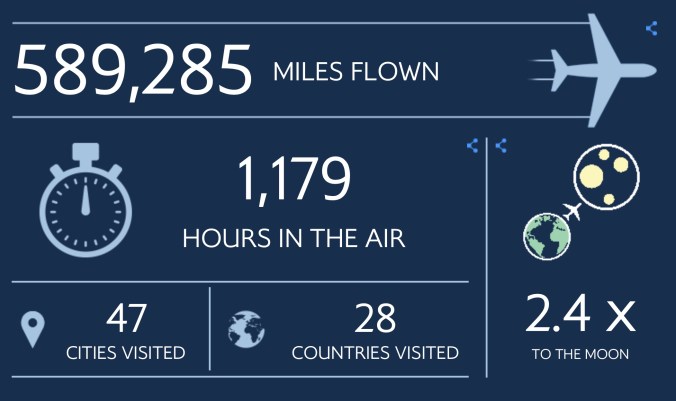
43870796-5CE2-4736-A95A-4C22F781B64D

I am often asked about travel, it’s synonymous with me, often an opening question when I see people. I find that interesting because the majority of it is not in my conscious, what I mean by that, is I don’t think about it all the time, it just is what I do. If I fly to Germany and back in a day that’s just like a commute to the office so to me it’s just another day, but to those following you it seems like a thing. I think that’s my overriding impression between business travellers and non – it’s a topic to discuss to an extent but changes from a question of interest with someone who does not do a lot of travel, to a more factual discussion on schedule. 

One thing that you do when traveling a lot for work is both form habits and observe others, as well as become very ingrained in your ways of wanting to operate, just ask Ashley my assistant! So I thought I would highlight some tips, maybe some observations and a bit of myth busting and then some differences between regular and non regular travellers. Please add yours in the comments!

In no particular order!

  1. Depending on where you live, drive to airport and park in short term, it costs less than taxis and they do loads of deals, it is convenient and close!
  2. Early flights mean having everything down to your keys ready the night before, especially important if you oversleep.
  3. If you drive yourself you can speed to make up time! Another advantage over taxis.
  4. Always take lifts in Heathrow, not escalators, all the pros take the lifts, faster
  5. Seat etiquette – big topic! Short haul, window, no exit rows – reason? You can lean against window for sleep. Who gets up in a 2hr flight? Well not me but some annoying person will choose to clamber over you if you do sit aisle. Never exit as the bag with your work life has to go up in locker! Long haul economy is aisle so you can get up and down easily, if business it’s window on BA but if you are on some of the old shit American flights with seats side by side then back to aisle. On long haul business on BA try and go upstairs on 747, quieter, better experience all around. 
  6. Tumi washbag which unzips at the centre and has clear plastic insides which in most cases you can do instead of plastic bags etc! I have one happy follower in Alex Altman on that tip.
  7. Long haul day flights, sleep enough to keep you up when you land to go out but not so much you can’t sleep in the evening. 
  8. Don’t talk to anyone. If someone speaks to you very early on a flight, answer, smile, put headphones on. 
  9. If you are BA business – don’t be shy to put the screen up, the person next to you will be happy you did it too! 
  10. Whatever happens don’t end up in the middle two seats on BA business, like getting into a double bed with a stranger in a suit.
  11. Don’t check bags! Holy jeez, if you are travelling with colleagues and you checked, you are truly the devil. I find it is mostly the young, trendy and non seasoned that check bags as they don’t have the simple business travel outfits and pack like they are on holiday. Some serious offenders out there.
  12. Don’t drink alcohol on flights – otherwise it’s like going to the pub every day. It also makes you feel like shit. Maybe one before a long haul.
  13. Use all those air miles for car hire on holiday rather than a small discount on a flight
  14. Walk straight into first class lounge in JFK if you travel business but are not Gold, they never check!

Jet lag? What jet lag?

I think the biggest thing that comes up is jet lag and it definitely gets harder every year but this is the fundamental difference between travellers and non travellers. Jet lag is 50% physical and 50% mental and in fact for infrequent travellers I think it is part of the fun of instagramming that you are wide awake in the middle of the night and talking about it a lot. You will notice regular travellers never talk about it because it is just part of the game and you have to ignore it or you would never get anything done. I am a big fan of doing exercise when you land and add that extra layer of tiredness which then helps you sleep, clears the head etc. Also use the fact you woke up earlier and get out for a run when going West. Jet lag at work Just needs some extra coffee and a busy schedule to get through. 

I am ruthless about going in and out for travel, no sightseeing, extra days, weekend stays, when you have a family you don’t have that luxury and if you are on the road a lot then you have to do that, at least if you want to hold down any relationship. So no travelling is not always great. 75% of trips start at 5am, flight, taxi to office, and then either team dinner, or taxi back and home.  No wondering around the ancient ruins, a day of pool time. If you then throw in delays, cancellations and extra nights stays, it gets boring fast. That said, I love it. I love it because it’s still a chance to see and feel a little bit of culture and learn something new. I learn about country behaviours and culture even in a meeting room. So a bit like jet lag I don’t moan about the bad bits and focus on the good stuff!

Working on the road is a bitch

Working on the road is something that you get used to, but again people who don’t travel, put their out of office on and go incognito for the length of their trip. Whereas those who travel a lot are constantly on, desperately trying to keep up with relentless inbound emails and at all times of day. I am always trying not to do lots of scrappy work and occasionally finding time to sit down and actually write something or at least think about it. It is the hardest thing to get right, avoid getting behind but not doing everything in a half manner. Emails definitely get shorter but better that than silence for days. There is nothing better than a full week at your desk..There are moments though when the silence on the plane, the quiet moments in a hotel can help, try and find time to think.

Things that always disappoint and annoy:

  1. When pilot says that we are early into Heathrow and isn’t that wonderful except that everyone knows that Heathrow does not do early so by the time they found a free slot, managed to get the steps over, found a bus, circled London, you are very rarely early.
  2. Buses. Shoot me now. The buses are the great leveller, First, business whatever, jump on that bus! I hate buses from flights it’s these small things that kill you when travelling
  3. Passport machines that don’t recognise my passport – at least 50% of the time 
  4. People who JUMP up when seat belt sign goes off!! Sit down and wait one second!! It’s not like we are calling a free for all to grab each others bags, the Hunger games of the airplane cabin, each grabbing for the best looking business bag! Just relax.
  5. People making and taking calls a lot. Just be normal and message / text them!
  6. Eurostar Wifi – horrendous
  7. Eurostar seats – come on! Headrests that are not actually headrests, sorry can’t bare it. I need to lean my head!!
  8. All my devices dying all of the time – so bad is it, I bought a suitcase with a charger as a last resource back up, but it’s so annoying because it always happens at once and always when you have to make a call.
  9. Airlines that hand out headphones and then want them collected back in, not sure why that annoys me but Just does. It’s the assumption they may get stolen, which in business should not be an assumption in my view!
  10. NUMBER 1. Irritant. US colleagues who don’t put their International dial code on numbers. HELLO??? When you are pulling a suitcase, carrying a bag, phone, maybe a coffee and you have a call, you just want to click on number and have it call – what you don’t want to do is copy and paste into contacts or dial pad, edit, add +1 because you happen to live in ‘rest of world’ work with us guys?
  11. No irons in room. No free WiFi in hotels. That kills me.
  12. Room inadequacies is massive! I want one switch, by the bed that switches EVERYTHING off, closes everything, you name it. I am amazed that almost all hotels think it amusing to have you hunt around trying to work out every light and every switch to every light and best of all not put them near the bed. Please, let me switch everything off in one go!! I have found about two places that do it!
  13. Never any healthy options in hotel room fridges, just sweets, chocolates etc
  14. Business flights with no power sockets – yes that’s you BA and your old planes!! How about buying just a couple maybe?

Well that’s my sum up to date, I would particularly love to hear any of your tips – tell me how to make life better! I am all ears!