Tiger Woods Ad is impressive..on the part of Nike

Marco Bertozzi:8.04.10

I have to say I am mightily impressed with the Nike Tiger Woods Ad. It probably says so much more about Nike than Tiger, and they probably know that, but never the less its impressive.

How do these things normally play out? Celebrity messes up, brands drop said celebrity, world moves on for a bit, debate about whether brands should use celebrity endorsement, sponsors come back and re sponsor when the dust has settled and off we go again.

A refreshing change from Nike, who have lived the whole episode, taken the flak, ridden the highs and lows and even been willing to jointly work through the relationship to what I can guarantee will be one hell of a come back.

This Ad is both rare and somehow quite addictive, draws you in, cuts out the hype and makes you think..shit this guy is having to really put himself out there and in this case so is Nike.

How has Tweeting changed the face of conferences?

Marco Bertozzi:29.03.10

I read today a post by Mel Carson that he tweeted out there about someone at a conference commenting on the clothing ‘suits’ and words they used at the conference ‘actionable’. He seemed quite upset that he had been described as a suit, you can see his defence at here and the fact a member of the audience had questioned certain words used.

That got me thinking about how the conference has changed, the old days you turned up perhaps a little hungover and under prepared, or absolutely word perfect, either way you did not really know how you were performing. The advent of tweeting at conferences and the fact presenters are actually reading them has meant you need to think very carefully about whether or not you want to tweet what’s on the tip of your tongue. The person Mel talks about has obviously caught the wrath of the conference speaker/attendee but will that always be the case? What are the rules?

It is easy to be bothered by peoples comments but at the same time you have put yourself in that situation and therefore should you not be prepared to take some criticism? I think yes, as a rule, thats not to say it is right that people hide behind electronic communication to make their points but equally if everytime someone is tackled up for their comments you will kill what has been the most interesting part of most conferences so I suggest caution. Although this was not the source of this post it did also get me thinking about the quality of ones presentations at conferences. Basically if you don’t want to get negative comments then prepare well and make the content interesting. It amazes me the amount of presentations that are re drafts, they are cut, chopped and diced to fit the subject of the day and often presented with no prep. In this age of live digital critiquing I think we all need to be prepared to take some grief if we have not put enough effort in.

In reality you will never please everyone, one man’s ‘suit’ is another man’s ‘professional’, who cares if you wear a suit? I think that the rule is if you don’t like what you read or hear, dont get up on stage.

When will instant be too slow?

Marco Bertozzi:23.03.10

Inspired by a meeting today with Harriet Dennys from Mediaweek I started to think about the speed of communication that surrounds us.

Along came email, no more letters or faxes needed. Everything sped up that little bit more, having said that we still held on much longer than we needed to before giving in to sending everything via email. There were concerns at the time that it was too informal and hard copy was more professional.

At around this time we received our news via the hard copy trade titles, it was a sign of position if you were able to receive a copy of Campaign and people waited with baited breath to see what would be said about them or their clients or their competitors. Now we receive our news via Twitter feeds, Linkedin, Facebook, we sign up to far more feeds than we would ever have contemplated reading, we cherry pick. News on demand.

Today I was asked if I thought email Bulletins were too slow? Amazing thought, to imagine that we are even considering that a daily email bulletin is too slow. Harriet was right though, in some respects a daily bulletin is too slow, news is everywhere, it’s on demand, its in feeds. People everywhere are aggregating all of these feeds into one location and getting it fed to them night and day, minute by minute and that is creating another effect..promiscuity!

Like search, do you care where you get your information from as long as its correct or first? Look at the myriad of Twitter feeds, most of them are just swirling the same content around so do you wait for your favourite feed to appear with the news that interests you or just click on the first? I click on the first and I bet many others do as well. It’s all changing, its faster, its more and more digital and it is all making even a Bulletin feel slow..someone stick the brakes on!

It does not stop at news, it’s the same with email. Many media companies are also communicating via messenger both internally and externally – why? It’s quicker than email..how much quicker can it get? It’s not just the mechanic but also the expectation – are we not all on email via BB or iPhone, why would it take that long to reply? How long do we all now wait before expecting a response? Ok its 10pm but he could just fire me back a quick response couldn’t he? Email is not slow, it’s now the users that are judged for their speed of response!

I am out of breath just writing this and during the time it has taken i have received about 100 feed updates, 5 emails at 11.30pm (damn the US) and 1 text. Where will it end? Thanks HD for the inspiration!

As a follow up – check Craig Robinsons response to this blog @ http://www.swissss.com

Loving the Heineken Inter vs Milan event

Earlier in my blog I highlighted the great ‘concerts in a banner’ work, well here is another extremely clever and engaging piece of work which brings together media, PR, viral and stunts all into one idea. Take a look, it is genuinely impressive.

Most praise has to go the wives and girlfriends that managed to get them to the event!

WiFi on planes, tubes and trains, we all know its coming – good or bad?

Marco Bertozzi:15.01.2010
It is inevitable. 10 Years ago when you went on holiday that was it, you were out of touch, out of sight, out of mind. That was not just about the technology it was also a reflection on work society not demanding you to be available, a holiday was exactly that.

Over time the demands by work have increased more and more with technology aiding and abetting all the way along. Phones turned to Blackberrys and iPhones, every conceivable space became WiFi and generally speaking now there are less and less problems with phone connectivity around the globe. As I mentioned above there are two issues here, one is the way it has become more and more acceptable to disturb people on holidays and at weekends and the other is technology making communication possible wherever you are. I want to talk about the latter.

The biggest thing to change here is the march of WiFi into once untouched havens of non connectivity. The train, although mobile broadband has eroded that for some time, but the bastions, that have withstood all attempts – the air flight and The Tube!

Its all changing, WiFi in planes is already up and running in the US and in 2010 Lufthansa, Virgin and sure many more will pick up the mantel for International flights. Interesting that research in the US has shown that there is a huge drop off of usage when one has to pay (up to 12 dollars for a 5hr+ flight), cost being the issue, I am not so sure. I think that people are not ready a world where they are never out of touch. Why would the usage drop off because of the cost? Its mainly used by business people who would expense their companies anyway, no this is about the last haven for people to not be contacted, trying to be retained. The plane flight is an opportunity to do what you want to do without guilt, work, sleep, play, talk, whatever suits, without blame. Marc Ruxin in his blog on a similar discussion quoted the fact that Napoleon often waited six months to answer post as most of the things that were urgently needed to be done had either been done or disappeared..so true. How many times do you catch up on email that if you had been there right from the start you would have waded in, but because you were caught up elsewhere they sorted themselves out.

On a situation closer to home, the idea of having connectivity for your phone on the tube will be both very useful and very annoying. Again the tube journey for many is their time to think, digest the news, read a favourite book etc etc, that will be destroyed by getting a signal. And what will the subject of the calls be about? ‘I am running late’ ‘problems on the tube’ ‘my boss is an idiot’ you can imagine, except multiply by thousands in a confined space, as far as I am concerned the Tube just got worse Obviously it will be a brilliant turn of events when I need to make that ‘I am running late call!’

All in all though the erosion of these last frontiers of isolation just answers probably what people are after but sometimes I think only because of either mobile addiction or work pressure. Deep down dont we enjoy those times where we are forced to consider filling our own time rather than Outlook telling us what we should be doing?
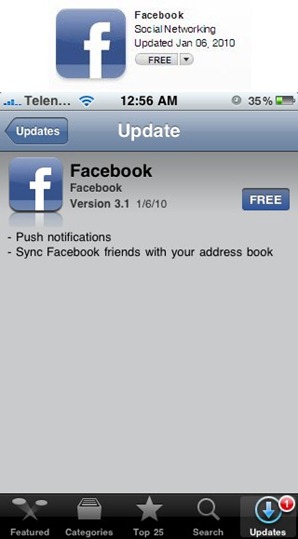
New Facebook push notifications will mean mobile dominates FB usage, even in the office

Marco Bertozzi:07:01:10
Discussion around whether or not Facebook should be banned in the office has pushed more and more people towards using mobile as the primary route to Facebook interaction. The numbers are impressive about how much people update their status via their mobile.

Now work will arguably be more interrupted than ever as people to take up Facebook’s new 3.1 update that allows push notifications to your iphone. At least before people often left FB open on their screen and could see messages easily, now they will be shovelling through their bags and desks as their phone beeps with that expectant moment when you wonder which of your friends has sought you out! The facts according to Razorfish annual study – Razorfish Feed – are scary for the workplace, apparently the average connected person updates their FB pages every 37 minutes, the full report can be found here:

Click to access Razorfish_FEED09_Webinar.pdf

Facebook is part of life now so I think offices that ban its use need to get over it as it is here to stay and part of our communication, I would rather see banned the trend of recent years of everyone wearing headphones at work. It is the most depressing of sights to see a bank of people all with headphones, no one learning from each other, no one knowing if your team member is talking utter rubbish on the phone. The office has changed, lets worry about things that stop people communicating rather than things that encourage it.

How many of your team have you pissed off?

Marco Bertozzi:04:10
In the next six months all companies are going to experience an extremely challenging time. Particularly those with young, ambitious members of the team that feel they have just lost a year or arguably two of salary, promotions and bonuses, regardless of the realities of the recession, they feel aggrieved.

Media, digital and advertising agencies are prime examples of companies where managing the staff costs has been paramount, they represent half the cost in the business, more in some cases. The last year has seen different agencies deal with their cost bases in many different ways. Some have been able to manage with some light redundancies and a little voluntary, others have had to take pay cuts and heavy redundancies. The niceties have been removed, the taxis, the lunches etc and everyone has been asked to work that much harder in return. Most people have obliged, in the main out of fear.

Now we are in what we hope to be a slow but steady return to the good old days everyone feels better, but along the way it is going to be exceptionally bumpy. Many agency chiefs are now sitting on an army of disgruntled employees, PricewaterhouseCoopers believe up to 30%, all ready to jump ship at the first sign of a decent job offer and promotion, the promotion they have been stopped from receiving over the last 18 months.

This is not the fault necessarily of the individuals in management, in many cases there is little they can do, they had to manage the numbers although some may have handled their individual situations better than others. I think the testing times will come now as to how we manage the exit from recession. How companies reconnect with their employees, that will be down to management and the steps they take.

It’s critical agencies do this because the end result if PricewaterhouseCoopers is correct (http://bit.ly/4LieSw) will be clients seeing a revolving door of people on their accounts, the continuity on the accounts falls apart and suddenly you have a client feeling a little disgruntled themselves.

So it’s probably about now that everyone needs to have a look at their teams and start to ask themselves honestly – just exactly how many people have I pissed off?