A week at The VivaKi Nerve Center

A week at The Vivaki Nerve Center

Monday

An early meeting with the WW CEO of ZenithOptimedia to discuss how the market is shaping up and what can be expected of 2012. As the conference season starts I am being pulled in a number of directions to make sure everyone who needs the latest info has it!

Later that morning a call with the boss, Curt Hecht, it’s a about planning stage and we discuss what we need to get done for 2012 and how we will work with the agencies. A lot of progress in 2011 for VivaKi and The VivaKi Nerve Center and so it makes for some great conversations for next year. More than ever we will be a very European organisation which is achievement in itself. a series of meetings with the major EMEA markets all to be planned.

A session on contracts, which seems to take up a lot of time at the moment, but we are making real progress with a number of contracts signed that will help power The Pool, Partnerships and AOD.

End the day back at the WW CEO’s office to finalise some notes for the conference and its my turn to start to prepare for the Exchangewire ATS event where I am on a panel with Nigel Gilbert from Orange, Gurman from MediaIQ, Breadon from AOL, Martin from infectious and hosted by Zuzanna at Microsoft. Will be a good day I am sure.

In the evening, I went to the Appnexus / Microsoft drinks and met with the founder of Appnexus, the new head of Microsoft, Andy Hart and a number of others. Bumped into Jakob of GroupM, always a pleasure and we had a little catch up and then I had to leave for dinner with Quantcast and Exchangewire down at BerryBros.

As usual you learn something on these nights and having spoken to a number of people from other groups, its clear to me that VivaKi are the most integrated and aligned group in this space, working hand and glove with the agencies. I hope over time this pays dividends for us all.

Tuesday – ATS Day

Arriving at the event really makes you see how far things have moved on in the last year. Ciaran’s first one was a big event but this really surpassed itself with 400+ guests. Unfortunately as the day went on it became clear that again it lacked publishers and advertisers. The more I think about this though, the more I think, why should they be there?

Morning sessions were OK but lacked direction, more moderation, different questioners and less keynotes would have improved the morning session. Keynotes fund these events but I feel having Mediamath and Rubicon and Appnexus all doing a turn is perhaps excessive.

Microsoft did a great session, slick presentation and I think surprised everyone, he even presented an Apple Ad, which was the talk of the Twittersphere..
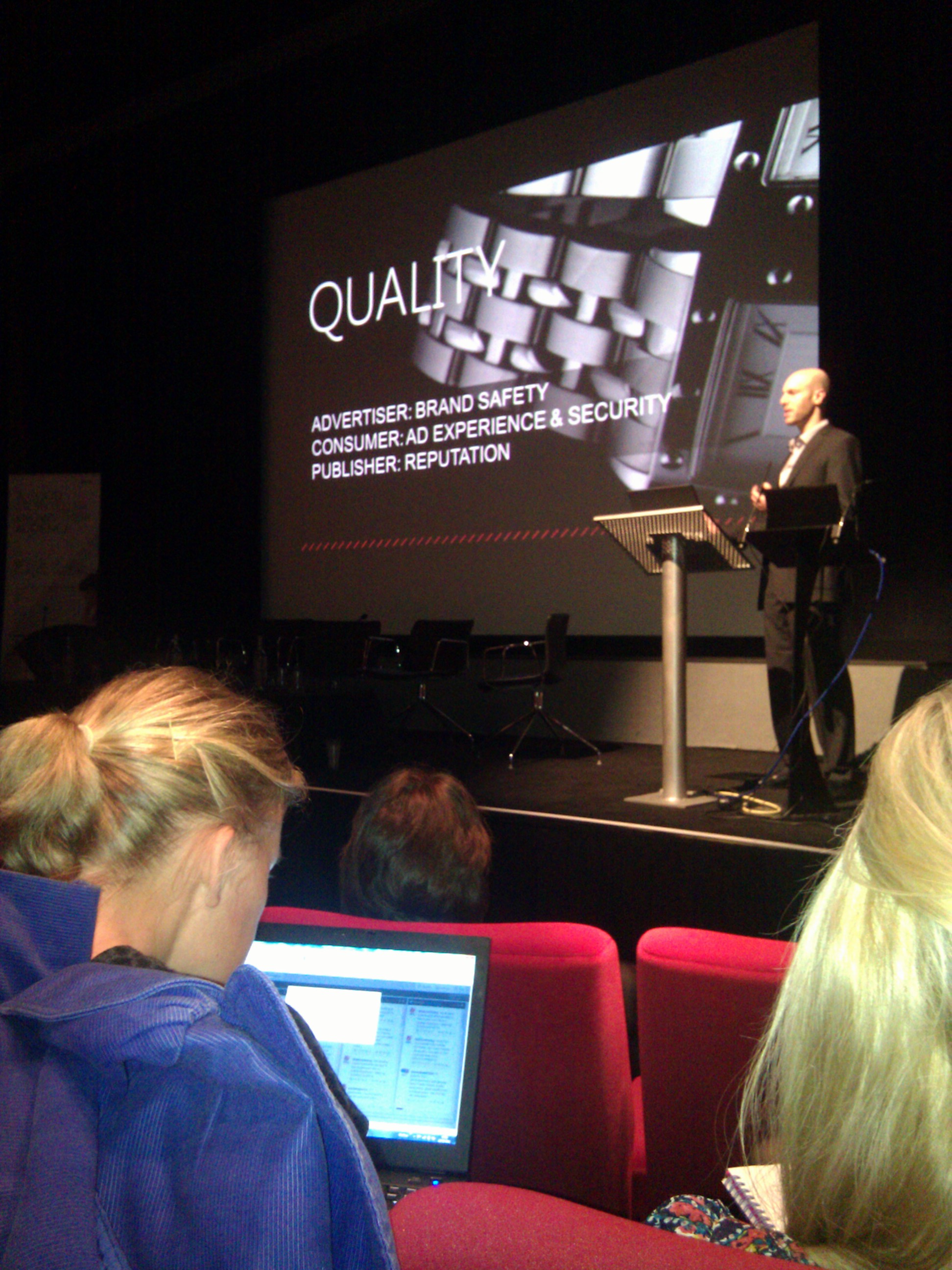
The afternoon panel I was on was billed to be controversial, I knew it would not be, for two reasons. The first is we have said this before and the second is that people in the audience don’t want to stand out and make issues. The bigger these events become the more polite they will become. I had a couple of key themes I wanted to get across around the whole Ad Trading Desks.

1. We are not an Ad Network
2. We will cut back on Ad Network spend
3. We will be aiming to centralise all retargeting and we think it’s the right thing to do
4. We work with a number of DSPs just not in the UK and we know what is what

I made all of these statements as well as suggesting Ad Nets use client data across their campaigns and received no resistance so, if it was not controversial, it was not because of me! Feedback has been that it was too about positioning of each others company etc but you go where the questions take you.

All in all though, a good day, got to catch up with some great people from around the business and generally enjoyed it all.

Wednesday

We march on with an exciting morning meeting with a large European company that is soon to become Vivak’s first VNC Partner in EMEA. We have of course high profile relations with Microsoft and Google as well as other US companies, but this is the first at scale. We worked through the opportunities, what we need to do together and how we can help each other, a great start to Wednesday and we look forward to releasing that news soon.

Later that day, I 100% focused on The Pool. We have been delayed on this but we are ready to go again, very exciting, there is other info on The Pool elsewhere on my blog Later this year I am presenting at the IAB conference on Spain the results of the Spanish Lane and some of the work that’s been going on in the US, I am really excited about the results that have come from this work.

We have three great publisher partners and already two major clients so things are looking great in that regard, there will be more to come on that subject shortly.

The day ends meeting a team of senior Google Product managers who are trying to work with us to provide insight to power Audience On Demand. It’s these meetings that the Google partnership is founded on, not media spend and discounts. It was a really interesting session and we learned alot about what is coming up. Invite will be a very powerful proposition.

Thursday

A quieter day on the meetings and valuable time to catch up. I did meet up with the CEO of Vindico and team who have big ambitions in the UK. We work with them on The Pool and they are a great outfit. Its time we need to get over the control issue around video adserving, we have been through this once with display and its time we moved on when it comes to video. We are used to substandard, early 2000 type tracking and reporting which is not acceptable.

Friday

A chance to discuss everything we have been doing and seeing this week. A morning appointment with a client with a brief to talk them through all the things The Vivaki Nerve Center are working on, went brilliantly and we will be doing some great work I hope. They showed the kind of interest in innovation that makes it all worth while.

A run for the train from glamorous Slough with just enough time to read the placard under the stuffed dog at the station and down to Microsoft to present to their regional scale display teams and talk about the importance of agency trading desks. Quite a turn out and some great questions from the group, I hope we can act on some of the discussions and continue to grow our global partnership.

I end the week with some time to keep up momentum with The Pool, discuss with thepaulsilver the final touches of an exciting launch next week and what I am going to do when he is on holiday!
My Microsoft video pre Exchangewire conference

Its not one of my best but being quizzed on the spot is never straight forward! This is on Youtube but actually was fed from the microsoft blog – you can get to that here

The video is one of a number from panelists from the forthcoming Exchangewire event – link to that is here


Will digital people ever run the advertising business?

Its funny, back in 2000 when digital took off, the sector was really sidelined in terms of importance, no one really took it seriously, there was no scale, it was specialist. Nearly 12 years later and the world has changed dramatically. Spend has moved from £150m in 2000 to £4billion. Internet has overtaken every media channel, recently overtaking TV. Share of overall spend has increased year on year at a huge rate.

Agency life has been dominated by digital, teams of search, display experts, planners, buyers, mobile experts, Heads of Digital, Digital Strategy Directors, API specialist, and on and on. Its been a revolution. The major agency holding groups are judged amongst other things by the percentage of their revenues derived from digital. Digital is the key battle ground in terms of services.

And yet..take a look at the CVs of all those people leading media agencies and creative agencies in the UK, have a look at Managing Directors and CEOs, COOs and what do they all have in common? None of them come from a background in digital. It’s an interesting fact I think. There is the odd exception, the most notable being Rob Horler and Mark Creighton. Again even there, Rob is in the Group and Mark is COO rather than CEO / MD roles but nevertheless at least they are influencing direction. Of course digital leads are influencing at a board level, its not that they are not heard, but they cant seem to make the next move.

Lets then look at clients – I can’t pretend to know the whole market place but I am pretty sure again that most CMOs and Marketing Directors don’t come from a purist digital background. What implications does this have for digital growth? Should anyone care, it will happen eventually, wont it? Well I think part of the problem is that digital media has always been so implementational – more important to know how to get something to appear on a page than think strategically about whether or not its the right thing for the brief. The generalist, the planner approach is more likely to think more holistically and therefore talk the language of the client. Who owns the client, gets on in most agencies.

I believe that the Head of Digital roles and careers will ultimately always hit a career ceiling until they start to become more generalist and strategic, and get less bogged down in tech and implementation. There are a number of Heads of Digital across the industry – lets see how many progress to MD or CEO of a mainstream agency vs moving out to find their next role. I guess eventually the boundaries will fall and everyone will be digital but that is still some way off.

Data: The new Wild West

I have invited Paul Silver – Head of Product, AOD UK to comment on the world of data – here is his first post and the first guest post on my blog. Enjoy.

By the one and only: @thepaulsilver

The 3rd party data space right now reminds me to some degree of The Wild West. As a result of that mad gold rush era, the legacies created were: hastily erected housing, mob rule, vigilante justice, hyper inflated prices….sound famililar?

There has for sometime now been a lot of discussion around 3rd party data for audience targeting. ExchangeWire hosted the first EMEA Data Economy Event in March 2011. The hype seems to be lessening, but the appetite is as strong as ever.

The recent announcement of Xaxis developing a global audience profiling database reaffirms my belief about the synergy between the current data space and The Wild West. Agency Groups, Ad Networks, Data Exchanges, Aggregators – everyone is trying to get a piece of audience data, acquire it if you will (directly or indirectly) to fuel more precisely targeted audience based campaigns. And like the Wild West, I fear this rush for data is creating more confusion, execution of some bad practices whilst fundamentally the core foundations remain sub standard at best.

The upside of this ‘demand rush’ means publishers have more distribution points than ever, that can only be a good thing right? Or does it mean in fact that the more points that data is sold to, the more commoditized it becomes? Is that inevitable?

Some publishers that I have spoken to do not know where to begin when it comes to data monetisation. There is also so much data kicking around that advertisers do not know what to do with it, what to buy in terms of un-deduplicated reach and access, or even begin to understand the complexity around different taxonomies for what could essentially be the same user in the same type of segment. There is also the case of advertisers (and publishers for that matter) not knowing the difference between the types of data: inferred or explicit, lifestyle, interest, intent, social graphs(?), lookalike. The lack of standards and transparency exasperates the problem.

Like the mob rule affect created by the Gold Rush, publishers are increasingly becoming vulnerable too. Large agency groups are starting to wield certain influence in trying to bake data into trading deals. On one hand, publishing groups with limited scale are never really going to make a fortune from selling their data, but its the principle of how that proprietary data exits their businesses that should raise concerns. There is also the case of publishing groups still unaware of what data is being collected on their users from third parties. It is still very common practice for ad networks and certain agency groups to cookie from a creative. It might be pretty high level data in some cases but it’s still data being used to build out data repositories, leveraged for campaign targeting elsewhere.

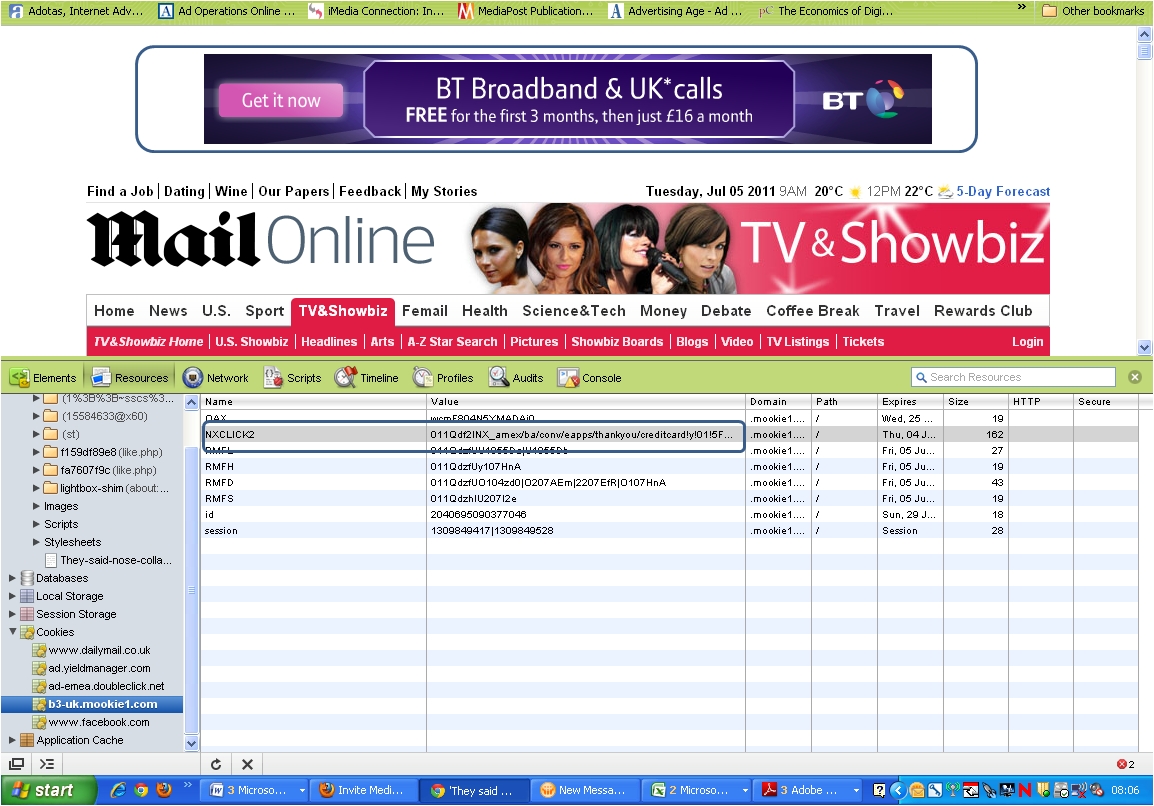
Co-mingling of client data is an old argument; some of which believe to be mythical (one network told me it was not technically possible) whilst some believe it’s still an operational practice today. Either way it’s a practice that carries many sensitivities. An example is outlined below. I recently applied for an AMEX BA Card. I have since been served ads for BT following some recent site visitation. Nothing wrong with that. However what I found odd was the cookie information, that is being directly or indirectly leveraged, includes details of the Amex transaction. I may be wide of the mark of here and as the technology is based on exclusion and inclusion pixelling, maybe it ‘needs’ to know I am an AMEX customer so the rules can be defined to say “dont serve AMEX to this user, serve another ad from the pool”. Or it could be simply using the data they have on me to enrich the targeting parameters of the BT campaign?

As far as the publishers are concerned, yes there are companies such as Krux who exist to protect the publisher’s data, but there’s a cost to everything. The cost to protect your data could outweigh the amount it will sell on in an open market – a difficult business case to make.

But how are advertisers being remunerated? More importantly, being protected? Data networks are built by certain businesses off the back of advertiser funded campaigns / creatives. Publishers may well be remunerated for this, but are the actual advertisers? Their ads are running across ad networks and are the principle facilitator of data collection. Surely they deserve some of this rev share?

Lastly, but by no means least, why is there not more discussion and focus on how to better measure and evaluate the use of audience data? Without this, the rush for data is simply a race to the bottom – either data becomes less qualified (to make it more scalable) and therefore less expensive to deliver against a CPA or the data investment remains minimal because a scaled use of it does not cost in against a KPI.* We should be nailing this first and foremost.

All in all, there are some murky practices still happening with regards to 3rd party data. I think industry needs to clean up the data space somewhat before anyone starts cashing in on the latest Gold Rush…

*(Fortunately for our partners, we are developing a solution within VivaKi that aims to address this challenge, identify the real value of data and reward partners appropriately. We believe there is certainly value to delivering against your target audience and we hope to be able to scientifically measure this value).

Follow Paul @thepaulsilver

Four days on the West coast

20110518-111704.jpg

20110518-111718.jpg

I was genuinely excited about my visit to the West Coast to visit all the HQs of the major Internet companies. When you have worked in digital for so long these places take on real significance. Mountain View, Palo Alto, Redmond etc. The Spanish VivaKi took 12 clients out there and I was there to represent the broader VivaKi organisation and make a presentation on how it all worked. It was perfect timing actually as I felt very ‘Groupe’ after the four days I spent on publicis training last week.

The first day was at Microsoft. Honestly I was disappointed with the offices, very dull and heavy and old. I always imagined, white and bright for these big spaces but this had more of the 70s about them. The opening couple of hours were spent in the home of the future. A seriously impressive vision of the house of the future, Microsoft have a couple of these but nothing like this, properly mind boggling and left you amazed, a great start.

20110518-180941.jpg

Microsoft does have so much to offer but really does struggle to join up the dots, demonstrate the power of 4 screens. They are almost unique in the position but it seems they struggle to capitalise on the opportunity. Nevertheless a demonstration in scale, scope and innovation is what Microsoft does best and I know the clients took a lot away from it.

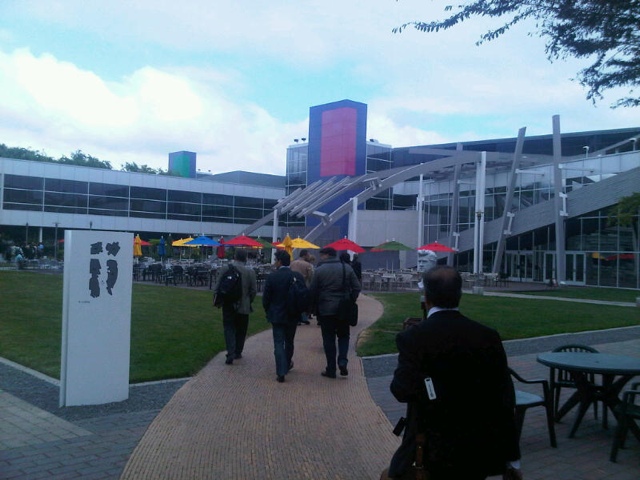
Google and Facebook followed the next day and the scale of the companies and their impact on the world is staggering. In both cases you have to remind yourself of what they have achieved in such a short period of time and as we wandered the offices how on earth they kept on top of the growth. The offices both had a dishevelled feeling about them, but both gave up space for thought and distraction, something we could all learn from I think. Everywhere there were break out areas in all shapes and sizes as well as canteens and small kitchens.

The average age of the staff was young! The Google canteen was like a high school dining area not one of the worlds largest companies. It also seemed open to the world. There was our trip that felt like a school tour, the were also school tours and other things, it feels like a company keen to be part of the community – I don’t know if that’s true or not but that’s what I was left with.

Google was not a company but a town, complete with their own Google company bicycles everywhere so you could get around, it was vast 8-9 thousand people..you feel like you are inside a legend of a business, a great feeling.

And after all that, what stood out for our clients? Akamai. The unheard of company that basically makes the web work and transfers the internets content. With their screens showing the load on servers across the world, beautifully brought to life with futuristic graphics, the power of this company is stunning and yet so understated. You can understand why a potential leader of Publicis Groupe in the form of David Kenny was attracted to the organisation. I suspect in the coming years we will all hear a lot more about Akamai.

So it’s been a week in Paris being trained on how to collaborate in our Groupe and now four days in the heart of the web world, a crazy couple of weeks but fascinating and week 1 seems all the more obvious having lived through week 2. This world is going mad with complexity and no one company can handle all of it, as agencies we want to be all things to all men, but those days are done. We are now in the age of truly collaborating to survive, rather than just saying we do, those who don’t use the power of our various agency brands and VivaKi will not succeed. Clients want solutions and together we can deliver.

Did someone at the ICO get pissed at lunch? Privacy lunacy

So the story so far..after many years of neglect the governments of US and UK decide we need to manage better the laws around privacy. The US agrees that we don’t need a law but the relevant bodies should show clear guidance and management of the issue, proving that the industry will be responsible. The US have done that, it’s still a little disorganised but it’s getting there.

At the same time in the UK we were doing the same. Everyone working together and moving towards an acceptable solution. It was loosely agreed that cookies required by a company to deliver a service, think about how intuitive Amazon is or how your bank remembers you etc etc. Everyone was happy with that approach. At the same time the advertising and targeting industry was looking, similar to the US at another self regulation approach. There was a number of options but it was going in the right direction.

As I had mentioned before, based on information from Evidon, consumers had shown not a fear of being tracked but rather a desire to be represented appropriately and therefore receive the most relevant advertising and or slick process through ecommerce websites. This to me is crucial, absolutely crucial and the government needs to understand this point further.

So all was going smoothly. Then someone went to lunch and got pissed at the ICO because when they got back they decided to throw all that out and do a number of things:

1. You need agreement from the user to cookie them, before you start to do it
2. They tightened up the rules for advertisers as to what is a crucial cookie and therefore exempt vs one that just makes your life easier.
3. They then left all that hanging with no actual solutions.

It is absolute lunacy, we are left with chaos, are we really suggesting pop up boxes and drop downs and virtual signatures before being able to drop a cookie? Perhaps we should just go the whole hog and ask for permission in writing as one European country is discussing.

This approach is a major departure from where the Government was only weeks ago and has caught everyone off guard, ecommerce is at risk as is most of the digital advertising business and hence why it is lunacy. The point in this blog however is simple, the only reason they could have had this short term turnaround is because they went to lunch and got pissed because frankly there can be no other explanation.

This needs of be sorted out, I am sure it will be and I know everyone is working closely together as agency groups, advertisers and industry bodies, so nobody panic. If all else fails get down the pub with the ICO boys and try and persuade them otherwise.

Data accuracy, not data privacy

OK it is a little black and white and overly simplistic but there is something in this phrase. After working with Evidon, formerly Better Advertising, I realised that we are spending so much time talking about data privacy when in reality part of the game is data accuracy.

Evidon are one of the first companies in the US and soon to be EMEA that overlay a logo on each and every banner, allowing a consumer to learn a number of things about who is tracking them and what these databases hold on an individual user. Once you click through you are told about the company whose page you are on and anyone else who may be tracking you across over 300 data partners. Now it gets interesting, not only can you see this data but you can change it in real time to reflect you and your life more accurately OR you can opt out altogether.

The first and interesting learning was only a tiny, tiny percentage of the users clicked on the logo, we can forgive that as there has not been much coverage and education, that said against billions of impressions the actual number was high enough to learn lots about what they did next..they did not opt out, no they updated their profiles on the databases. They were happy to be tracked but only on their terms, they wanted to make sure they were rightly represented so they got the best advertising.

I dont think enough people talk about this, we are constantly assuming consumers / users want out, no they want accuracy and they want to see who and what is looking at them, after that in the main it appears they are happy to work with us nasty, media and data companies, they may even want to receive an advertising message!

So I think we should talk as much about data accuracy as we do data privacy..

Why Ad networks can’t become agencies but the reverse is not true.

The latest debate in the display space is whether or not ad networks are going to have to become agencies and go direct to clients to sustain their business. It’s a fair assumption, the likes of Specific and others will hire agency people, create better strategies and approach clients. The latest article can be found here on exchangewire.

It’s a believable concept but one that is out of sync with the way the industry is heading. Although there is a lot of hype around ad exchanges and targeting / data opportunities, within an agency, exchange trading remains a line on a schedule, albeit a complicated one. The exchange space asks many questions of agencies but that is around change and adapting, once its all settled down, it will revert to being an important channel like search and crucially will be integrated into all the other channels.

Over the last few years clients have been on a journey where in the main they have consolidated channels, first digital overall and then they have dragged search in where specialists have held on for some time. It’s not only channels but they are integrating their media agencies both within countries and between countries with more and more international pitches. Anyone in a major agency will have lived that in the last few years. So after all of this integration I think it is unlikely they will want to start farming individual channels out again, especially when it may be big news in the exchange world but within agencies, it’s just another new channel. Time and time again through research, better coordination and integration has shown better results for the advertiser so there is no reason to split out exchange trading.

There is also some realistic areas to take into account. Clients spend 80% of their budgets on offline, 60% of their digital budgets on search, the rest is split all over. So its fine for an adnetwork to go direct but they will never fill the roll of an agency. The agency roll is more than buying and is across all media channels, its events, experiential, etc etc, it’s also highly people heavy and Ad networks have been used to high margins, low headcount.

So direct is fine but will struggle in the UK marketplace, however I think with time the agencies could start to deliver an ad network experience and product within the context of their huge global corporations. Of course there is middle ground, some chameleon organisations that act as an agency or a network, but their offer only goes so far to be a real threat.

I dont think we need to start a war between agency groups and ad networks, I am sure we will all find a way, but I know what side I would want to be on.

Back to the future in biddable media

There is one area of digital that changes at an unbelievable rate and yet seems strangely familiar. Anything to do with addressable / biddable media and all the companies involved in it are now populated by all those faces from the past. All these new companies that could have come along and worked really hard to get in the front door are now using the brightest and best from the old ‘display and search’ industry to speed the process up.

Lets list a few

Stephanie Carr – Joined Marin recently
Phil Macauley – Quantcast
Chris Ward – Kenshoo
Michael Steckler – Criteo
Nigel Gilbert – Launching the Orange marketplace

There are many others , but its fascinating to see the faces now popping up in an area of the business that a few years ago would have been considered a little dull or geeky. Its happening on the agency side too though. Of course Andy Cocker and Martin Kelly are pushing data driven display, Adam Pace is heading things up in this area at OMD, your truely focused on it at Vivaki again, there are others that I am missing out but its a quite a shift and I hope it will represent where the spends follow as well.

Our business has always adapted well and its great to still be working with some of these fantastic people many years later, I look forward to 2011 and all it brings for me and all those people listed above!