Have we reached ‘Peak Technology’

Original article in Campaign HERE

Cannes is fast approaching, so it makes sense about now for us discuss creativity and technology and how it works together to power our advertising future.

I wonder, though, whether the changes in advertising we have experienced over the past 12 months are going to have as much impact upon the event as the new need to register to walk into a hotel or get on a yacht.

This past year has been quite traumatic for the advertising community; the ongoing onslaught against programmatic, the questions about digital vs offline, and circular debates about which media channel is most influential.

These would all be the standard issues for an average year, until ANA-gate, which kicked off a huge surge of self analysis across the industry.

Procter & Gamble’s Marc Pritchard weighed in more recently and delivered the biggest mic drop – basically calling out the whole digital industry. And of course it did not end there.

Too many unfulfilled promises and uncovered secrets in terms of the micro-targeting, data offerings, media properties that are unsuitable, and not enough human eyeballs.

Enter stage left – The Times – and so the we hit rock bottom. Technology, data, programmatic, privacy, fraud, all in the spotlight.

It has felt like an endless stream of negativity, but what has it changed and how can we expect Cannes to reflect it?

The initial outcomes of all this introspection have been a drift towards a rejuvenation of interest in more traditional channels. TV, premium publishers and “safe” environments are having a renaissance, as advertisers worry about where their ads are appearing.

It feels to me that we have reached “peak technology” within advertising. Too many unfulfilled promises and uncovered secrets in terms of the micro-targeting, data offerings, media properties that are unsuitable, and not enough human eyeballs.

Now we see the need to have a reset – a fresh approach to how we connect with consumers.

It has felt like an endless stream of negativity, but what has it changed and how can we expect Cannes to reflect it?

Now, I’m not suggesting we are going to see an “anti-tech brigade” per se, but we will see a surge of realism… a step back.

In advertising we adore the creation of a powerpoint presentation. Yet we are all familiar with the feeling you get when you get lost in the weeds and eventually you have to say, “what are we trying to communicate?”

I feel that’s the same with our whole industry. I have worked in digital from the start, and we have done exactly that – we started to tell a story, a good one, but it got more and more convoluted.

We allowed other people to insert slides that were “really important” – adserving, retargeting, audiences, data, programmatic – until we are all staring at a mess of charts on the inside of a meeting room glass wall.

We are now looking to go back to basics. What are we trying to communicate?

Well, I suspect Cannes is going to be the echo chamber. Woe betide anyone who starts wanging on about data without substance, to my mind, I believe the industry is getting to the point where, if you don’t own that data, if it does not come from a reputable registration, you should keep quiet.

Stop paying for videos the moment they start playing. Take down the spend going to programmatic Adnets that won’t tell you where your ads appear. And let’s show our ads to humans.

Geo data, segments, match rates and most recently viewability numbers that only talk about desktop and not mobile, your time is up.

We are about to take a step back and look at that wall and rip up all those superfluous slides, get back to basics and start again.

Here is how it will look:

  • Everything begins with a great campaign idea. It begins with a strong hook, a smart idea, a utility that people want, a price people need.
  • It will be followed by some easy questions – did they see my ad? Did they see all of my ad?
  • Did they see my ad for the whole ad or majority of it?
  • Was my ad seen by a human?
  • Was my ad on a property that I would be comfortable with in terms of content?
  • Do I know where my ads were served?
  • Did my ads deliver some ROI?

Anyone remember taking this for granted 15 years ago? Well those properties exist today and there is lots of room for them.

What Cannes I hope will show is that advertisers need to pull down those slides that don’t fit that narrative.

Advertisers have to cut that budget that is being wasted and reinvest into premium publishers. Spend to your heart’s content with digital but make it quality – so stop persuading yourself that scrolling video is viewable and three seconds is good enough.

Stop paying for videos the moment they start playing. Take down the spend going to programmatic Adnets that won’t tell you where your ads appear. And let’s show our ads to humans.

I believe that advertisers could slash half their digital budget and reinvest in the publishers that deserve it – those that deliver audience, quality environments and humans. Our industry has been planning and buying based on muscle memory, and that has to end.

I have worked for 20 years in agency and a few months at Spotify. I am proud of what we are doing as a business and I want to challenge the industry to hit these standards. It is possible. And yes, Spotify does hit those standards, but so do others.

Let’s take the blinkers off, rip off those slides that add nothing to the narrative, and ask the biggest players in town to shape up, and to leave room for them and the other premium publishers.

Let’s cut the dross, and I hope Cannes will shine a light on quality and cast a shadow over the kind of behaviours that will finish our industry and ruin the presentation
Read more at http://www.campaignlive.co.uk/article/reached-peak-technology-its-time-reset-digital-media/1436267#XA4X1cD4BcGXQ3jx.99
The re-birth of digital advertising

So I thought for a change from talking about Spotify, I would give my humble views on the latest digital furore.
It is a well trodden path – Scandal first, debate and finger pointing and finally actions and solutions often leading to a better future state. We see it in everyday life with so many different topics.  It is always a shame that it gets to that point but at the same time we should grab the opportunity that it presents us.
I know I sound like an old git and have said it before but I have seen so many stages of digital, starting with the concept of selling hits. Ironically we never knew less about what we were selling in 2000 but it was probably in front of humans back then, Ad fraud was not on the radar. We have seen the social media wave, video, programmatic,  and on it goes.
However this latest scandal is not about impressions appearing against unfavourable content, and by all accounts a tiny amount,  it’s about the fact that everyone just got a cold bucket of water thrown over them and screamed at to wake up. The bucket was thrown by The Times as it happens but this topic has been on every stage in programmatic for two plus years. It has been the sell of many companies talking about brand safety for years but the truth is, no one listened. In 2014 I was at a ANA conference with hundreds of buyers and I asked them if they cared about brand safety and unanimously they said they did. I then I asked them if they bought blind performance or blind inventory through any number of RTB networks and most did. I ended with the phrase. ‘Then you don’t care about brand safety’ this is not to have a dig at those companies, by the way, many still operating, but to make the point that the issue has been out there for some time.
My blog is littered with articles I have written on this topic and I was not the only one of course. Trouble was no one listened.  Ask any agency that wanted to deliver more brand safe impressions, the toughest thing was applying quality inventory, whitelists, vetting etc and still hitting cpms demanded by auditors and pitches.
So now the scandal is passing and we have had much debate, now on to the solutions. Here is my take out on the topic. Here are the likely developments for the industry:
  1. Advertisers are going to continue to take more ownership of their programmatic work in some way, hopefully finding a happy balance with agencies, combining best of both worlds
  2. Quality media will see a resurgence – it will at least be given air to breathe. Quality sites will be seen for what they are, brand safe with quality audiences
  3. Verification will be standard for Facebook and Google – at last advertisers will be able to see what their viewability scores are on puking rainbows
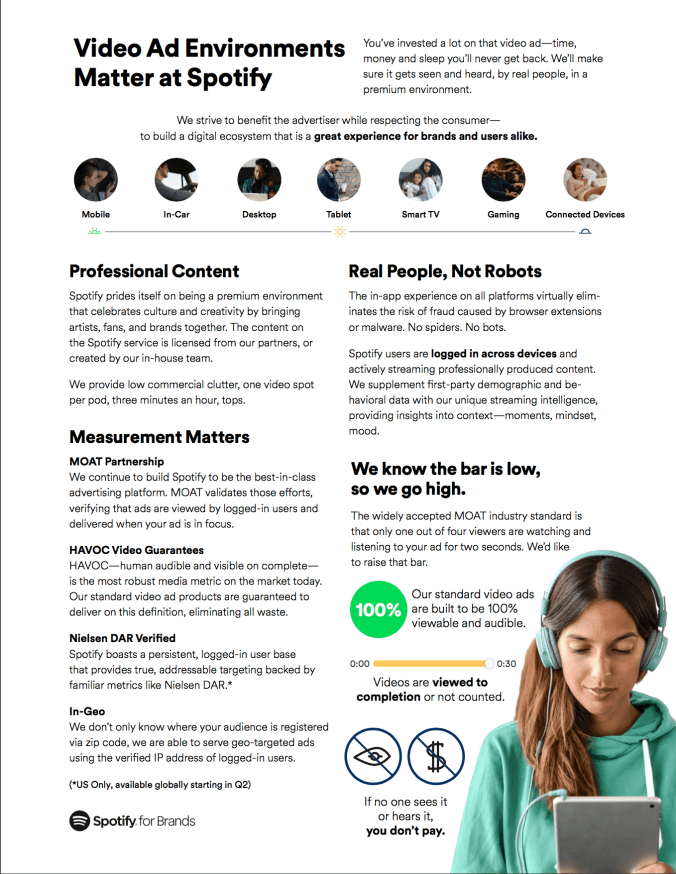
  4. Standards are about to shoot up. At Spotify we sell all video with Moat HAVOC standards – Human, Audio, Video, on complete. Our ads deliver 100% SOV, 95+% viewability. See these as becoming standard.
We are entering a new dawn for digital advertising, the question is whether everyone goes back to sleep or decides to get up and out. Take the opportunity to make our industry a better place.

Adblocking -please advertise responsibly

Ad-blocking, is now in its next chapter. The converted network in the form of Three is going to banish ads en masse. We have lived through a number of chapters in this story, we are reading fast because it is such a page-turner and on a panel a week or so ago I was asked a number of good questions.

The first was why had we taken so long to wake up to the issue when ad-blockers had been around for some time. The second was “what are we actually going to do about it?” and finally a question about what advertisers think. The questions raised some good points because right now the whole industry is standing around admiring the problem with little visible action.

Let’s start with the advertisers, why are they not up in arms on this topic? Well the answer is that it has not affected them, as far as they can see. They ask for media and they get media, often at a lower price than last year so everything is rosy. The mobile network Three’s partnership with the ad-blocker Shine might start a trend that means the only feasible answer is restricting inventory and increasing pricing. Advertisers will then find the cost of their digital ads goes up. When you see that six months after bringing in new rules on its exchange Appnexus has reduced traffic by 90 per cent, you start to see the potential impact if you clean up ad fraud and restrict eyeballs.

I believe we did not notice the problem until other businesses started to make money out of the problem. Not unlike the earliest protection racket that started up around the olive groves of Sicily, once it was clear that there was money to be paid the topic was widely distributed by the aforementioned racketeers, sorry ad-blocking companies. Since then, ad-blocking has seeped into the common consciousness appearing in articles, films and more. In fact as Caspar Schlickum of Xaxis said, we basically brought it upon ourselves by talking about it so much.

We are now admiring the problem from every angle like a fine work of art. Yet this is an industry issue like no other we have had before. This is an issue to end the industry and we need to create a collective approach to the problem. We have to do something on the scale of the alcohol industry. “Please drink responsibly” needs to change to “please advertise responsibly”. We need to get behind a body of people capable of creating change.

image: http://offlinehbpl.hbpl.co.uk/news/OMC/richedit/DrinkResponsibility.jpg

Advertising needs its own version of the ‘drink responsibly’ industry effort

The question is who is going to put their hand up? The Internet Advertising Bureau, IPA, and Advertising Association have to come together to start the ball rolling. Some of that should be official sounding work and some more basic. The easiest example is to all collectively agree to not build certain ads.

The IAB with its “lean” approach is starting with that, but we should all get behind it. There was a time in 2002/3 when pop-ups were banished to whence they came. They were not cool, the sole preserve of gambling and porn companies. In the last few years they have made a return in a big way, but disguised as something more sophisticated. We have to cut them out. None of this is pretty and we have to get on the front foot.

And as a parting remark, I would say it is not helpful that other parts of the business are rubbing their hands together on this topic. Whether it be people working in other media channels like TV who think that people actually like TV ads, when actually they have no choice really, give them an app to dodge TV ads and they will, or creative agencies blaming programmatic. We all have a part to play and it threatens all of us.

One thing we could all do is not allow ad-blocking companies into conferences as the IAB did in the US because the lights that beam on the stage, the food they happily eat in the break, the drinks they consume in the bar afterwards and everything in between is paid for by advertising. For that reason alone they should not be invited.
Read more at http://www.campaignlive.co.uk/article/ad-blocking-end-industry-why-no-one-stepping-change-that/1384789#7uGwk0Qmp1bklfyh.99