My piece in Mediaweek

This was a piece done in Mediaweek which I have transferred onto my blog so as to keep records of what people have been saying..

Mediaweek 01.04.2010 Marco Bertozzi hits a nerve at VivaKi. Article here

Marco Bertozzi, back in the media world after a two-and-a-half-year absence, tells Media Week about his new role as EMEA managing director of VivaKi’s Nerve Centre and what will happen when the lunatics take over the asylum

Marco Bertozzi, managing director EMEA, VivaKi Nerve Centre
Marco Bertozzi doesn’t like being away from his pregnant wife Angelina, global brand manager at Unilever, so he got up at 3.30am to fly to a meeting in Madrid and back within a day. But there are no signs of tiredness when he meets Media Week the following day; the only glitch is the fact he hasn’t been warned he will have his picture taken. “I would have worn a suit,” he grumbles.

But then, as Media Week points out, he would look like a City boy, and that isn’t his style. A City boy wouldn’t order a pint of lager just the wrong side of midday, as Bertozzi does as he sits down to talk about his new role at VivaKi, nor would he have staked his career on an intuition that the internet would one day dominate the media landscape, at a time when everyone thought he was “mad and would fail”.

Bertozzi [pronounced Ber-tott-zee] is back in the media world after “ticking some useful career boxes” during a two-and-a-half-year spell at recruitment firm TMP, enticed back to the agency group he first joined in 1996 thanks to an encounter with ZenithOptimedia’s global chief digital officer Fred Joseph, who offered him the role of managing director EMEA of VivaKi’s Nerve Centre division.

The move to “a new job in an old home” felt right, Bertozzi says, because he wanted to pick up the digital thread again, working with leading online publishers – VivaKi has partnerships with Microsoft and Google – and the latest technologies. The basic function of the Nerve Centre is to act as “the Intel chip” inside VivaKi, a future-facing unit that helps the Publicis agencies add value to their clients’ businesses.

The Nerve Centre is more established in the United States, and Bertozzi’s job is to ramp up its presence and investment in the UK, working with digital and management heads across all the Publicis Groupe agencies: Starcom, MediaVest, ZenithOptimedia, Digitas, Denuo and new addition Razorfish. But it is not an agency-within-an-agency; Bertozzi is the Nerve Centre’s only full-time member of staff in the UK, reporting to Curt Hecht, the US-based global president of the Nerve Centre.

Bertozzi explains: “The Nerve Centre is not about creating its own fiefdom; it is about thought leadership. The exciting part of the job for me is working with all the different agencies and people within the group, being in the middle of everything. When people know you they don’t tiptoe around and you get to the root of the issues they are facing far quicker.”

After a “whirlwind” four weeks in the role, Bertozzi has identified two areas to focus on: the US-led Audience on Demand service, which engages with ad exchanges to buy the right type of audience impression in real-time, and VivaKi’s research initiative called The Pool, which works with media owners and clients on “high-end, market-changing research”, such as online video and mobile. Bertozzi says: “The point is to create research that will end up changing the market in response to the answers of that research.”

Early adopter
Bertozzi got into digital as an “instinctive move” back in 1999, when digital was so far off the radar that colleagues emailed Zenith Interactive Solutions, the division founded by Damian Blackden, now EMEA president of digital at OMG, to ask if they could fix their computers. He recalls: “Anyone who got involved in [digital] back then had no knowledge it would be the big thing of the future. TV was the power-base of the agency and I was being promoted, but I couldn’t see myself staying in television.”

Now, of course, Google’s ad revenue has outstripped ITV, and the challenge is to keep up with how technology evolves. Bertozzi started his own blog last autumn, Bertozzi’s Bytesize, purely to understand the digital ecosystem: its viral effect, how people communicate and where the traffic is coming from. He says: “The audience is fragmenting and there are more and more ways of communicating with consumers. The way we plan and buy media, particularly digital media, has to change, because it is so fragmented and there are so many sites.”

The solution, Bertozzi says, is to solve the “big battleground” around data and how it relates to ad exchanges and targeting. He says: “The right audience delivers the best sales. So the future is about technology that allows you to target people in a more sophisticated way, taking into account previous behaviours and overlaying other data sources. I like to think there isn’t a digital buyer in town who isn’t excited by ad exchanges and that side of the business.”

Meanwhile, mobile has had so many false dawns it remains “strangely unresolved”, says Bertozzi, although he believes it will gain momentum over the next year. And social media is coming out of its box to evolve beyond direct response ads on Facebook to a “more refined” art involving blogging, seeding, generating pools of fans and responding to customer issues. “The purer end of social media – when you properly restructure a client’s communications plan around all the social media channels – is still a challenge and that will continue.”

Coming back to the industry following a tough two years, Bertozzi has observed how the recession has “woken people up” to the fact that everything is business critical. “In tough times like recession, people definitely grow up,” he says. In keeping with the new mood of seriousness, Bertozzi is no longer tempted by lavish industry jollies, preferring to drink in low-key haunts with agency colleagues he has known for years, such as the pre-Christmas reunion of Zenith alumni at the Dudley Arms near Paddington.

So, as someone whose career has grown alongside the internet, going from off-the-radar to the central nerve within 10 years, does he now consider himself the elder statesman of digital? Bertozzi, who turned 38 in January, laughs. “No. But there is some pride in the fact that I got involved in digital before the market had confidence in it, as opposed to all the people who joined when they could see it was not going to go away.”

Later, Bertozzi speaks of the day when “the lunatics run the asylum” – when those people who have grown up with digital take the top media agency roles. Bertozzi, with his 12-year pedigree at Zenith, has the credentials to be an agency chief executive, and if his career continues on the same trajectory, the big promotion could come sooner than he thinks. Publicis bosses would be mad not to consider him

Is Flipboard the first App made for the iPad?

Yes I am addicted to the web and I love Facebook for staying in touch with people as well as a lazy address book and Twitter for sending me through everything I have ever needed to know, and much I didn’t about my business. Since having a child I seem to have only 10 minutes here, 15 minutes there at home and my iPad really fills that gap. It is especially good as you can carry it around when the baby is in a sling – perfect!

I still feel though that I am constantly jumping in and out of apps, looking at facebook, twitter and the rest and also clicking on links and waiting for videos to load, but now that has all changed. Flipboad has arrived. It is what I would describe as the first App made for the iPad with real innovation and thought, its an amazing piece of kit. So amazing that if you try to download and use right now it is overwhelmed with people trying to sign up.

Take a look at this video

It looks slick, it is a brilliant concept, I may never go to any of the other sites again, it makes Tweetdeck look like something from the dark ages and overall shows up the rest of the developer world for being lazy and slow, this should have been created by someone like Facebook or a publishing group or someone who took the iPad seriously.

I wish Flipboard all the best, I love it, and I truely believe this to be the first App made for the iPad

Vivaki Nerve Center launches The Pool video lane

When I started in the Vivaki Nerve Center I had quite a few things on my to do list. One of the most exciting was getting ‘The Pool’ live.

The Pool is a vehicle through which we would bring together advertisers and publishers to participate in a project that would shape the market in whatever field it is concerned with, drive future facing ad formats and hopefully drive revenue on both sides. It was designed to be objective, a consensus approach but based in consumer insight. The Pool started in the US with fantastic results, if you want to read more about it, click here

Video advertising is the subject of choice. Why is that? Well there are some fundamental factors that lead video to be an ideal Lane in any country. Firstly we all know its growing hugely, unstoppable and more and more quality content is migrating to the web which is not being followed by advertising pounds. That leads to the next couple of issues. The ability of publishers to monetise has been difficult due to the constant erosion of pricing and lack of research to prove it works and secondly it’s a chaotic ad market in terms of formats. If you work on the basis of 50-60% of TV ad pounds go against a 30sec Ad it’s easy to ramp up investment rapidly. Anyone who has done video advertising knows there are too many formats, too many creative approaches and publishers all have their own model. The Pool aims to solve that.

Tomorrow sees the launch to all the major publishers in the UK of The Pool Lane 1 in the UK, Long form video. Vivaki Nerve Center with close collaboration from ZenithOptimedia and Starcom will be aiming to get publishers on board with the project to find the single best Ad format for video across a range of categories of results. Once on board we will work through field research and with the help of clients to identify the winning Ad format.

It’s an exciting project and I hope very high profile, the end result should be a win for the publishers, a win for the advertisers and a win for the agencies in the Vivaki groupe. I hope by the end of this there will be a model that becomes second nature to planners and allows scalable spend in video which has to be a good thing.

I will then be turning my spotlight on mobile. Mobile suffers similar issues if not worse and needs to have a greater industry focus put upon it. The levels of spend in mobile display are appalling when compared with the time spent on mobile devices so I hope in 2011 The Pool approach will drive some great new learnings for mobile.

Pitching has become so time sensitive, there is no time for good ideas.

Pitching is all part of being in an agency, to some extent its the best part, the thrill of the chase, the battleground of the pitch itself and then the exhilaration and pride of a win or the dejection of loss. I am sure the more enlightened clients understand what goes on behind the scenes, but i have a feeling many don’t understand the true reality of the labour that goes on. A large pitch can use up a team of 30+ people, working night and day for three weeks to deliver the final product – do all clients understand that?

What has changed over time has been the length of the pitch presentations, some even very large pitches have now fallen to a time scale of 1 hour for even a large account. Many people will tell you that if you can’t get your good idea across in that time then it can’t be that good an idea, I disagree. Some ideas need explaining as do some concepts, especially around the new battle grounds in digital and 40 slides is not enough to bring that to life. I think a major pitch should afford the competing agencies the time to genuinely deliver ideas, if more time was spent, I think more would come out of the pitches, more questions asked and therefore more of a sense of the agency.

The problem comes when often the advertiser cant seem to be able to knock people out of the process at different stages, I have been in processes where there were still 5 or 6 agencies in at the end, that strikes of a complete lack of decision-making from a clients perspective and is not the right way to approach things – have less people in at the final stage and give them longer to present, that’s a good model.

If you have to cover, buying, digital, strategies, responses to briefs, creds and many other areas you will not get enough time in, I think they should get down to 2 for a final stage and then do a Boot camp process where the clients get to spend some decent time with the teams, after all we could be talking about a 100m budget, spend some time and get to know the agency strategies and ideas in detail, then make a decision.

I should add though, agencies on the whole do a great job of these situations, I would like to see them get a better chance to shine.

Cannes Lions Festival – You dream it, we deliver it

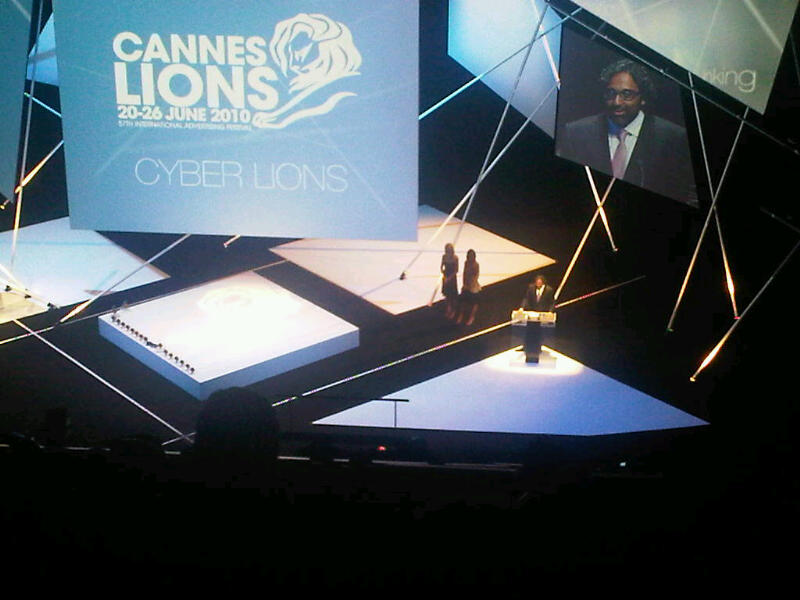
Monday to Thursday was the plan, but then work got in the way! So instead we went for a Tuesday afternoon flight, one that I of course missed by one minute, one minute that cost me 8 hours! I eventually arrived via Amsterdam and immediately got out into the thick of the event, it’s an impressive set up, there are not many places where you can meet up with all of your work colleagues from across the industry in one single city which is buzzing with both work and play conversations.

Down at the Gala event it was heaving with people from across the business, the business being very varied. Media groups, advertising groups, content companies, digital, film, music you name it, all here. A lot of drunken idiots as well to be fair, in fact some people were such imbeciles I was amazed they had been let in the country!

It was a fantastic evening, I met with Christian and Kate from AOL at their own party on a roof top, very civilized and a great ease into the evening, obviously as a reciprocal arrangement from zeitgeist, who should I see there but Damian Burns, Global Head of Agency Relations and Ben Faes from Google. Later in the evening there was Tom George from MEC, Stephen Haines from Facebook and a few other golden oldies. Although of course most of the talk is social, there is some interesting conversations about what has been seen and heard during the day. Apparently the Ben Stiller/Yahoo event was a little weird and did not entirely work, that said by then we outside the cleverly Yahoo sponsored ‘gutter bar’ which was the end destination most evenings and stayed open until way beyond you should have been in bed, luckily it was next to the Martinez where I was staying, so that worked!

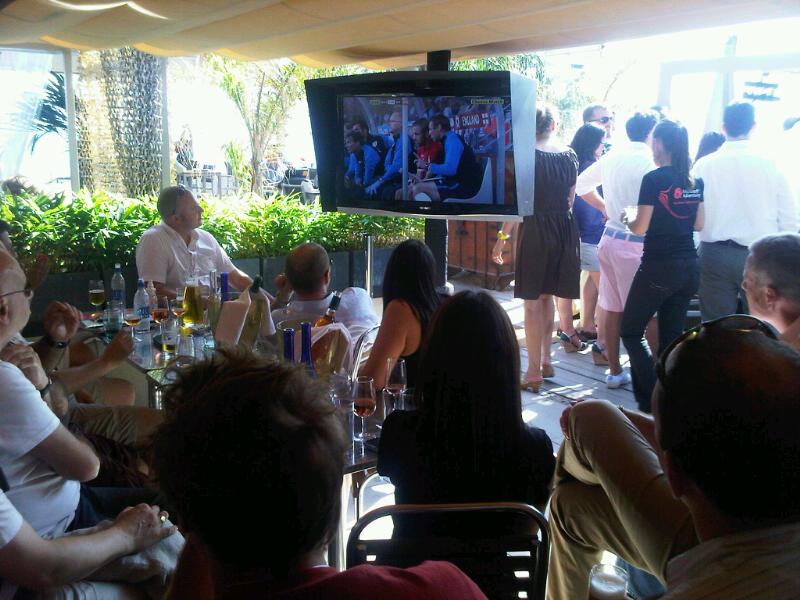
The next morning after 2.5hrs of sleep Vivaki and Microsoft had their ‘steering committee’ meeting which lasted for some hours and covered the state of the nation between our two companies, an interesting meeting with some grand ambition which I am looking forward to working on in the coming months. After a lovely lunch a couple of meetings around ad exchanges (my topic of choice at the moment) and then on to the football. Microsoft hosted a great event with all of the UK people seemingly choosing their beach club to watch, great atmosphere not least as the US were playing and the Americans were getting very excited about their game too, we exchanged cheers through the afternoon, although i suspect they were less sure what they were cheering for!

Later at the awards I took my seat, waiting to see what award winning work looked like, there was some great stuff, I loved the recruitment work from one agency that distributed a calendar with a resignation letter for each day, waiting for the day you had had enough. The Aides campaign from TBWA France was also the rudest thing I have seen on the web, a willy chasing a vagina round a homepage and eventually having sex once safely inside a condom was pretty risqué, but brilliantly done.

All the winners can be seen here

An evening spent with Google was very entertaining and good to be on the inside when they win a big lawsuit with CBS! It also appears that I was sat down to one of the men who has contributed most to the uk digital scene, our own Bruce Daisley, winner the next night at the NMA awards for the accolade. I am very pleased, if disbelieving for the lad, he is a great practitioner and a great guy, he is just no good at hosting jollies as he reminded me of our jaunt to Germany for the football.

The next morning I got the chance to see the Microsoft Experience centre, packed full of their three screens, windows 7 phone, Xbox and Kinect. All of them looked amazing and full of potential for an advertiser. As I went round though It just reminded me of how little of this stuff the average planner or advertiser has seen or experienced. There is a gap between the possibility and the reality, I don’t think advertisers see how a touch sensitive table could drive their crm or sales. The Xbox is a home entertainment system with connectivity, content and games, do advertisers see this? I don’t think so and even worse I don’t think the agency folk are much better. If you get a chance go experience it!

As my trip came to an end and I got a chance to catch up with some other agency friends on the way home I thought to myself what a fantastic event, yes there is a lot of fun and drink and socializing but it’s a chance to bring a lot of very interesting people together and the opportunity to see some great work and technology.

A 4 hour delay on the way back, rounded the whole trip off. Thanks to Microsoft, sorry I did not make it on your video blog, I must have been as dull as my blog. When I got home I had an iPhone 4 waiting for me, that’s my next post..

Au Revoir

The iPad is fantastic.

People said it would change the way we computed, it does, it makes me think the laptop is a bother to open! In fact I am now walking around with my 3 week old in a sling and typing this, could never do that on a laptop.

Publishers need to change though, they are not taking advantage of this great piece of kit. It’s more immersive, a more personal experience than the laptop. I can see this rapidly becoming my favourite gadget after the iPhone 4 I am about to buy.

A small criticism is that it does look too much like an iPhone, not sure why it bothers me, but it feels a bit like they could not be bothered to do something different. Anyone seen the new windows phone? It looks new and fresh and I was hoping the iPad would try something new. On top of that I wish some of the mainstream app makers were already geared up to deliver their apps for this, I mean no official Twitter app? No linkedin? Come on these machines are designed for staying in touch and will become the business mans friend so it seems strange.

There is no doubt this has changed the computing landscape and I am sure when the next generations come out the iPad will become evermore versatile. So to those wondering whether to go for it or not, the answer is yes..

Three months in at Vivaki Nerve Center

Why does the Nerve Center exist? Lots of people want to know that. I have just come from a week of meetings with journalists and have been asked the very same thing. Well let’s look at the three months that have just passed. The iPad has launched, the new iPhone announced, iAds were launched, iLevel went bust, News Corp put up firewalls, The Windows 7 phone is around the corner, the Google Phone started to sell and on and on…this is the reason the Vivaki Nerve Center exists and why any major Advertising group needs something like it.

All agency brands are being challenged to be future facing and think about the larger digital world we are living in. Day to day in an agency it is easy to be swamped by either new business pitches or the demands of the average client and suddenly that plan to do a global deal with a publisher falls by the wayside! Also its not always necessary to reinvent the wheel everytime. It is beneficial to have a body of people focused only on the longer term and delivering solutions that satisfy those longer term goals.

The Nerve Center is focused on four key strands that cover technology and platforms within the media landscape, global partnerships, innovation and efficiencies in certain disciplines. It’s exciting times, in technology and platforms I am working on the Ad exchange solution for Vivaki called Audience on Demand, I work closely with Microsoft and Google in relation to our partnerships and am close to launching The Pool in the UK, a research and productisation project that I hope will change the video marketplace in the UK.

It’s taken time for the organization to take hold and become more structured but we are getting there and the one thing that is most exciting is the ambition. The city has recently highlighted Publicis as the most digital and forward thinking agency Group and that’s on the back of the ambition that started the VNC. There are detractors of course, change comes with a price and I understand that but it’s very exciting and feels like being in the centre of the digital revolution as it happens, my role will be to make it ever more real and valuable in the eyes of the Vivaki agencies and I am already enjoying that day to day.

Three months in it’s been a fascinating journey, looking forward to the rest..

The birth of my son Alexander Jack Bertozzi

As most of you will know I normally reserve these pages for rambling about digital and media and occasionally some things outside of that. Today I want to write about the birth of my son.

Don’t worry not the details, those are impossible to impart, intensely private and in some cases X rated in terms of the experience. The feelings pre, during and post birth can only be understood by the two of you and so the idea of blogging about that is pointless.

No, today I wanted to just write down my appreciation of the NHS and in particular St George’s hospital in Tooting. Its a big hospital, its chaotic, sprawling and yet the service they have provided has been exceptional. I sometimes struggle to work out how all those moving parts work together, how can they keep track of everything, stay in the know when it comes to all the patients, but they do.

More than that they care, of course there are the odd ones who are less good but that goes for anywhere, but generally they were helpful, attentive and went beyond the call of duty and for that I am grateful, its all a pretty scary experience.

Not that long ago my Dad nearly died and the care he received was second to none, it was out of this world and the amount of attention was staggering, all to save my dad. A never more stressful situation have I been in than during that experience and now the birth of my son and in both cases they keep you sane and work in your best interests, constantly reassuring, explaining and making the experience as positive as it can be.

My only criticism is the level of arse covering they do now to not be sued but thats no their fault as ours. So yes I join the long list of people who say pay the nurses and doctors more and go shaft a couple of bankers.

Thanks St George’s.

Welcome Alexander Jack Bertozzi 3.29am 24/5/10

My Q & A with Exchangewire on Ad Exchanges / Agency models

Marco Bertozzi is the Managing Director, EMEA, VivaKi Nerve Center. Vivaki is a strategic unit within Publicis Groupe that helps agencies leverage the scale of the group’s media and digital operations to improve campaign performance for its clients. Marco took time this week to speak to ExchangeWire about the Vivaki operation in more detail, the industry’s move to automated audience-buying, and the evolution of the agency model.

There’s much confusion about what Vivaki does? Is it buying platform? Is it a crack exchange trading unit? Can you explain the Vivaki proposition in more detail?

MB: Vivaki is the strategic entity created by Publicis Groupe to leverage the combined scale of its media and digital operations, which represent nearly $60 billion dollars in global ad spend and influence. VivaKi aggregates the marketplace influence of five autonomous brands, including: two global media agencies, Starcom MediaVest Group and ZenithOptimedia; two leading digital marketing agencies, Digitas and Razorfish; and a premiere futures practice, Denuo.

On behalf of its agency brands and their clients, VivaKi faces the market to help identify and build technology, message distribution, audience aggregation and content solutions for the future. VivaKi also includes a “Talent & Transformation Practice”, which leverages the scale of the VivaKi brands to develop and deliver tools and approaches designed to attract, develop, train, motivate and reward the world’s best people.

Sitting at the core of VivaKi is the VivaKi Nerve Center, which serves as a think tank, R&D centre and testing ground to activate new pathways for clients to connect with consumers in an increasingly digital world.

The key objective of the VivaKi Nerve Center is to help deliver better solutions for our clients as the marketing landscape continues to evolve and accelerate at a fast pace, collaboration within the VivaKi family, and across the Groupe, is essential.

To succeed in our mission, the Nerve Center will focus on some key areas to empower our VivaKi agency teams and clients:

Global Platforms & Products: Developing global platforms and proprietary products that help our agencies differentiate and compete in the marketplace. Products will be supported by an advanced underlying technology and data infrastructure that delivers speed and scale.
Industry-Leading Partnerships: Creating strategic global partnerships that provide tangible value for our clients and partners, while differentiating against the competition.

Innovation & Thought Leadership: Investing in innovation and next generation emerging opportunities, like The Pool, which will validate our leadership position in the marketplace.

Our ad exchange solution is called Audience on Demand and is therefore a key strand in the global platforms and products category above and indeed innovation. It’s one of the most exciting areas to touch all agency groups in recent years and needs to have a defined and aggressive focus put upon it. Vivaki Nerve Center has worked very collaboratively with the brands in delivering the Audience on Demand platform to their clients. We are live with Audience on Demand and really excited by the performance of the solution.

Can you elaborate a little more on your role within Vivaki?

MB: My role in is Managing Director of The Vivaki Nerve Center in the EMEA. I report into the Global President of the VNC, Curt Hecht. The VNC has made significant progress in the US and my role is to work closely with the brand management and digital teams to establish how the VNC can help them in delivering the future-facing digital solutions that our clients are asking for everyday. Ad exchange trading through Audience on Demand is a significant area of work for me.

What’s your perspective on automated trading and audience buying through exchanges and other demand sources?

MB: I have been blown away by it. I may be biased and perhaps my background lends itself to making this exciting to me but when you see the potential of automated buying you can’t help but be impressed. It’s worth saying that automated buying is a little misleading. It requires clever optimisation strategies and insights that the agencies need to lead through talented people. I would not want people to think that you a press a button and it’s all done. Anyone who thought search bidding would be automated would testify that is not the case – it is search bidding times ten so definitely not just automated.

The trading platform allows you to target exactly the individuals you want at the price you want. You are buying one impression at a time which makes a CPM approach look outdated although it is not the death of the CPM buy just yet, not least because media auditors would not know what to judge us on! I believe it will ask questions of every agency trading model to some extent or another. It will also challenge auditors to stop judging agencies on an arbitrary discount off a pool metrics, and force everyone to consider more performance related contracts. I think for now it lends itself more easily towards the performance models but down the line I can see far more being traded through this method.

Do you think that large European holding companies like Publicis are now seeing ad exchanges as an efficient channel to buy ad inventory?

MB: I think the large network groups get a hard time for not changing enough and being slow to react. In some ways that may be true but agencies today are very different to those of 15 years ago. They have completely transformed: agencies realise change is inherent in what they must deliver year in year out.

Ad exchanges are just another media / trading / targeting opportunity that have come along, and agencies will embrace it and make the most out of it on behalf of their clients. My experience so far is that all the groups see the benefits of it but that will vary by group as some are more advanced than others. You will see who believes in it the most by how quickly they grow their ad exchange spend because once you start to see the results, clients and agencies alike will want to move their budgets into new the model.

Do you think that trading on ad exchanges makes it easier to leverage agency and client data to deliver better campaign performance?

MB: Trading on ad exchanges will allow data to become more important but actually it’s not the exchanges where the benefit lies but with the use of DSPs like Audience on Demand. It is this technology that allows us to best use data to enhance the performance of campaigns and target only those users that are most likely to deliver a beneficial response for our clients.

The combination of our clients being able to retarget their visitors but on a much larger scale with the introduction of third party data means we can turbo-charge our schedules to deliver at the right cost and at the right level of volume. Those third party vendors need to move quickly over here. We already have demand and they are a little slow to get going. I was pleased to see Phil moving from Yahoo to Quantcast, perhaps a sign of things to come.

Does Publicis have an exchange strategy for Europe, and if so will this be headed up by Vivaki? Are there plans to devote more resource to developing this area of the business?

MB: This is not a UK or US only market place. It will become important across all major markets so of course we will grow our business in those countries. Many of our major European markets are already testing different models and gaining from the insights. Vivaki Nerve Center will take the route that drives the consistency and ability to learn as a group and not at a country/agency level. We are in the very formative stages of this area so it’s important we all learn from each other.

Resources will evolve over time. Some people will re-skill into this area, some will be recruited. But we have time yet to get into that. Rest assured though that the number of people working in this area will grow substantially!

What do you think are the key difficulties in moving an agency toward automated media buying? Is it the lack of technology and data skills that exist within the agencies? Or is it a lack of technology?

MB: It’s not a technology issue. We have the technology and it works. I am sure all of our competitors have their technology too. Some will work better than others perhaps, but generally I don’t see that as an issue. Technology should not be the differentiator for agencies, it’s the people behind it and what it delivers that counts. Clients do not want pitches where we all get our technology out and wave it about; they want to see insights and results.

In Vivaki there are pools of people who understand this new area and those that know less about it but is that not always the way? Over time we will train people and recruit people so that we have the right level of understanding and evangelism in the business. Look how agencies changed around search. We had the same discussions back then and we now have these amazing skill sets around search in the agencies, so I don’t really see too many issues. If you think the opportunity is a good one, you can make things happen.

Do you think the arrival of DSPs into the European market will help agencies bridge this technology and skills gap?

MB: DSPs will allow agencies to build campaigns across multiple ad exchanges, create data pools, and control frequency etc across the whole playing field rather than at a site or network level. They will also provide us with the largest search area when we are trying to find the elusive consumers who have visited our client sites previously. DSPs are enablers so of course it’s a great innovation in the marketplace globally.

I would say that I believe a true DSP is one that’s only interest is in providing technology to do all the above. It should not to try to resell inventory or have morphed from an ad network. There are many blaggers out there and it’s important that people choose carefully in who they work with as you may discover that the systems they provide are not as future-facing as you thought. The market place is very grey around the edges!

What’s your view on real-time bidding? Is it a game changer for the display market? Or are there still fundamental problems that need to be worked through (such as the computational costs) before we see the benefits?

MB: It works. Our campaigns are delivering great results on the RTB strands of the campaigns. I think RTB will be affected by many different elements not least volume of competition, which will only increase. But this is where the clever use of data helps you in RTB: only you know what is deemed a valuable cookie. Hence you will be bidding on it, not the rest of the world. This is different to search where everyone knows that if you bid on home insurance you will sell insurance. This is a huge benefit for ad trading – the agency knows who is valuable not the publisher telling us what is valuable.

Overall I believe that RTB will be a game changer. Suddenly impressions are valuable again in the volume game. Interestingly though, they are valuable from a data perspective and not so much from a context /channel perspective. The rules have changed. What’s premium now?

How do you see the European exchange space developing over the next twelve months?

MB: I think you will see many of the major players in the US getting people on the ground here to push into big European markets. The ecosystem is developing rapidly in Europe, and it will not be any different than the US. There are already companies up and running in Europe, providing ad serving and other services, and they will try to steal a march in these markets. The DSP pure players will soon be driving a more objective approach across Europe. I also think we will see the likes of Google really ramping up in the markets here, which in itself will drive liquidity.

Thanks to Google Zeitgeist

I just wanted to post an official Thanks to Google for their world beating Google Zeitgeist conference. The level of delivery, the speakers, venues and thinking really put almost all other events to shame.

Just take a look at the schedule for the two days click here

The quality of content was fabulous and the discussions expectantly lively at times, I particularly liked the ‘Zappos’ vs Alcatel debate, it was ready to kick off I thought, good fun though! That said after all of those illustrious people, who came out on top? Boris Johnson, amazing orator, funny, informative and I know that everyone to a man thought he stole the show, even the Google founders could not deliver that level of interaction with the audience. See all the vidoes here:

These events are fascinating, there are some very aggressive networkers. People talk about ad exchange technology delivering Ads in a second, at these events, people can look at your badge and decide if they want to talk to you even quicker! I am no good at it, too obvious, I think I need glasses although Google were kind enough to make the names pretty big! A lot of cards were exchanged, polite coffees and drinks consumed and many different languages spoken, that’s the beauty of these events. Normally Google do not showcase any of their own wares but due to popular demand they walked us through Google Squared, Search, Youtube Disco, Mobile, Maps and Gmail and I think everyone was taken back by how much stuff they have up their sleeve but don’t talk about excessively. After what I saw yesterday I think they should strut their stuff a little more, because its good…take a look at Youtube Disco here just add an artist.

I think this sort of event is one others can only aspire to, but I hope they catch on, especially the handing out Nexus Ones at the end! My over-riding image though was leaving at the end and walking to the exit to see what can only be described as an army of men in black suits next to fleets of Mercedes and BMWs, clearly not many people like to drive themselves anymore!

Anyway thanks to Damian and the team, much appreciated!