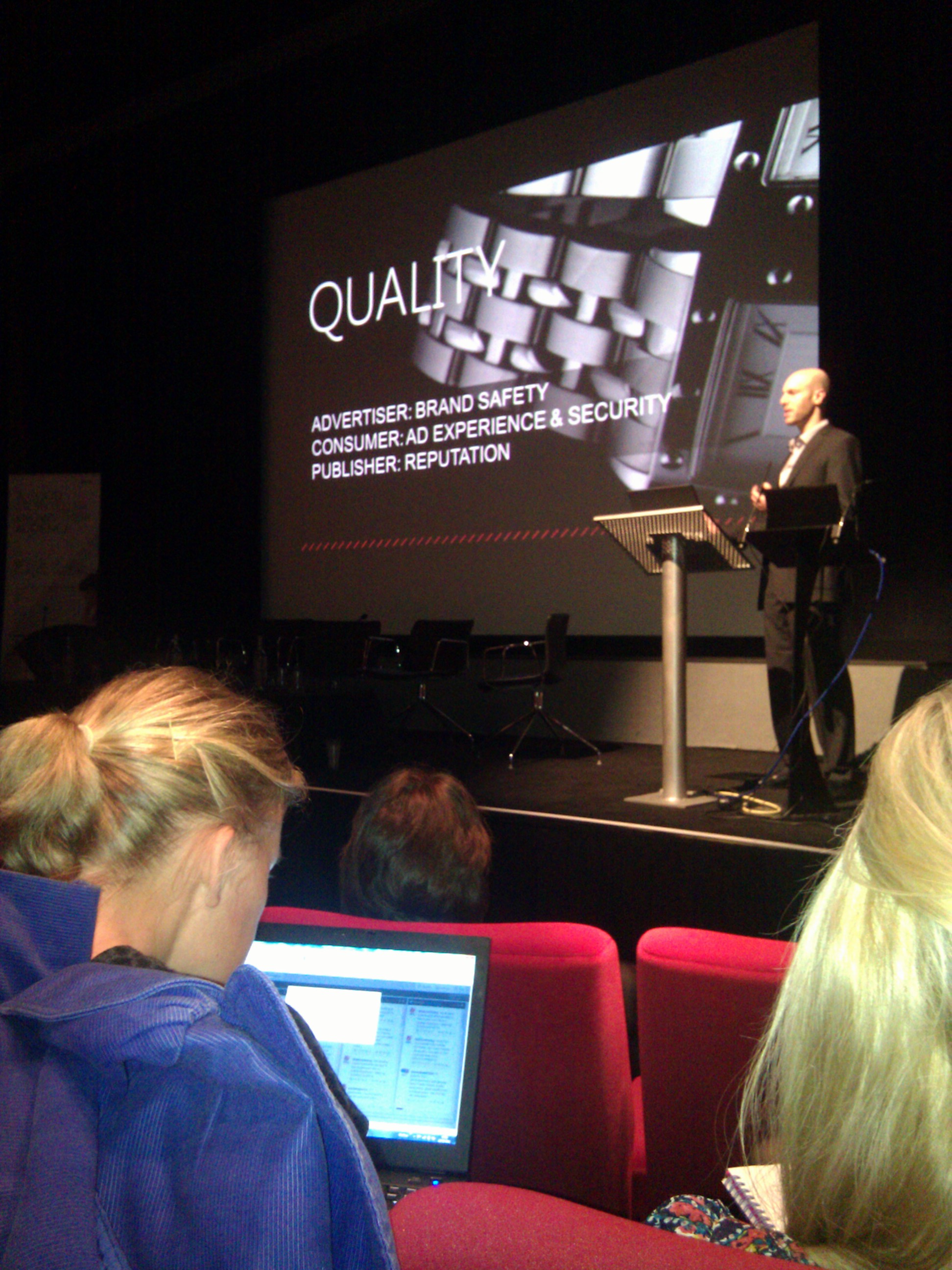
My piece in Exchangewire on AOD going mobile

Marco Bertozzi Discusses The Vivaki Mobile Partnership With Google, RTB In Mobile And The Rollout In Europe
Posted: November 10th, 2011 | Author: ExchangeWire

Marco Bertozzi is Managing Director EMEA at Vivaki Nerve Center. Here he discusses the Vivaki mobile partnership with Google, RTB in mobile and how to execute mobile buys as well as track performance without the cookie.

Can you give some overview on the recently announced mobile partnership with Google?

In November 2010 we renewed a long-standing partnership with Google, and in doing so we announced our intention to scale video and mobile display advertising on Audience on Demand™ (AOD). Over the past summer we have successfully beta-tested AOD video with a number of major clients and launched this in market a couple of weeks ago.

The latest announcement signals the advent of AOD mobile and initially means AOD will be given access to AdMob mobile advertising inventory through Google’s DoubleClick Ad Exchange. As AdMob publishers and developers make their inventory available on the DoubleClick Ad Exchange, AOD, which has been testing the new model, will be able to buy the mobile ads for marketers in real time. The ads will run inside mobile games, news apps and content.

It will help us deliver the AOD standard to our agency’s clients as we bring mobile to scale, and will provide us with unprecedented insight into the operational elements, targeting, the creative assets that work best in this environment and importantly how mobile ad serving is embraced by the consumer.

What inventory will you be running campaigns across? Will it all be apps based?

Apps (avia admob) and mobile inventory via DFP are being leveraged in this particular instance. We will also be incorporating additional inventory from other sources, but in the very near term, the focus is on AdX’s new capabilities and gleaning a clean, in-depth understanding of the opportunities it presents for clients.

Does VivaKi see mobile as a pure DR channel?

Not at all. All clients want to reach the right consumer at the right time. Mobile, Video, Display, Search, etc… – all of these have value to clients. It’s our job to help our clients unlock this, which is a fundamental objective of our addressability strategy as an organization. AOD is all about reaching the right people at the right time on the right screen. We have seen clients across all sectors leverage mobile so far, and as we can bring the targeting, trust, and scalability to this addressable side of the mobile marketplace, we expect to continue to see such adoption by all clients.

That being said, we do expect clients with performance-based metrics to be amongst the first to test and develop strong POVs. That has been and will always be their nature. But it does not mean mobile is a DR channel.

Will we see significant volumes of mobile buying from VivaKi in the European market?

Our approach is to connect the buyers (clients) with the sellers (publishers and conduits) in the marketplace as demand warrants. The European marketplace is large and sees variation within different regions – it’s developing for display of all sorts and every market is moving at a different pace. Audience On Demand™ is technically ready to go and we will move as fast as the demand and supply.

I’m anticipating that the UK will pick up very quickly – there is huge demand on all sides so this should be very rapid and I know our AOD teams in France, Spain and the Netherlands are also keen to get going so this should also progress quickly.

The benefit of having a streamlined approach and structure across EMEA is the ability to share learning rapidly and benefit from this. Paul Silver, our Head of Product for AOD UK will be working with other markets to enable fast roll-out.

How are you buying? Will you trade through Invite? Are you buying in real-time? Is that possible?

VivaKi is technology neutral and our primary goal is to support client needs. We recognize that AdX is not the only source for mobile activity and Invite Media is not the only DSP to access mobile inventory and support targeting and campaign management. We are currently in discussions with other inventory sources and platforms to support mobile, which we expect to be available in early 2012.

This is entirely about real-time buying in the mobile space, so yes – it is possible and it is possible at scale with AdX. This is what we’re eager to better understand and see what “truths” we’ve developed on other channels translate to mobile and what new “truths” we uncover.

How difficult it is to target across mobile inventory without a universal cookie? When the cookie is not available, what targeting parameters are you using?

This is something that has been and will continue to be a hurdle relative to other channels. The ideal state that most desire is one where frequency and actions on other channels can inform decisions in the mobile channel. This ideal state is not a reality (yet), though there are means to incorporate insights from other channels to power decisions made on the mobile channel. For example – the context of the page, the geography of the impression, and the time of day are factors common across all channels. We have strong insights about how these factors influence advertising results and we incorporate those into our campaigns on all channels. So although targeting consumers across multiple channels and having each feed the other in real-time isn’t here yet, using what we’ve learned elsewhere to make a smart decision in the mobile channel is something we’re very confident in doing.

Is there still a big issue around tracking campaigns through the mobile channel given the lack of an established mobile ad server?

Tracking in mobile is still a challenge, and every honest participant in this industry will tell you so. The not so honest participant will try to confuse you with where cookies can be set vs. where they cannot be set – it is not at parity with the standard display space. The mobile channel also has the added complexity of the in-app tracking vs. the mobile web tracking, which are at a different places with regards to tracking.

The mobile standards such as the newly released MRAID will go along way with technology providers going down the same path. We are actively working with several partners to develop and also explore best in class solutions that will benefit our advertisers from a tracking and reporting perspective while respecting consumer privacy. We are looking to quickly close this gap so that we can introduce to our clients a standard measure for mobile and scale their use.

Can we expect to see other integrations with other mobile inventory sources, like the Microsoft ad exchange, in the coming months?

Without a doubt – those conversations and opportunities are already happening.

Smart Agencies Understand the Partnership Imperative

In the time I have been writing for this blog, I have worked substantially with Google. The VivaKi Nerve Center are tasked with identifying key partners in their role of being the future facing R&D division of VivaKi. Google are one of our major Partners and because of this I invited Google to write my 100th blog post and to talk about the importance of partnership in this new media landscape that is evolving into a tech driven business rather than just a media one.

Simon Birkenhead of Google, Global Agency Leader for Publicis has kindly submitted the below post and I must thank Simon and the brave Comms team down at Google for letting him loose on my amateur blog!

Smart Agencies understand the Partnership Imperative

In January 2008, Maurice Levy, CEO of Publicis Groupe, and Eric Schmidt, CEO of Google, shook hands on the terrace of the Publicis building overlooking the Arc de Triomphe in Paris. Their agreement, to join forces and partner in the deployment of new digital advertising technologies, kickstarted a radical transformation in the way that large agencies work with technology companies.

For decades agencies have been the masters of delivering effective advertising campaigns at the best possible value for their clients. A key strategy to achieve this was to maintain an arm’s length (some would say, adversarial) relationship with media owners to preserve objectivity and a strong negotiating position. The slow pace of true innovation in traditional media meant there was little pressure for this to change: agencies’ fluency in offline media required little 2-way interaction with media owners beyond discussions over pricing and tactical proposals.

However, the explosive growth of digital marketing over the past decade, and the associated emergence of Silicon Valley’s fast-moving technology companies, has instigated an urgent reappraisal of this adversarial mindset by the leaders of the world’s largest agencies. The increasing importance of data analytics as a key component of agencies’ service offering, combined with the lightning-paced evolution and technical complexity of the new digital marketing platforms, means that a closer working dynamic with technology companies is no longer an experimental initiative, it has become a business imperative.

When Maurice met with Eric in Paris in January 2008, which was also around the time I joined Google, Google’s product suite was largely limited to Search and our display network. Just three and a half years later, the conversations I have with agencies now cover mobile, online video, social, ad exchanges, global ad-serving platforms, rich media advertising, DSPs, analytics, real-time insights tools, data platforms and even enterprise software.

The pace & scale of change is truly mind-blowing:
● In 2008 Search accounted for just 3% of all media investment in the US and Western Europe. Just 3 years later this has tripled to ~9%. In UK, Search now represents at least 15% of all ad spend.
● Android has grown from zero to over 550,000 new activations per day in 3 years and, with iOS, is radically transforming how advertisers can engage with customers through mobile devices
● YouTube now streams 3 billion video views per day, double the volume just 18 months ago
● Facebook, Twitter & Google+ together have close to 1BN users globally, 50% of whom log on every day, half of these through mobiles
● In just 18 months, Ad Exchanges, DSPs and Agency Trading Desks have revolutionized the way display media is bought, challenging the business models for hundreds of existing display networks
● Google announced over 350 major new products or feature changes over the last 12 months alone, an average 7 per week. (To see what these were, visit http://www.google.com/newproducts)

As a Googler, with full access to our internal resources, it is a huge challenge to maintain my own knowledge of all these technologies and the associated opportunities they afford marketers and agencies. For agency account leaders, planners and buyers, who also have to be fluent in a similar suite of products from dozens of other digital companies in addition to all forms of traditional media, it has become truly impossible to remain true media ‘experts’. Every new layer of complexity created by technology evolution creates an even deeper requirement to nurture and build strong external partnerships. As Rishad Tobaccowala of VivaKi recently commented, “The world is too complex and moving too fast for any one company or team to do it all. We need to train people who are cross-bred and hybrid and who are willing to work together.” Tight-knit day-to-day collaboration at account team level with technology companies like Google have now become a necessity for agencies to keep up with all the potential options for connecting advertisers with their customers.

Many advertisers have also come to the same conclusion. A key component of many major media pitches recently has been the requirement for agencies to demonstrate the strength of their partnerships with Google and other players in the digital ecosystem, and how they can use these relationships to deliver additional value to their clients.

Smart agency leaders like Jack Klues, Laura Desmond and Steve King have realised that a close global partnership with Google would help their agencies to stay ahead. Today our global partnerships with VivaKi, Starcom Mediavest and ZenithOptimedia deliver immense value beyond the technology collaboration originally envisaged by Maurice & Eric in January 2008:
● Our industry experts provide deep insights into consumer & market trends that illuminate new consumer engagement opportunities for agencies, enabling their clients to lead rather than follow
● Our display, mobile & video experts work with agencies to create innovative, high impact campaigns for advertisers by pushing the boundaries of what is technologically possible
● Our product managers help agencies to understand and prepare for new marketing opportunities generated by technology change
● The joint research studies we publish each year with agencies deepen our understanding of consumer behaviour in this new digital realm and deliver the proof points needed to encourage advertisers to leverage these new opportunities
● Our training initiatives and digital media certification programmes, covering everyone from the top CEO to entry-level graduates, are helping the agencies to maximise the ROI from their digital campaigns and keep their teams operating efficiently and effectively
● Our ongoing partnership with VivaKi’s Audience on Demand trading desk is helping agencies & their clients to improve the performance of their digital campaigns through superior buying processes.

Yet despite all this, as I talk to agency leaders around the world, both inside & outside of Publicis, I still occasionally get asked what the value is to an agency from working with Google.

Agency leaders who have not yet figured this out, who are not actively encouraging their account teams to build a deep collaborative partnership with Google, may soon discover they are at a significant disadvantage to their competitors in this fast-changing market.

Simon Birkenhead is Google’s Global Business Leader for Publicis Groupe

A week at The VivaKi Nerve Center

A week at The Vivaki Nerve Center

Monday

An early meeting with the WW CEO of ZenithOptimedia to discuss how the market is shaping up and what can be expected of 2012. As the conference season starts I am being pulled in a number of directions to make sure everyone who needs the latest info has it!

Later that morning a call with the boss, Curt Hecht, it’s a about planning stage and we discuss what we need to get done for 2012 and how we will work with the agencies. A lot of progress in 2011 for VivaKi and The VivaKi Nerve Center and so it makes for some great conversations for next year. More than ever we will be a very European organisation which is achievement in itself. a series of meetings with the major EMEA markets all to be planned.

A session on contracts, which seems to take up a lot of time at the moment, but we are making real progress with a number of contracts signed that will help power The Pool, Partnerships and AOD.

End the day back at the WW CEO’s office to finalise some notes for the conference and its my turn to start to prepare for the Exchangewire ATS event where I am on a panel with Nigel Gilbert from Orange, Gurman from MediaIQ, Breadon from AOL, Martin from infectious and hosted by Zuzanna at Microsoft. Will be a good day I am sure.

In the evening, I went to the Appnexus / Microsoft drinks and met with the founder of Appnexus, the new head of Microsoft, Andy Hart and a number of others. Bumped into Jakob of GroupM, always a pleasure and we had a little catch up and then I had to leave for dinner with Quantcast and Exchangewire down at BerryBros.

As usual you learn something on these nights and having spoken to a number of people from other groups, its clear to me that VivaKi are the most integrated and aligned group in this space, working hand and glove with the agencies. I hope over time this pays dividends for us all.

Tuesday – ATS Day

Arriving at the event really makes you see how far things have moved on in the last year. Ciaran’s first one was a big event but this really surpassed itself with 400+ guests. Unfortunately as the day went on it became clear that again it lacked publishers and advertisers. The more I think about this though, the more I think, why should they be there?

Morning sessions were OK but lacked direction, more moderation, different questioners and less keynotes would have improved the morning session. Keynotes fund these events but I feel having Mediamath and Rubicon and Appnexus all doing a turn is perhaps excessive.

Microsoft did a great session, slick presentation and I think surprised everyone, he even presented an Apple Ad, which was the talk of the Twittersphere..

The afternoon panel I was on was billed to be controversial, I knew it would not be, for two reasons. The first is we have said this before and the second is that people in the audience don’t want to stand out and make issues. The bigger these events become the more polite they will become. I had a couple of key themes I wanted to get across around the whole Ad Trading Desks.

1. We are not an Ad Network
2. We will cut back on Ad Network spend
3. We will be aiming to centralise all retargeting and we think it’s the right thing to do
4. We work with a number of DSPs just not in the UK and we know what is what

I made all of these statements as well as suggesting Ad Nets use client data across their campaigns and received no resistance so, if it was not controversial, it was not because of me! Feedback has been that it was too about positioning of each others company etc but you go where the questions take you.

All in all though, a good day, got to catch up with some great people from around the business and generally enjoyed it all.

Wednesday

We march on with an exciting morning meeting with a large European company that is soon to become Vivak’s first VNC Partner in EMEA. We have of course high profile relations with Microsoft and Google as well as other US companies, but this is the first at scale. We worked through the opportunities, what we need to do together and how we can help each other, a great start to Wednesday and we look forward to releasing that news soon.

Later that day, I 100% focused on The Pool. We have been delayed on this but we are ready to go again, very exciting, there is other info on The Pool elsewhere on my blog Later this year I am presenting at the IAB conference on Spain the results of the Spanish Lane and some of the work that’s been going on in the US, I am really excited about the results that have come from this work.

We have three great publisher partners and already two major clients so things are looking great in that regard, there will be more to come on that subject shortly.

The day ends meeting a team of senior Google Product managers who are trying to work with us to provide insight to power Audience On Demand. It’s these meetings that the Google partnership is founded on, not media spend and discounts. It was a really interesting session and we learned alot about what is coming up. Invite will be a very powerful proposition.

Thursday

A quieter day on the meetings and valuable time to catch up. I did meet up with the CEO of Vindico and team who have big ambitions in the UK. We work with them on The Pool and they are a great outfit. Its time we need to get over the control issue around video adserving, we have been through this once with display and its time we moved on when it comes to video. We are used to substandard, early 2000 type tracking and reporting which is not acceptable.

Friday

A chance to discuss everything we have been doing and seeing this week. A morning appointment with a client with a brief to talk them through all the things The Vivaki Nerve Center are working on, went brilliantly and we will be doing some great work I hope. They showed the kind of interest in innovation that makes it all worth while.

A run for the train from glamorous Slough with just enough time to read the placard under the stuffed dog at the station and down to Microsoft to present to their regional scale display teams and talk about the importance of agency trading desks. Quite a turn out and some great questions from the group, I hope we can act on some of the discussions and continue to grow our global partnership.

I end the week with some time to keep up momentum with The Pool, discuss with thepaulsilver the final touches of an exciting launch next week and what I am going to do when he is on holiday!

My 2010 review for Exchangewire on Exchange trading, an agency perspective

End Of Year Review: Marco Bertozzi, Managing Director EMEA at Vivaki, Gives The Agency Perspective On 2010

Posted: December 9th, 2010 | Author: admin | Filed under: Online Advertising | Comments

Exchangewire story here

I first talked about ad exchanges in a pitch in 2008. The DoubleClick ad exchange was either recently launched or due to be. Either way it seemed like the answer everyone in the industry had been looking for: namely, the chance to only buy audience you wanted and move away from buying in the thousands. That principle stands true today and overall the ad exchange trading approach is a successful formula.

The market place has remained pretty static since the late nineties. The industry traded in the same way as every other media channel and it worked quite nicely. When ad exchange trading emerged and became a serious proposition it asked many questions of the roles of agencies, ad networks and brought to life the data practices that had become so prevalent in recent years. 2010 has been an amazing year. The companies and technology on the lips of the media industry now – Invite Media, Turn, BlueKai, DSPs – were not even on the radar here in Europe twelve months ago. It’s incredible how quickly our industry can adapt and I have enjoyed being in thick of it in 2010.

A year in developing an ad exchange proposition

One of the hardest parts of a role such as the development of a new way of trading is gaining trust and buy-in from agency teams. It is actually harder to get traction with a proprietary approach than introducing a third party – see how Group M has struggled with the purchase of 24/7. There has to be proof that something like Audience on Demand can work and beat the competition. Client teams are rightly very defensive of their clients.

In every group you also have of course different agencies with their own approaches and ethos to digital. My challenge with Audience on Demand was to create an offering that worked for each agency and one they felt they could make their own. You have to work with many different opinions but in the case of Vivaki we did that and through that due diligence has come a unified view on how Audience on Demand could look and one of the reasons we have made so much progress. It is great that we have Starcom Mediavest, Zenthoptimedia and Razorfish all involved through consensual means rather than command.

Unique in this arena is the level of attention that needs to be given to data ownership and making sure that we are not buying unsuitable inventory. It’s important that contracts reflect the new world we are living and trading in. Outside of that we need to manage some people’s concerns that ad trading will be the death of the buyer and lead to an automated buying environment. Those concerns are mainly unfounded. Of course as more media is traded in this way it will make agencies more efficient – but take a look at search where we still have teams of people bringing the strategies to life.

The challenges we face in an agency

In considering the challenges we face I have chosen to break up the ad exchange trading proposition into four core areas, people, technology, marketplace and data. Each area has had its own areas of positives and negatives.

People

The challenge with ad trading is that it sits in the display camp. But the execution needs to be with those who are more direct response or search focused – namely those people who enjoy numbers and optimisation. This is not a ‘display’ buy. At the end of the day someone needs to have the skills to make this work and finding those people will be the next battle ground in this market. I fear a repeat of the search market where we competed for talent to the extent that search planners were getting large pay rises after 6 months in the job. We need to avoid a repeat of that by spreading the skill set as much as we can rather than concentrate on a select group of people.

I think there will be a new breed of buyers in this space but they could work across different elements of the same principle – biddable media. Some agencies claim to be employing NASA trained graduates, who could unpick the meaning of life in an instant. I don’t believe this is not a viable strategy for all. Some middle ground is needed here. What skills will be required by agencies? There should be heavy data knowledge, and more analytical than perhaps in the past – but this new breed of buyer shouldn’t be a complete departure. After all, the ad networks have been doing this for years without recruiting from MIT.

Technology

That’s easy! Why do I say it’s easy, well because it is all the same. I can already hear the howls from the baying crowds of technology companies, but fundamentally it’s true. Let’s not hide behind technology. It’s hugely important and exceptionally scientific but unless you have the people to make it work, it’s effectively useless. We work with Invite in the main and they are the leading player in the space now with the backing of Google – and hopefully they will continue to drive innovation. That said we have not won a single piece of business on the back of our technology sell. It’s all about the people and strategy. The most important thing any agency can do is work on the overall integration of the data provided by these systems into the agency’s data warehousing infrastructure. That’s where the value is created not in the individual system itself – and that’s where NASA knowhow comes in!

Ciaran asked me about developments in this space. I think we have been seeing the morphing of companies with a technical core into DSP offerings. That for me is the biggest shift. Real-time-bidding capabilities have also driven this development. As we have seen from results, it really makes a difference to performance and the margins publishers are able to take.

As I mentioned earlier its fascinating watching all the new players come to market. Dataxu, Turn, Mediamath, Appnexus and many others all staking their claims in this space and that battle with continue unabated. On the back of that I hope we will see product improvements to benefit our clients, especially around video and mobile.

Marketplace

Is there inventory or not? There is a lot of exchange inventory that needs to be supplemented with more mainstream inventory, Yahoo already do this. Microsoft has just signed up with Appnexus and there is a ground swell of larger publishers that are starting to hear the whispers that they can make more revenue through exchanges than going to ad networks. Critical mass is key and it is coming fast.

If you were to ask me what has changed in this area I would say that publishers are now considering putting more inventory through exchanges and dipping their toe in the water. Many people talk about the threat to ad networks from agencies – in terms of replicating their model. I am more inclined to believe that publishers are less willing to forsake their remnant and unsold to ad networks, preferring to move inventory into open exchanges.

Scale to compete is another topic of intense debate. Anyone who has run an attribution model on one of their campaigns will see that a number of sites can feature heavily across a number of exposures on a campaign but the last click will often fall to a small list of companies that effectively buy up the web. These networks buy at huge scale and therefore often win the last click battle. That’s not strategy or skill – it is sheer bulk. But it works in our current basic last-click-wins approach to digital. It’s no surprise to find that the ad networks are the largest buyers off the exchanges!

Data

Come back to me next year. There’s been so much talk but little action over the past twelve months. The area of most interest is of course retargeted inventory – first party data rather than third. For the last few years agencies and advertisers have been giving it away to ad networks to make their own campaigns work better. Ad networks were thus able to create greater insights on competing brands. The battle is now on to retrieve that data usage from third parties and keep it between agency and client. One thing that is blatantly clear is the need for a huge shift in data contracts. Client contracts and media owner contracts are going to change as everyone wakes up to the reality of how data is being used.

As for third party data, we are not there yet in Europe. There is little to no decent data on the market. A couple of companies are starting to shape their offerings. Obviously there are those who will sell data but on the back of their media networks. I think we will see some developments in 2011 as US companies come to town but we have some way to go. The greatest challenge is managing the price and value. Up to this point data has been too expensive and has invariably underperformed – so we should see some big improvements next year.

European ad exchange trading

I think that the idea of a group offering across Europe is more than possible, but it remains very complex. I spend much of my time investigating the developments in European markets and trying to understand their individual nuances. Each country has different marketplaces – with some more ready than others. Germany is a particularly entrenched market with some very established publisher relationships and a low use of ad networks. There are big companies in the space such as Weborama, Adjug, Adscale all looking at establishing opportunities. The importance of working with local partners cannot be underestimated if you are to make a success in these different markets – a one-size-fits-all approach will not work.

Conclusions

It’s been a fascinating and exciting year. I have met with some extremely bright companies and people – and I believe that this ad exchange trading tide will change our business more than any other single development. As we move into 2011 – and we see the addition of video and mobile to the automated ad trading mix – the ad exchange space will become even more complete.

As I discussed it will ask questions of many company structures and approaches, people skills and data capabilities but that is the interesting area for me. It will make us all re-evaluate how we work and what our structures and people skill sets should be. I work with great teams in the VivaKi agencies and am fortunate to be able to push on an open door. This innovation requires some elements of trial and error, and we all need to learn together. I would also say we should encourage each other in this space. The more we work together, the better the traction from publishers and data companies, the more we will grow as an industry.

Marco Bertozzi discusses Vivaki/Google deal on exchangewire

Marco Bertozzi Discusses The Renewal Of The Vivaki And Invite Partnership
Posted: November 17th, 2010 | Author: ExchangeWire | Filed under: Ad Exchange, Ad Trading, Agency, Demand Side Platform, Online Advertising, RTB | Comments
Vivaki recently announced it was renewing its partnership with Invite Media. Marco Bertozzi, Managing Director EMEA at Vivaki Nerve Center, spoke to ExchangeWire this week about the implications of the partnership and what we’re likely to see in terms of innovation from Vivaki over the coming months.

FULL ARTICLE ON EXCHANGEWIRE CLICK HERE

Vivaki announced that it is renewing its partnership with Google for another two years. Does this mean that Vivaki will just exclusively use Invite Media to trade inventory? Or is there more to the deal?

MB: As I mentioned in my blog, the best friendships / partnerships come with time. Google and Vivaki have been working together since 2008 and have a close working relationship at a product development level and not just at a media level. It was our collaboration that encouraged them to purchase Invite. On that basis we feel that working with one partner, who in our view is the leader in this space is going to deliver better results than working with a whole range of partners who all have different processes and approaches, we will learn together and they are more likely to work to our needs as we are a large customer of theirs.

All that said of course it is incumbent on us to make sure we have a view on the marketplace and understand different systems. On that basis we have trialled different DSPs so to that extent it is not exclusive. As an aside the deal as you call it, I prefer a partnership as that is closer to the truth, is a Google one, not just an Invite one. Invite are one important part of our discussions.

What effect will the deal have on the European arm of the Vivaki and the Publicis agencies here?

MB: The US has been market leading in many areas of digital and ad exchange trading is no different. They are a good 12 months ahead of the UK in terms of maturity, understanding of the marketplace and scale. Therefore in EMEA we have always benefitted from that forward thinking work from the US and deals like this just add to that and help us mature more quickly in the EMEA markets. I believe this will create for us some very good first mover advantage in the areas we are focusing on such as video and mobile in the exchange space.

In a recent blog post you spoke about how the partnership with Google will focus more on mobile and video. What opportunities does Vivaki see in those channels from the perspective of data-driven ad trading?

MB: We see the whole ecosystem as being display whether its mobile, video or traditional display. The growth in spend is in these areas, the interest from agencies and clients is in this space so for us will come the need to be able to deliver an efficient and targeting solution in the form of exchanges across these different channels. We will want to have data that crosses channels and helps us discover out audience regardless of screen and this partnership will help us get there in the quickest time but at scale. There will always be small PR led partnerships around mobile and video but they are not at scale and often a lot of hot air, our approach is to do it right and to do it at scale.

Will “The Pool” initiative be part of this video and mobile strategy?

MB: The Pool is a slightly different approach where we are identifying the optimum ad format with in the video space. In the UK, Spain, China and US we are well underway with all of that work and it’s exciting to see the results. Although we will not be directly linking these, of course when the video ad exchanges take shape, our Vivaki built ASq model will be part of the formats available on the exchanges. I think more broadly Vivaki and SMG have really owned the video innovation space and so we would see these two areas being complimentary.

What are the key objectives you would like to achieve in the next two years with your renewed partnership with Google? Is it more automation across display, mobile and video?

MB: I think it’s pretty straight forward, we want to work with the Vivaki brands to accelerate all ad exchange trading but most importantly in the space of video and mobile, this will be a key battle ground and we want to be leading the market in this space, our work with Google and Invite will be a big part of this. Let’s not lose sight of why we are looking at all of this though, it’s to target the right audiences, minimise wastage and deliver strong targeting solutions and strong commercial results for our clients.

What currently differentiates Vivaki’s exchange strategy from those of other European holding companies?

MB: We have a purist approach to ad exchange trading and are not looking to create an ad network or exchange right now. The most important development for us is fine tuning the best approach to trading on exchanges and delivering an expertise to our clients, if the focus was on creating a marketplace or network I think the ambition is too centred on margin management and not on the best solutions. On top of that, the sheer scale and experience we now have from the US and more latterly in the UK in particular means we can use that experience to the benefit of our clients. Practical experience over the last 18 months gives us a head start on the other agency groups, some of which are still grappling with technical or organisational issues.

Since joining Vivaki do you think the European exchange space has evolved? Or are we still in the early stages of development?

MB: It’s slow but steady. On the one hand it feels as though everyone is talking about it but then you realise that it’s still very much under radar, I think all the people connected with this industry know each and other and interact, some limited teams in the agencies are aware but generally it’s still nascent. That said I am having more conversations with publishers who are waking up to the possibility that exchanges are an opportunity rather than a threat and that can only be a good thing. We are also slowly seeing the migration of US companies into EMEA but that remains surprisingly slow, so all in all I think things are growing but we are not mainstream yet!

Google and Publicis/Vivaki renew partnership

Oh yes there will be those who start to pick away and question this partnership, some ask what this partnership is about, but you need to start at the start. Maurice Levy set out a strategy for the Groupe to be the leading digital group in the marketplace. He has achieved that ambition, but how do you get a huge organisation to move in one direction? Well firstly you show them you mean business and invest. Look back at what he has done. Maurice bought up Phonevalley in mobile, Performics in search and SEO, the big one was Razorfish and others, this has created no doubt about his intentions. So what else would a digital organisation of this size do?

Well you should have some close friends that are themselves giants of the digital business. Enter Google partnership in 2008 and Microsoft a little later on, both significant relationships, both the first partnerships of their kind and both giving an insight and opportunity to the clients of Vivaki that noone else could offer. This approach make so much sense and cannot be open to criticism.

Now the thing with friendships, the longer they are the more fruitful they are, the partnership with Google is now into its second term and third year. The senior teams in the VNC and digital teams of the group have been working with product and commercial guys from Google in a more integrated and collaborative way for some time and it’s this that drives the value and the reason, you cant undo a long friendship.

The announcement today of the renewal is significant a) because it has been renewed! We have worked well together and we want that relationship to continue and b) our renewal comes at a time when others are just creating their first deals and they are basing them on very spend related terms rather than strategic and product led. These deals are designed to create opportunity for the clients, not deliver a low cpm. Its an exciting space and the VNC will be working closely with Google on creating some of the most advanced strategies around exchange technology in video and mobile so this can only be a good thing.

Read the announcement here

I look forward to working with Google over the next two years and can proudly say that Vivaki really does have a couple of great BFs.

Battle for the living room. Apple vs Windows vs Google.

These three companies are battling it out in a number of arenas, phones, TV, PC/mobile operating systems and each time one of them launches something the others follow, they take turns. Well I was thinking about the launch of the new Windows phone 7 the other day and how it compares to the iPhone and the same thing came back to me..I am all in with Apple, so even if it’s brilliant I won’t get one.

It goes further too, at home I have 3 sets of speakers for Apple, I have Airport Express, an iPad and close to getting Apple TV so if Apple actually allowed me to seamlessly link this all up, which they don’t, then that’s my house completely apple-fied. I am talking hardware and systems I guess, the actual programs and sites they carry whether it be Facebook, Linkedin, Twitter etc should all be universally accessible but the systems that carry them? Some believe that eventually all these platforms will communicate, that consumer pressure will make it so, but I am not so sure. Apple has not bowed to pressure from it’s own customers to get its equipment talking to itself, so what chance getting it to talk with Android or windows. Further proof of this is the fact that Windows Live is aggregating FB feeds and messenger from Yahoo but point blank refuses to include Gtalk.

So actually these brands are not fighting for a phone marketplace, they want your home! Microsoft have the phone, PC and Xbox. The Xbox is basically a home entertainment centre with streaming movies, music, links back to the phone as well as catch up TV and Facebook messenger etc so they have a great foot hold. This all leaves Google without the physical foot hold on your room until that is Google TV. So in a few years I think you will need to choose who your team is, that way you will have a seamlessly linked home and mobile experience.

Question is, which team are you backing? I am in too deep with Apple now so that’s easy, but who knows, maybe Apple will let me pull up my itunes music on my Xbox? No chance!!

NMA piece I contributed to, small coverage for a big subject.

As the online display ad ecosystem continues to evolve, this map of the status quo highlights the essential cogs and major players

Comparing the UK online display ad marketplace of ten years ago with today’s shows how rapidly it has changed, from an exchange of media and money through an ad server to a technologically complex and multi-layered ecosystem. And it’s about to change again.

One of the most talked about developments of the last six months has been Google’s acquisition of Invite Media, a technology firm with a demand-side platform that lets advertisers buy from multiple ad exchanges through one interface, while providing people support services.

While automated buying through ad exchanges has been heralded as a way for advertisers to cherry-pick the most targeted impressions in real time, with publishers avoiding the wastage of bulk buys and getting the highest value for inventory, its success depends on an abundance of buyers and inventory, plus knowing how to define bids.

Infectious Media founder Andy Cocker, highlighting the complexity of what’s currently on offer, warns, “There are around ten companies to which agencies could go to license DSP technology. But unless they know how to bid in a safe and controlled way, and how to use data to buy, they won’t have a good experience.”

For these reasons, development of automated trading has been hesitant. But some media players expect Google’s acquisition to change this. They argue it’s an endorsement of how display trading will develop and that it will help pave the way for much-needed standardisation in an area of technology that’s hugely disparate.

“This space needs to develop as a marketplace. Google buying Invite will only bring sophistication,” says Marco Bertozzi, EMEA MD of Vivaki. “Because it’s so dominant in search, there are a lot of people who start wailing and pulling their hair out, but everyone’s still using DoubleClick. The natural reaction is that it’s a bad thing, but any investment in the space is a good thing.”

Google’s latest acquisition gives it end-to-end capability within the online display ecosystem. It now offers an ad server, ad network, ad exchange and DSP technology. The impact this will have is hotly debated by industry players.

“We’re investing significantly in technologies that are helping to grow the display advertising ecosystem for publishers, agencies and advertisers,” said a Google spokeswoman. “Like our partners, we see enormous potential in this space. Real-time display ad buying, in particular, is delivering significant benefits for all players.”

Yet Jay Stevens, international VP and general manager for The Rubicon Project, which works with publishers to optimise inventory yield, is worried. “Google’s acquisition of Invite represents the last link in that value chain,” he says. “It already controls a digital market through search. If it owns the display landscape as well, it’s monopolisation which will hurt agencies and publishers.”

Full article here http://www.nma.co.uk/features/online-display-map/3018213.article

Google Zeitgeist, inspiration in a day.

There was more passion from the speakers and less from the audience compared to the EMEA version, that was my overriding impression. I expected more whooping but instead found a very reserved audience.

So I missed the first day, by all accounts a roller coaster of a day where the economists depressed everyone and Ted Turner inspired everyone. I arrived in time for dinner and Cirque de Soleil. I was surprised how little enthusiasm there was for the show, people were clapping politely when they should have been going crazy, the Europeans were far more excitable, I thought it was meant to be the other way round! That theme of restraint continued into the next day except for Geoffrey Canada – anyone heard of this guy? No probably not in EMEA, he is a US inspiration, he is a social activist and educator who campaigns for better education for the ethnic minorities with a focus on Harlem.

Geoffrey was one of the best speakers, most entertaining, intelligent and passionate speakers I have seen for some time. I have been to 5 zeitgeist and it was the first time there was a standing ovation, it felt strange for me, a bit like the judges getting up and down for X factor but he deserved it, look him up, there are not many presenters like him.

The crowd did not ask questions, there were limited interactions, in europe they are queuing up, to be fair mainly spanish, Italian opinionated people happy to tackle anything, perhaps the Americans are more respectful and don’t want to challenge everything, the Europeans love it! This was what surprised me the most.

Geoffrey was great. Later in the day Lance Armstrong was on stage, he clearly is an inspiration, I found him a little dull if I am honest, he sparked up when he talked about cycling, part from that it all felt a little emotionless for me, it’s a personal thing but I can’t help but feel when i see famous sportsmen that i want to hear about amazing anecdotes about their sport not their website, albeit a worthy cause. By the way he reconfirmed that he never took performance enhancing drugs, I believe him.

One man who was very impressive was the CEO of Verizon. He runs a company of 120billion dollars and employs 220k people! That is a staggering number of people to be responsible for, he was impressive, very impressive. The shame of the session was he was subjected to banal questions that came from a very subjective perspective. One man stood up and recounted how his wife waded through bills and would it not be easier to simplify the process? To be fair to him, he answered diligently. He was clearly a man who ran a serious business, he joked with Eric Schmidt of Google with a kind of ‘ I know you are big and powerful and Google, but my company is big stuff even against your operation, kind of way.’ That session ended with one man banging on about his contract and how T-mobile did it differently. At last his patience ran out and he tersely replied – we are not T-mobile and shut him down like the annoying man that he was. There is only so much of that shit you need to listen to. I was amazed at how low level, subjective, experience led the questions were, there was not a single weighty question asked of him..strange. By the way 4g is coming in a serious way for Verizon by end of year.

Will.I.am was brilliant. Simply brilliant, these musicians are now so talented in so many other ways, business people, innovators, entrepreneurs. He was very funny, but clearly was leading the way in how to change the music industry. This is a guy who would be happy to shut out the music label industry. He was joined on stage by the CMO from coke which made it feel a little more dirty to me, he was talking a very purist story, it felt diluted by her intervention.

I have gone on for a while now. I want to end on a more serious note. The CEO of Canter Fitzgerald, Howard Lutnick was invited to talk about he coped with 9/11 and the impact it had on his business. Let’s hear the facts. Honestly I can’t remember them all it was too shocking but roughly it was something like this..650 of 900 members of his team were killed. Because he had always encouraged family and friends to be employed by existing employees it was something like 17 sets of brothers and sisters were killed, he lost his own brother..9 years after the event he was still struggling to deliver his speech without tears. The story was unbelievable, his clients rallied to them, the LA office gave up profits to pay for the families of the dead, he ran the business at cost and gave the rest to the families of the dead. It brought tears to everyone’s eyes, it was incredible. I am glad I was there just for that. Read more here

There were no questions after that session.

I found the content and speakers far more inspirational and interesting than the UK this year, they appeared to come with more passion than in the UK and I found myself addicted to what was going on, the only thing that let things down was the audience.

Finally I found the relentless and ruthless networking quite distasteful, the thousand mile stare as they try to see your badge and decide if you are important or not. One thing you realise is just say you have a UK or EMEA role and they switch off, oh, that little island , no, you are not worth anything to me..it’s painfully transparent.

Google Zeitgeist – US experience.

I think I am one of a few people lucky enough to go to both Zeitgeist conferences. I always enjoy the UK experience but to get to go to the US version is a treat. I was only let into the holy experience because I was in the same hotel anyway for a Board meeting of The Vivaki Nerve Center but it does mean I intend to follow very carefully what goes on.

I find myself working with the US more and more in my role, we do truly live in a global world and in many areas they do indeed lead the digital world, not by far but they do, the sheer number of companies operating means there will be faster development in all things technology. Look at the data space, the number of companies that saw the opportunity in the US vs the UK or Europe is significant, even now EMEA is playing a huge catch up game in that space.

So it is with this background that I am excited to be in the heart of thought leadership in the US and will be tweeting and writing up what I see, albeit just one of the two days. Come back for more as I go through the day.