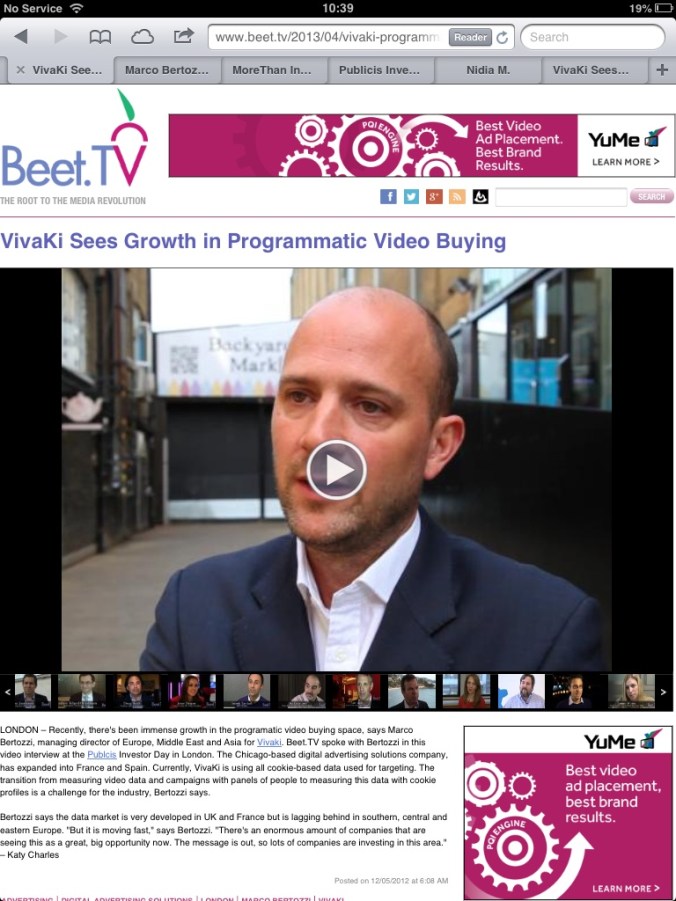
A year is a long time at Google

As I sit wide awake on an American Airlines flight to California, when really I should be sleeping, mainly down to the horrendous ‘Angle flat’ beds I started thinking of the blog I wrote a year ago called ‘A Frictionless Web’

It talked about how Google wanted to streamline the whole cookie process and launch for the first time a ‘true stack’ something that had raised some eyebrows at the time mainly because Google had been excellent in many areas but had been flawed on Doubleclick and bordering on slow in the DSP space after purchase of Invite.

Google presented the new DFA and lots of new brand names like DDM – Doubleclick Digital Marketing, DBM, DC Bide Manager, DS3 and so on. Funny to think back then that even the Google people on stage were struggling to remember to use this terminology rather than good old Invite, DART etc etc. Neal Mohan presented credibly what the future would look like and that it was going to be powerful. At the time I thought, sometimes out loud and to the dislike of the DBM competition that this could really strike a blow to the competitive ecosystem if it turned out to be true.

Fast forward a year. In my opinion a big part of that dream has turned out to be right. Let me start with some of Audience On Demand’s change. We were well known for working with Invite and were heavily crticised for it but we stuck with it, especially as I saw the content of CAB 2012. The London office of AOD, powered by Geoff and Danny migrated all accounts to DBM (we say that now instead of Invite with out reminder!) the London office was and probably still is the largest user of DBM anywhere in the world and that includes the US, that does not happen often with something like DC.

As a result we were the first in the world to use the Search remarketing opportunity where DBM joins seemlessly with DFA and DS3. I cant reveal the results to that as thats my presentation at CAB but we learned an awful lot and that is still a big USP for us in the market as not many people have lined up DBM, DS3. DBM itself had a rocky start but again is now delivering the promise and we are pleased we got out there early and set the pace, working closely with the US team.

Bigger and more ominous for the competition however is that the new DS3 has really started to roll and two big things have happend. The first is that the product itself is good, widely acknowledged to be an improvement on some systems without the extra cost. I have seen across Europe business being returned to them from the companies that jumped in to fill the void of a quality Google product for years. The second is DFA in general has started to win back some lost ground from others in its own right. A good job Facebook bought Atlas as that was literally dead in the waters and amazingly those few major clients who continued to use them had seen the light and were off.

But the real success has been where advertisers or whole agencies are swapping to DS3 and DFA because they are or are about to be heavy users of DBM and want to benefit from the frictionless web. I work with people a year ago who were nowhere near wanting to work with DFA and were proudly using Mediamind or Flashtalking etc and have now switched and are happy. One major advertiser held a pitch right around now this time last year and the Stack solution was sold but was a just a little early with DS3, DBM all untried for them. One year on that shift is well under away. This is the fruits of the Stack and it is pretty compelling, Google in a year has transformed the display sell and regained an incredible amount of ground in such a short period of time.

There is work to be done of course around social tools and dynamic creative but hasn’t everyone? I am looking forward to presenting the amazing work the UK Audience On Demand team have done at this years CAB and hearing the next stage of the revolution. Over to Neal Mohan…

Our latest recruits – Their views, one month in at Audience On Demand

Image

I thought I would ask our three latest recruits, all graduates to give me their view of our industry just one month in. The message is clear, we are big and complex and we love TLAs but that is what makes it fascinating. Backgrounds of economics, maths and marketing show that regardless of diverse backgrounds, all roads lead to RTB! Sorry Real Time Bidding! I am always excited when we have new people joining and so let’s hear from them..

Trisha Halai @trisha_halai

Having done a maths degree I never thought I would see myself taking on a career in the digital advertising industry. After being approached by a recruitment agency and being told about the role and company – I can say I will never look back. My first month has been very much a learning curve and a very interesting one. Understanding the technical aspect of the role in terms of getting to grips with the platform and the systems has been one thing and understanding the hundreds of jargon used in advertising is another. Initially, I was completely thrown back in my first week when I heard acronyms such as DSP, SSP, DFA, DFP, DBM, MPU and PMP to name a few. However, as time has gone on and the more I have heard these terms, they have become second nature to me and now not using them would be slightly absurd.

Coming from a maths background, I developed many transferable skills and I can say I am proud to have the opportunity to apply these analytical, problem solving and logical thinking skills into my current role.   Working in a dynamic and creative industry, one that is so measureable and trackable in every aspect is exciting. It is great to be exposed to the industry at a point where it is constantly changing and advancing. Communicating and building relationships with highly respected technology and data providers and some of the big publishing names as well as agencies is what makes the day-to-day role so varied.

Being part of the AOD team at Vivaki has been an insight in many ways. It is very exciting working in a team that helps brands to deliver strong, highly targeted messages to very niche audiences across many channels such as display, video, mobile and social media. Working in a team that takes great pride in what it does and is passionate about its day-to-day management of campaigns is inspirational.

I look forward to learning new skills and developing a deeper understanding of my current role and I look forward to any challenges I may be faced with in AOD.

Claire Hobson @claireHobs

My first month as a member of the AOD team at VivaKi has been both exciting and eventful. I’ve had the opportunity to meet so many new people and have learnt a great deal about the dynamic industry of digital media in such a short time.

As a Marketing MA graduate, I had developed an interest in digital marketing and was keen to get into this area as a first step in my career. However, I had never come across agency trading desks or real-time bidding and as a result I found the complexity of the real-time bidding ecosystem quite overwhelming when I first started. RTB, DSPs, Ad exchanges, ad networks, ad servers, SSPs, PMPs… it was all like a foreign language to me, particularly with the frequent use of (appropriately named) TLAs.

Four weeks on, what seemed complex to me back then is now much clearer, having benefitted from being amongst the hugely knowledgeable AOD team and from meeting the various external teams that represent the other vital pieces of the RTB puzzle. I have noticed the difference in levels of understanding and views of RTB across these different teams, whether it be media planner/ buyers, publishers, data providers or technology platforms. This has been useful for me to gain a more holistic understanding of how RTB is viewed in the wider media industry and has helped me in developing my own opinions.

Part of the reason why I wanted to work in digital after graduating is that it is an industry that is growing and constantly changing, making for an exciting and fast-paced environment to work in – my first month at VivaKi has definitely confirmed this. However, it has also highlighted that there are often challenges, difficulties and problems to solve around these changes, something that I did not previously fully appreciate but have come to see how this is key to the development of such a dynamic industry.

A good way to sum up my first month is perhaps not to reflect but to look at how it has given me both an eagerness to learn more and a strong desire to be a part of the future of RTB, whether it be in display, mobile, video or even connected TVs. I look forward to my second month at VivaKi in the exciting world of digital media and RTB.

Nick Brown @NickPhBrown

PMP, IO, SSP, DSP, KCT, vCPM, KPI, ABC1, GRP, MPU, RTB are just a bunch of letters… However, I have come in to contact with them such remarkable regularity that I find myself thinking what a laborious task it would be to have a conversation using full, un-acronym-ed words. Since, I started work at VivaKi, the AOD team has performed massive brand blasts, won over some great clients, tested cutting edge industry inventory, even achieved a world first! The list goes on… We work closely with companies like Doubleclick, VisualDNA and large pubs like eBay and Amazon, all to our own varied ends.

Point being, there’s so much to Real Time Bidding; too much to ever come close to having a shrink wrap solution to it. On top of that, it is constantly morphing and progressing. Not only are Mobile and Video making leaps and bounds forwards, but the platforms we work with on a daily basis bring in a whole host of new features almost weekly. It’s a crazy trade to be in and my first month has overwhelmed me with a phenomenal amount of information. I would love to write all about the diverse, highly affable team I’m working in, and on how much fun I’ve had in the many social events that have already taken place but if I tried to it would fill pages and pages. Suffice to say that my first month has been a whirlwind tour of the immense and fascinating world that AOD is right in the centre of: RTB.


Have Publishers learnt from the past?

I was recently prompted to think about the sales policies of publishers when Criteo approached us to buy their inventory through a Criteo network. On the face of it one could argue it would be a good buy for us, potentially unique inventory, sourced through publisher deals that by many peoples opinion is good quality and high up the adserving priorities of the publisher. Obviously after about 1.5 secs I decided I was unlikely to contribute to the clever business model of Criteo by filling their coffers so they can then go pitch direct to our clients and move the business. That is not what this post is about but it set in motion some ideas that I think publishers should consider.

Companies like Criteo, have created a good business and are doing well in their niche but they got there through persuading publishers that they should sell to them quality impressions, in some instances first look, even above direct and brand channels at a low cpm vs those direct channels but high vs the RTB market. They deliver good business for them and everyone is happy.

Problem is that they buy a lot of it and need to get rid of it and so they want other people to buy it from them ie trading desks and potentially Ad networks / Managed DSPs. The demand in the exchanges has increased significantly since many of those deals were done and so cpms for quality inventory like this will likely create a higher cpm than they bought from the publishers. So that means then that trading desks are buying good inventory from Criteo rather than direct from the publisher? Is that what the publisher had in mind when they sold or agreed to the positioning of the sale?

I think it raises questions that publishers yet again have to face, is it better to sell at a flat cpm or find other channels to monetise. A lot of big names are doing this and for me makes no sense, if you want your inventory to be monetised, come see us rather than put us, your direct buyers second to someone who is re selling it to us? It is time to ditch the flat cpm and embrace the auctions and private market places.

We can also offer transparency to the publishers as to how well their inventory is performing and we can partner to create improvements for them and us. The alternative is sell and see no insights. In my view that era has ended. Publishers, come talk to us we can help you with that.

Linkedin etiquette – Why link but not shake?

16-LinkedIn-dos-and-donts-600x337

In the last two days I have had discussions about how to use Linkedin. When I say use I mean the etiquette of connections, why you connect and how you should behave once you have. You always assume everyone is in it for the same reason, but that is not necessarily true as I have found out.

Let me start by summarising my contacts:

Category A: People I know very well either personally or via work, or have worked with over the years pretty closely. Linkedin for me in those cases is a good contact directory as inevitably you lose people’s details over time.

Category B: People I have known, perhaps through work for a short period of time, but none the less they are people I could stop and have a chat with.

Category C: People I have met in a meeting, maybe just the once, but we met. I notice the US visitors have Linkedin before they have left the office many times!

Category D: People I have not met but have heard of along the way and so at least know someone they no and or their company, many times you know what they want before they ask it.

Category E: Randoms.

Of the 1141 contacts I have, I would say about 20-30% are in this camp. It is this category that recently caused some offence with a sensitive sales guy called Lee oh and Joanna and a couple of others. Lee felt that he should comment on his incredulity about the fact that people accept invitations on Linkedin and then don’t respond to emails he sends to that contact. Well a debate started along two lines.

The first was whether you should agree to a connection if you had no real ambition to do business with that person, the second was it was rude not to reply to someone who had written to you. I think the third will soon become how you see Linkedin vs say Facebook and Twitter, but for today I am going to leave that one.

Here was my view that I expressed to their disappointment. I accept Linkedin invitations to almost anyone because I have nothing to hide or keep private like say on Facebook, so as far as I can see, more the merrier, in fact more fool them as they will have to suffer my Twitter updates! In fact the most useful thing about Linkedin is the ability to track people down you don’t know and find out more. It could be an interview, a meeting, a new business pitch, whatever, if they are in your network you can see their details. Therefore the bigger the network, the more likelihood of being about to track them down. Apparently that is seen as being a little negative and cynical, I was surprised to discover this as I assumed everyone did it! Any thoughts?

As for the second debate about contact etiquette the general theme was that you should respond to every in bound email. Well on this I thought that yes in theory you should respond to every email out of politeness but then again, if it is a mass email with limited targeting and thought then absolutely no chance. There are other categories of in bound though that wont get a response. They normally start with ‘I just had a meeting with someone senior in your organisation (add in whoever) who I have know for years (read old school network and good old days club)  and thought we should meet for a coffee. Well you know what, for better or worse I don’t reply to the name dropping approach. Cant stand it. The other blank is anyone who starts with ‘I would like to take you for lunch this Friday type thing’ No. I don’t know you and just because I accepted your Linkedin invite does not mean we can start dating. Too pushy.

So you see there are many reasons for not replying, often the least of them is just straight too busy. It happens to all of us all of the time, people don’t return calls, don’t turn up for meetings and all that, so Lee in my opinion was being a little sensitive and had us all believing that he sends his 1000 copy and paste emails and then waits with bated breath for a reply. You wrote three lines and copied and pasted a couple of times and then pressed a button. Forgive me if I don’t send a carrier pigeon laden with chocolates explaining that I am unable to enter into business with you.  You can always remove me – I will never know!

Communication on Linkedin is the same as everywhere. Make it personalised, well thought out, relevant and well written. Even better find another way to contact me that shows you have put the slightest extra effort into the process if you are really serious. And just for clarity I am still talking Cat E types, the rest I am fine with.

What does everyone else think? Am I being too black and white? Make sure everyone of you replies or I will cry like a baby and post how upset I am that you follow my blog and don’t comment!

In defence of Jargon

It annoys me when people say that our industry uses too much Jargon. Do we? Or do we use shorthand? Do we not all use shorthand in life? Anyone for a BLT? No wrong time of day I would rather a G&T or maybe a JD and coke. I make the point, we all use short hand in our discussions and conversations, I would not describe it as jargon.

I listen to advertisers talking about their business all the time, more jargon than you can shake a stick at! RTB – you want me to say Real time bidding every time? CTR? CPA? Life is too short to say that every time. No where we all go wrong is using them at the wrong time. Conferences, advertiser presentations, these mixed audience scenarios we need to all tread more carefully and explain what we mean.

The ability to explain a complex notion to a crowd that has less experience of your topic is where the art comes into its own. The programmatic buying business is technology obsessed and too focused upon it. It is this that we need to cut out, less the jargon. We should have learned from the past that technology is not the subject, it is what it can create for our advertisers. I met with an advertiser recently outside of our group and he seemed positively relieved as I focused on a more simplified approach to the business and a less techie pitch. As he put his algorithm back to basics manual away he seemed positively lifted.

And this is where Trading Desks can add value, the value of cutting through the jargon and the bullshit. As an advertiser with limited resources focused on this complex marketplace, they are pitched by everyone, each with their own shiny optimisation and algo (shorthand for algorithm) and it is daunting. Our job is to help navigate this world and design strategies that link up all of these marketplaces and technologies. We should focus on the outcomes of jargon, not the jargon itself and slowly for many the jargon will turn into normal day to day shorthand.

Well it is EOD so maybe a G&T?

Google Glasses: don’t take them seriously. Take the tech seriously

I am so tired of seeing articles about Google Glasses from the perspective of a new Apple phone review. Even worse from try hard bloggers talking about the impact it will have on others. These articles are mainly dedicated to increasing traffic. @undrip.

Google glasses will be on sale. It will sell. People will wear them. But does anyone think that Google is planning to compete with Samsung shipping numbers or iPhone sales figures? Do they think their self drive car will be a top seller? No. No.

They are a technology and innovation company, they have people who innovate and they have started with Glasses. Already people are protesting about the fact they may be recorded mid conversation. Perhaps they be used inappropriately, maybe they will be but at a minimum of 1500 dollars they won’t be owned by some delinquent. Even if they were, this is not about Glasses this is about the evolution of technology. It is here, it is happening. It would be like saying that we don’t want the Internet because kids will look at porn. Well if the adults didn’t watch it then it would not be there in the first place.

Whether it is uncomfortable, whether it comes in the form of Google Glasses is neither here nor there. It is technology and you can’t stop it. An analogy was used about a guy on a bus filming stuff on Glasses and then transferring it to text and tagging it to a person and how that was the end of the world. Come on, whatever you do on Glasses you can do on a Nexus 4. I can film on a bus, I don’t need Glasses to do it.

Let’s all stop taking Glasses seriously but take the technology and brains behind it seriously because it is the heady cocktail of those two that will show you up as totally missing the point.