Will digital people ever run the advertising business?

Its funny, back in 2000 when digital took off, the sector was really sidelined in terms of importance, no one really took it seriously, there was no scale, it was specialist. Nearly 12 years later and the world has changed dramatically. Spend has moved from £150m in 2000 to £4billion. Internet has overtaken every media channel, recently overtaking TV. Share of overall spend has increased year on year at a huge rate.

Agency life has been dominated by digital, teams of search, display experts, planners, buyers, mobile experts, Heads of Digital, Digital Strategy Directors, API specialist, and on and on. Its been a revolution. The major agency holding groups are judged amongst other things by the percentage of their revenues derived from digital. Digital is the key battle ground in terms of services.

And yet..take a look at the CVs of all those people leading media agencies and creative agencies in the UK, have a look at Managing Directors and CEOs, COOs and what do they all have in common? None of them come from a background in digital. It’s an interesting fact I think. There is the odd exception, the most notable being Rob Horler and Mark Creighton. Again even there, Rob is in the Group and Mark is COO rather than CEO / MD roles but nevertheless at least they are influencing direction. Of course digital leads are influencing at a board level, its not that they are not heard, but they cant seem to make the next move.

Lets then look at clients – I can’t pretend to know the whole market place but I am pretty sure again that most CMOs and Marketing Directors don’t come from a purist digital background. What implications does this have for digital growth? Should anyone care, it will happen eventually, wont it? Well I think part of the problem is that digital media has always been so implementational – more important to know how to get something to appear on a page than think strategically about whether or not its the right thing for the brief. The generalist, the planner approach is more likely to think more holistically and therefore talk the language of the client. Who owns the client, gets on in most agencies.

I believe that the Head of Digital roles and careers will ultimately always hit a career ceiling until they start to become more generalist and strategic, and get less bogged down in tech and implementation. There are a number of Heads of Digital across the industry – lets see how many progress to MD or CEO of a mainstream agency vs moving out to find their next role. I guess eventually the boundaries will fall and everyone will be digital but that is still some way off.

Trading Desks are in for the long haul, not the sale.

I cant decide where to start on this post, there has been so much going on in the hectic world of ad exchanges in the last few weeks. Top of the bill was an excitable debate between an Audience on Demand employee and a disgruntled DSP. The key issues raised around conflict of interest included agencies being forced to put spend through their trading desks, lack of impartiality etc etc.

Interwoven with this debate was the fact that so many companies are approaching us at the moment, DSPs, Data targeting companies etc all with interesting premises I suppose but all with one thing in common, they all need to make as much money as possible, as fast as possible. Lets talk about conflict of interest..I use the DSP marketplace including Triggit which was involved in the above debate. How many shall we say there are, that are currently aiming for Trading Desk revenues – 4? 5?. Everyone is coming to town, everyone wants a piece of the action, but when they get into town they realise that a couple of those 4/5 have been busy for a few months / years and pretty much wrapped up the business. Its not to say thatagency groups will not test and learn, we do in the US and there is definatley room for more than one or two but for some, the market’s not big enough. What happens then? They need to fight for revenues, they need to say why they are better than each other and especially better than Invite to try and find the big ticket, except I am not sure there is a big ticket at the moment. So then they resort to the last option which is to try and undermine the credibility of a trading desk to try and open up some cracks of opportunity.

The conflict of interest for those guys is they have to make money to keep the VCs happy. The agency group trading desk model is not in the same boat. Audience on Demand’s sole purpose in life is to navigate on behalf of its clients a very complex market place and deliver great results. They are in it for the long haul, they have much more to lose. AOD messes up on a client it can jeopardise the whole business. Yes there is pressure to deliver..but its to deliver results not revenue first and foremost. In a competitive marketplace as the agency landscape is, the more things you do well and right, the more chance you have of retaining the client.

So whats better then? An organisation like Audience on Demand that has a remit to make sure it is working with the best, understanding strengths and weaknesses – and believe me all these tech companies have them – or a heavily invested tech company struggling to make ends meet. Who is actually going to have the interests of the client? I can tell you, it’s us. Anyone who thinks that agencies and clients are naive enough to accept sub standard strategy and results just because its in house is a) clearly lacking in understanding of how an agency works and b) underestimating the clients and Account people. If a client asks about our impartiality we can show them the full vetting we do of all DSPs, I can show them the data compliance methods we have in detail for every supplier, I can show them the results in detail where an acceptable flat cpa or cpc is not acceptable as it encourages the supplier to focus on growing their margin rather than delivering the lowest metric. I will show you 100’s of people who live and breath this space and understand it better than any individual tech company thats trying to undermine it.

Conflict of interest is doing what you have to do to stay afloat in one of the most competitive eras of all digital times vs doing what’s best for our clients. Finally it is always worth analysing who is throwing the mud, its often one of those people who came in to town too late and cant find anywhere to hang their hat.

You think you know me?

I guess it is the same query the celebs have about privacy. If you are public and use social media etc does that mean people should act like they know you, does it give them the right?

Recently I have been doing a lot of interviewing and its amazing how many people will take all the information they could find on you and use it straight to your face. Should this be a surprise to me? I always saw this information as great background and helped me inform a conversation, not repeat it verbatim.

Is it better to say ‘I believe that the future of display will see less Ad networks’ or ‘I read your post and completely agree with that and the three tweets you send about Specific Media’ I think the former? I suppose I can live with that sort of stuff as what else are they meant to read. It’s when they start with the how was the trip to Moscow and is little Alex better now? STOP.

Maybe I am a hypocrite, it’s not even that I have an issue with it per se, its more that I think it’s a better strategy to weave the knowledge in to an interview rather than reveal you spent last night reading everything I had ever written (poor you).

Anyway for the record tonight I am off out with some lovely people off a training course I did in Paris – you remember that one, I wrote about it?

Data: The new Wild West

I have invited Paul Silver – Head of Product, AOD UK to comment on the world of data – here is his first post and the first guest post on my blog. Enjoy.

By the one and only: @thepaulsilver

The 3rd party data space right now reminds me to some degree of The Wild West. As a result of that mad gold rush era, the legacies created were: hastily erected housing, mob rule, vigilante justice, hyper inflated prices….sound famililar?

There has for sometime now been a lot of discussion around 3rd party data for audience targeting. ExchangeWire hosted the first EMEA Data Economy Event in March 2011. The hype seems to be lessening, but the appetite is as strong as ever.

The recent announcement of Xaxis developing a global audience profiling database reaffirms my belief about the synergy between the current data space and The Wild West. Agency Groups, Ad Networks, Data Exchanges, Aggregators – everyone is trying to get a piece of audience data, acquire it if you will (directly or indirectly) to fuel more precisely targeted audience based campaigns. And like the Wild West, I fear this rush for data is creating more confusion, execution of some bad practices whilst fundamentally the core foundations remain sub standard at best.

The upside of this ‘demand rush’ means publishers have more distribution points than ever, that can only be a good thing right? Or does it mean in fact that the more points that data is sold to, the more commoditized it becomes? Is that inevitable?

Some publishers that I have spoken to do not know where to begin when it comes to data monetisation. There is also so much data kicking around that advertisers do not know what to do with it, what to buy in terms of un-deduplicated reach and access, or even begin to understand the complexity around different taxonomies for what could essentially be the same user in the same type of segment. There is also the case of advertisers (and publishers for that matter) not knowing the difference between the types of data: inferred or explicit, lifestyle, interest, intent, social graphs(?), lookalike. The lack of standards and transparency exasperates the problem.

Like the mob rule affect created by the Gold Rush, publishers are increasingly becoming vulnerable too. Large agency groups are starting to wield certain influence in trying to bake data into trading deals. On one hand, publishing groups with limited scale are never really going to make a fortune from selling their data, but its the principle of how that proprietary data exits their businesses that should raise concerns. There is also the case of publishing groups still unaware of what data is being collected on their users from third parties. It is still very common practice for ad networks and certain agency groups to cookie from a creative. It might be pretty high level data in some cases but it’s still data being used to build out data repositories, leveraged for campaign targeting elsewhere.

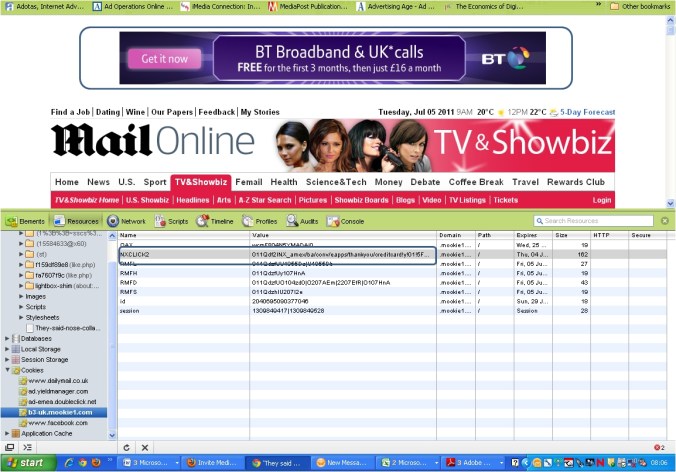
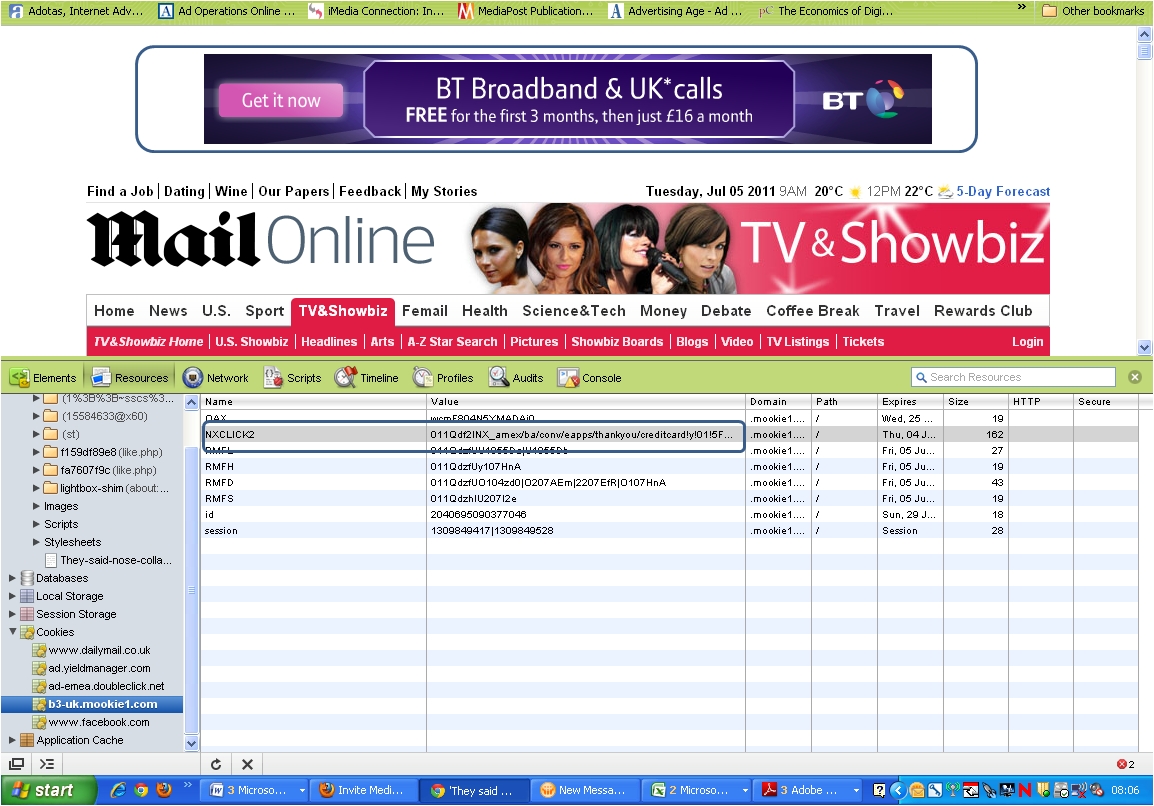
Co-mingling of client data is an old argument; some of which believe to be mythical (one network told me it was not technically possible) whilst some believe it’s still an operational practice today. Either way it’s a practice that carries many sensitivities. An example is outlined below. I recently applied for an AMEX BA Card. I have since been served ads for BT following some recent site visitation. Nothing wrong with that. However what I found odd was the cookie information, that is being directly or indirectly leveraged, includes details of the Amex transaction. I may be wide of the mark of here and as the technology is based on exclusion and inclusion pixelling, maybe it ‘needs’ to know I am an AMEX customer so the rules can be defined to say “dont serve AMEX to this user, serve another ad from the pool”. Or it could be simply using the data they have on me to enrich the targeting parameters of the BT campaign?
As far as the publishers are concerned, yes there are companies such as Krux who exist to protect the publisher’s data, but there’s a cost to everything. The cost to protect your data could outweigh the amount it will sell on in an open market – a difficult business case to make.

But how are advertisers being remunerated? More importantly, being protected? Data networks are built by certain businesses off the back of advertiser funded campaigns / creatives. Publishers may well be remunerated for this, but are the actual advertisers? Their ads are running across ad networks and are the principle facilitator of data collection. Surely they deserve some of this rev share?

Lastly, but by no means least, why is there not more discussion and focus on how to better measure and evaluate the use of audience data? Without this, the rush for data is simply a race to the bottom – either data becomes less qualified (to make it more scalable) and therefore less expensive to deliver against a CPA or the data investment remains minimal because a scaled use of it does not cost in against a KPI.* We should be nailing this first and foremost.

All in all, there are some murky practices still happening with regards to 3rd party data. I think industry needs to clean up the data space somewhat before anyone starts cashing in on the latest Gold Rush…

*(Fortunately for our partners, we are developing a solution within VivaKi that aims to address this challenge, identify the real value of data and reward partners appropriately. We believe there is certainly value to delivering against your target audience and we hope to be able to scientifically measure this value).

Follow Paul @thepaulsilver
RIP Paul

I was shocked today to see the life of a friend, and eventually the end of their life play out on Facebook. You see and hear about it in newspapers but today I saw it first hand and it’s not pretty.

The ever more heavy usage of social networking and online really has taken it’s toll on communication and I think at times very much to the detriment. It’s too simple to blame networking etc for certain specific situations but as I read the comments from this guy and those of his friends I do start to wonder what might have happened in the age of the telephone call.

As one person commented I was looking and not seeing, that’s what social networks allow us to do. I saw the post a couple of weeks back ‘I hate life’. Have you seen that sort of post before? Did you read anything into it? Comment on it? Call the person? I am sure those who new him best did, at least I hope so, but now a few weeks after that comment and the ‘Goodbye’ that followed he is gone.

I love social media and it’s power, the world is better for it in so many ways, I would say though, just sometimes pick up the phone to those you have been meaning to for some time. Who knows how important that call could be.

Paul R.I.P

The Trouble with Trading Desks is that..

They threaten a nice and cosy Ad network world where the networks manage to co exist by all buying the same inventory in exchanges, using client data and passing it back to agencies at a nice margin. Let me ask a few questions:

1. Does the average client / buyer realise the Ad networks that all have nice individual sounding names are all down shopping at the same auction, forcing up the prices for our clients and making delectable margins.
2. Why is it so bad that the agencies are bringing transparency back out of the black boxes of the performance networks, so we all learn?
3.. When did an Ad network last tell you how they achieved their results? They wont as they have to expose their exchange buying techniques. Agencies can now show the workings not just the answer.
4. Why would a client be happy to spray their data around like its going out of fashion – it’s a valuable commodity that is being used by networks to power the individual client results as well as who knows what else?
5. Is the client absolutely sure that their data is not being used by an ad network to power one of the clients competitors?
6. Why are the publishers fighting tooth and nail to protect their data whilst advertisers are giving it away?

Lets balance off this debate a little and ask who the main protagonists are in the debate, perhaps there are people out to protect their business models. I will say that our clients are getting better results, more transparency and better control of their data. Does not sound too bad to me.

Finally can we stop building cases on the back of a couple of media buyers who we don’t know the identity of, who have probably not got a pay rise this year. If this was a court of law it would all be thrown out. If I were a client, I would trust the agency as we have a lot more to lose, the networks win some lose some.

In case this annoys anyone, these are my views, not the views of my organisation.

Four days on the West coast

20110518-111704.jpg

20110518-111718.jpg

I was genuinely excited about my visit to the West Coast to visit all the HQs of the major Internet companies. When you have worked in digital for so long these places take on real significance. Mountain View, Palo Alto, Redmond etc. The Spanish VivaKi took 12 clients out there and I was there to represent the broader VivaKi organisation and make a presentation on how it all worked. It was perfect timing actually as I felt very ‘Groupe’ after the four days I spent on publicis training last week.

The first day was at Microsoft. Honestly I was disappointed with the offices, very dull and heavy and old. I always imagined, white and bright for these big spaces but this had more of the 70s about them. The opening couple of hours were spent in the home of the future. A seriously impressive vision of the house of the future, Microsoft have a couple of these but nothing like this, properly mind boggling and left you amazed, a great start.

20110518-180941.jpg

Microsoft does have so much to offer but really does struggle to join up the dots, demonstrate the power of 4 screens. They are almost unique in the position but it seems they struggle to capitalise on the opportunity. Nevertheless a demonstration in scale, scope and innovation is what Microsoft does best and I know the clients took a lot away from it.

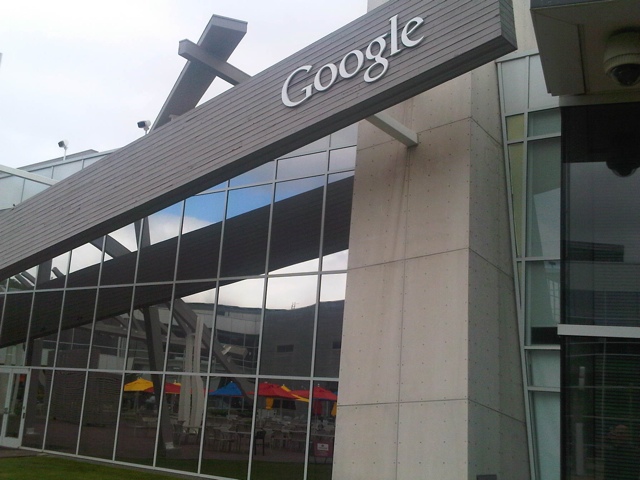
Google and Facebook followed the next day and the scale of the companies and their impact on the world is staggering. In both cases you have to remind yourself of what they have achieved in such a short period of time and as we wandered the offices how on earth they kept on top of the growth. The offices both had a dishevelled feeling about them, but both gave up space for thought and distraction, something we could all learn from I think. Everywhere there were break out areas in all shapes and sizes as well as canteens and small kitchens.

The average age of the staff was young! The Google canteen was like a high school dining area not one of the worlds largest companies. It also seemed open to the world. There was our trip that felt like a school tour, the were also school tours and other things, it feels like a company keen to be part of the community – I don’t know if that’s true or not but that’s what I was left with.

Google was not a company but a town, complete with their own Google company bicycles everywhere so you could get around, it was vast 8-9 thousand people..you feel like you are inside a legend of a business, a great feeling.

And after all that, what stood out for our clients? Akamai. The unheard of company that basically makes the web work and transfers the internets content. With their screens showing the load on servers across the world, beautifully brought to life with futuristic graphics, the power of this company is stunning and yet so understated. You can understand why a potential leader of Publicis Groupe in the form of David Kenny was attracted to the organisation. I suspect in the coming years we will all hear a lot more about Akamai.

So it’s been a week in Paris being trained on how to collaborate in our Groupe and now four days in the heart of the web world, a crazy couple of weeks but fascinating and week 1 seems all the more obvious having lived through week 2. This world is going mad with complexity and no one company can handle all of it, as agencies we want to be all things to all men, but those days are done. We are now in the age of truly collaborating to survive, rather than just saying we do, those who don’t use the power of our various agency brands and VivaKi will not succeed. Clients want solutions and together we can deliver.

Did someone at the ICO get pissed at lunch? Privacy lunacy

So the story so far..after many years of neglect the governments of US and UK decide we need to manage better the laws around privacy. The US agrees that we don’t need a law but the relevant bodies should show clear guidance and management of the issue, proving that the industry will be responsible. The US have done that, it’s still a little disorganised but it’s getting there.

At the same time in the UK we were doing the same. Everyone working together and moving towards an acceptable solution. It was loosely agreed that cookies required by a company to deliver a service, think about how intuitive Amazon is or how your bank remembers you etc etc. Everyone was happy with that approach. At the same time the advertising and targeting industry was looking, similar to the US at another self regulation approach. There was a number of options but it was going in the right direction.

As I had mentioned before, based on information from Evidon, consumers had shown not a fear of being tracked but rather a desire to be represented appropriately and therefore receive the most relevant advertising and or slick process through ecommerce websites. This to me is crucial, absolutely crucial and the government needs to understand this point further.

So all was going smoothly. Then someone went to lunch and got pissed at the ICO because when they got back they decided to throw all that out and do a number of things:

1. You need agreement from the user to cookie them, before you start to do it
2. They tightened up the rules for advertisers as to what is a crucial cookie and therefore exempt vs one that just makes your life easier.
3. They then left all that hanging with no actual solutions.

It is absolute lunacy, we are left with chaos, are we really suggesting pop up boxes and drop downs and virtual signatures before being able to drop a cookie? Perhaps we should just go the whole hog and ask for permission in writing as one European country is discussing.

This approach is a major departure from where the Government was only weeks ago and has caught everyone off guard, ecommerce is at risk as is most of the digital advertising business and hence why it is lunacy. The point in this blog however is simple, the only reason they could have had this short term turnaround is because they went to lunch and got pissed because frankly there can be no other explanation.

This needs of be sorted out, I am sure it will be and I know everyone is working closely together as agency groups, advertisers and industry bodies, so nobody panic. If all else fails get down the pub with the ICO boys and try and persuade them otherwise.

Reflections on The Publicis Executive Training Programme

Last week saw me holed up in a very average hotel in Paris with colleagues from around the Publicis Groupe. The aim of the week was to make us better leaders, more accomplished commercial operators and to understand more about the range of companies in the groupe.

I met with people from Leo Burnett, Saatchi, Publicis, Publicis Dialog, Zenithoptimedia, Starcom media vest, MS&L, Publicis Live, SaatchiX and others, fascinating to Hear about all the work these agencies did. We learned a lot that week although there was one over riding message from the two members of the P12 of Publicis, if you want change, if you want to work more collaboratively then start to take ownership and make it happen.

A simple message, and one I was sceptical to start with but as I started to consider this and got to know the people around me, a message I thought was actually bang on. In reality in these huge agency groups, you can always sit back and wait for things to be decided for you and it all be given to you on a plate but as leaders we should be shaping this ourselves. A very simple, but significant realisation.

As we stood on the terrace of the Publicis Groupe headquarters in Paris, you started to feel motivated to actually make this happen and not be swallowed by politics. Having worked with all these different people for four days, companies stopped being companies and became people. Leo Burnett was now Emily, Saatchi was now Leigh and so on, this is powerful, to not think in terms of companies but people makes everything so much more possible, I hope very much I have the opportunity to put into practice with these people and what their companies provide.

As a foot note, I would like to add that the was also significant capacity in the groupe to drink and work. A special mention goes to Rachael, Anthony, Leigh, Geza, Rupert, Emily and others for some excellent work in the bar..a great bunch of people all round.