Not one of the highest quality videos! This is like Jeopardy – I give the answer, you guess the question! We had 80 people from all of the top Italian publishers to cover issues around RTB and private marketplaces. The market is cautious but definitely progressing well.
AOD
Persistent Identity – holy grail available to some..
I am Just back from meetings in Seattle and San Fran with the Big 4. Big 4 you ask? Well in todays world of data connectivity, mobile innovation and growth as well as digital commerce the big 4 has changed. Facebook, Twitter, Google, Amazon are now gunpowder and bullet. The others more and more the barrel.
The message that is coming out loud and clear is that these players in their own varied ways are out to maximise the insights they have on their users and customers through a single themed approach of ‘Persistent Identity.’ I heard it a few times over the time I was out there, I have seen it mentioned in the odd article. But when you get to spend three days with all these market leading companies it becomes loud and clear that the data they hold on consumers is the key to their future and the single most valuable asset.
Persistent Identity is a fancy way of saying ‘we know who you are, we know where you are and we know what device you are on, the holy grail of data. The kind of data and insights advertisers are crying out for. What strikes me about this data is how much more powerful it is than third party data sold by any number of companies, data which is slightly worn out, like an old apple at the bottom of a bag, still edible but just not as fresh and juicy as when it was picked.
The ability to recognise you, add insights to your iD, serve ads depending on which device you are on, understand you through your behaviour by device, friends, clicks and links is so powerful, so powerful in fact you can see the likes of Facebook being the defacto judge of what is good or accurate data instead of the traditional players. That has already started of course but I think will gather momentum. Watch out panel data.
When you take a step back and realise what data they have you can understand why they are reticent to share it or risk it being stolen, putting up walls of protection around it. Amazon with their marketplace, Facebook only allowing access through API, Twitter pulling info from Google, these are the actions of companies with hidden treasure. These businesses dont need all the old methods of tracking whether it is panels of adserved cookies, they know their people, signed in, registered people at scale.
Persistent identiity is powerful and logical, the only problem is that you have to stack up on these solutions. Like having a car and pulling up at the fuel station and putting 3 or 4 different petrols in to be able to get the car going. I want to recognise everyone through the ability of joining up these players – I would love to spot a FB user who has been updating a status about an iPod, browsing on Amazon and nail them with a promoted Tweet or video Ad to close the deal. I know it is too much to ask to have all these companies reveal their secret source but targeting would be fun..
Either way, data businesses will need to work hard and fast to justify their models in the face of the biggest digital players in the world starting to pull up their sleeves and flex their guns, because be under no illusion they are big guns.
Putting the RTB in B2B
Since 2000 when I started to work in digital there has been a constant learning curve for agencies, advertisers and publishers alike. The fantastic part of working in digital but also the greatest challenge is that it rarely sits still for long, leaving people constantly chasing the next level of knowledge. If I look back over the last thirteen years there have been some key milestones. First we got this whole thing off the ground around 2000 in a real manner. We then saw the rise of Search as a real revolution of the digital business. The dot com crash and overall stagnation saw little innovation until Youtube, social media start up around the middle of the decade. Just as everyone was comfortable along came Real time bidding and exchanges.
Each sector of our business has responded differently to each of the challenges and seen different challenges and opportunities. In the last 12 months I have been asked to talk at a couple of B2B events on the subject of RTB, it is a business that was traditional in nature and could understand digital from a search and targeting perspective, mainly because they could replicate the very industry specific offline approach online. Many websites, content specific and so on. The trouble is RTB is not about the content. It can be part of the equation, but it is not the driving force. The driving force is Audience and reaching that audience.
At first that felt wrong to people but actually I have had many conversations over the years where we wanted to target small business owners or IT professionals and the conclusion was that these professionals ‘were just people’ and we should target them not just in work specific environments but also in their spare time, catching them where you would expect them to be. How many campaigns run on Golf sites in the hope of attracting C-level execs?
At the heart of the issue is that, how do you target very specific audiences without being in very specific content. Reaching the investment community, IT hardware budget holders, small businesses, you name it. Well RTB has some answers and the marketeers of B2B and Publishers alike need to start testing and creating their own very bespoke audiences. The data is there, as an advertiser you have visitor data, registered user data, you have data from your social presence and more. Publishers collect information all the time and there is even more they can do as sophistication increases. Planning is not what it used to be, planning starts by creating profiles and target segments using your data, publisher data and third party data. Start to create and test, RTB allows you to switch on and off in an instant and so the opportunity to learn is immense.
I sometimes have this impression that people still see RTB as the remnant of the industry on long tail sites. This is a misconception so I advise a marketeer to go an investigate. The world’s leading content is now in the exchange ecosystem, whether through private marketplaces or public. If the FT, Guardian, Telegraph most IT sites all see opportunity then the marketeer should also. The technology and the data can now be applied intelligently to all this premium inventory and combine that with intelligent use of dynamic creative and you have a powerful opportunity. And after all of those benefits you can apply the macro benefits of RTB – you dont buy upfront, you buy what you need to buy, one impression at a time. You can frequency cap, single reporting and achieve transparency of what you are buying. These are vital in the new digital ecosystem marketeers should be demanding this as standard.
I often spend time explaining to advertisers that we have changed our agency model, the publishers have adapted or are in the process of adapting to this revolution in digital, but many times we dont challenge the advertiser to change. That would be my core message here, dont do what you have always done, you should change and if you agency partner is not challenging you to do that then you have the wrong agency.
VivaKi and DoubleClick Video Interview: Search to display re-marketing
An interview with Geoff Smith and Myself on the successful learnings of the world first work we carried out earlier in 2013, where we took search signals and used them to re-market against through display.
All facilitated with DBM and DS3.
Trading Desks – the latest darling of the Pitch consultant
I will let you into a secret, this whole RTB thing is a real hot topic..I know, I know I hear you say but it is not with the people you would imagine, no it is with the auditors and intermediaries. They have seen an opportunity to turn a buck and are starting to get really interested in the subject.
‘Advertisers think this is a murky world’ is what I hear time and time again, but then I often wonder how they have come to that conclusion. Experience suggests that very few advertisers are engaging to any great degree, that is a shame in my view as we do all our best work with those advertisers who co-build the solution. My hunch is the plethora of intermediaries and auditors who don’t understand this subject and cant see how to make it work in their one size fits all race to the bottom approach to dismantling our industry step at a time. I also think that there maybe some advertisers who have had a bad experience and then try to spread that and tar everyone with the same brush without having a close grasp of the facts and of course, the competition in all its forms.
It is a diverse market place with many different offerings available and everyone approaches commercials and operations differently, so there is no simple way to do this, it is incumbent on communication between us and our advertisers and an ability to talk openly about how and why we do what we do. Audience On Demand for instance in display is 100% RTB, 100% transparent on inventory, buys only VivaKi Verified inventory, takes no position and does not arbitrage so we have a pretty simple approach to life that if an advertiser wants to discuss, we are more than happy to do so. I would say though that we also need to make sure we evaluate all companies in the same way, not just look at Agency Desks but all exchange trading operations.
We want a constructive dialogue in this space as opposed to a series of companies all trying to build their own businesses on the back of the latest hot potato of RTB and through scare mongering. There are so many fantastic opportunities in RTB, Google Search re-marketing, Youtube retargeting, mobile innovation, data design and execution, the best of that work comes through a very close collaboration, if we can do that, we will deliver some great, great work.
Beet.tv interview in Cannes
An interview in Cannes around technology and creativity and the fact they are merging and events like Cannes and CES are the perfect canvas for that. Click on the image below for a link to the video.
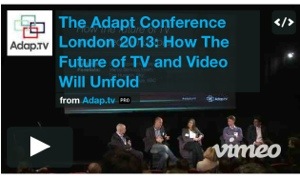
Adapt TV : My Panel – The Future Of TV
Click below for full video on evolution in video and TV space with BBC and SKY. It was an interesting debate, mainly between me and Tim, as usual full of opinion (rightly so!).
Our latest recruits – Their views, one month in at Audience On Demand

I thought I would ask our three latest recruits, all graduates to give me their view of our industry just one month in. The message is clear, we are big and complex and we love TLAs but that is what makes it fascinating. Backgrounds of economics, maths and marketing show that regardless of diverse backgrounds, all roads lead to RTB! Sorry Real Time Bidding! I am always excited when we have new people joining and so let’s hear from them..
Trisha Halai @trisha_halai
Having done a maths degree I never thought I would see myself taking on a career in the digital advertising industry. After being approached by a recruitment agency and being told about the role and company – I can say I will never look back. My first month has been very much a learning curve and a very interesting one. Understanding the technical aspect of the role in terms of getting to grips with the platform and the systems has been one thing and understanding the hundreds of jargon used in advertising is another. Initially, I was completely thrown back in my first week when I heard acronyms such as DSP, SSP, DFA, DFP, DBM, MPU and PMP to name a few. However, as time has gone on and the more I have heard these terms, they have become second nature to me and now not using them would be slightly absurd.
Coming from a maths background, I developed many transferable skills and I can say I am proud to have the opportunity to apply these analytical, problem solving and logical thinking skills into my current role. Working in a dynamic and creative industry, one that is so measureable and trackable in every aspect is exciting. It is great to be exposed to the industry at a point where it is constantly changing and advancing. Communicating and building relationships with highly respected technology and data providers and some of the big publishing names as well as agencies is what makes the day-to-day role so varied.
Being part of the AOD team at Vivaki has been an insight in many ways. It is very exciting working in a team that helps brands to deliver strong, highly targeted messages to very niche audiences across many channels such as display, video, mobile and social media. Working in a team that takes great pride in what it does and is passionate about its day-to-day management of campaigns is inspirational.
I look forward to learning new skills and developing a deeper understanding of my current role and I look forward to any challenges I may be faced with in AOD.
Claire Hobson @claireHobs
My first month as a member of the AOD team at VivaKi has been both exciting and eventful. I’ve had the opportunity to meet so many new people and have learnt a great deal about the dynamic industry of digital media in such a short time.
As a Marketing MA graduate, I had developed an interest in digital marketing and was keen to get into this area as a first step in my career. However, I had never come across agency trading desks or real-time bidding and as a result I found the complexity of the real-time bidding ecosystem quite overwhelming when I first started. RTB, DSPs, Ad exchanges, ad networks, ad servers, SSPs, PMPs… it was all like a foreign language to me, particularly with the frequent use of (appropriately named) TLAs.
Four weeks on, what seemed complex to me back then is now much clearer, having benefitted from being amongst the hugely knowledgeable AOD team and from meeting the various external teams that represent the other vital pieces of the RTB puzzle. I have noticed the difference in levels of understanding and views of RTB across these different teams, whether it be media planner/ buyers, publishers, data providers or technology platforms. This has been useful for me to gain a more holistic understanding of how RTB is viewed in the wider media industry and has helped me in developing my own opinions.
Part of the reason why I wanted to work in digital after graduating is that it is an industry that is growing and constantly changing, making for an exciting and fast-paced environment to work in – my first month at VivaKi has definitely confirmed this. However, it has also highlighted that there are often challenges, difficulties and problems to solve around these changes, something that I did not previously fully appreciate but have come to see how this is key to the development of such a dynamic industry.
A good way to sum up my first month is perhaps not to reflect but to look at how it has given me both an eagerness to learn more and a strong desire to be a part of the future of RTB, whether it be in display, mobile, video or even connected TVs. I look forward to my second month at VivaKi in the exciting world of digital media and RTB.
Nick Brown @NickPhBrown
PMP, IO, SSP, DSP, KCT, vCPM, KPI, ABC1, GRP, MPU, RTB are just a bunch of letters… However, I have come in to contact with them such remarkable regularity that I find myself thinking what a laborious task it would be to have a conversation using full, un-acronym-ed words. Since, I started work at VivaKi, the AOD team has performed massive brand blasts, won over some great clients, tested cutting edge industry inventory, even achieved a world first! The list goes on… We work closely with companies like Doubleclick, VisualDNA and large pubs like eBay and Amazon, all to our own varied ends.
Point being, there’s so much to Real Time Bidding; too much to ever come close to having a shrink wrap solution to it. On top of that, it is constantly morphing and progressing. Not only are Mobile and Video making leaps and bounds forwards, but the platforms we work with on a daily basis bring in a whole host of new features almost weekly. It’s a crazy trade to be in and my first month has overwhelmed me with a phenomenal amount of information. I would love to write all about the diverse, highly affable team I’m working in, and on how much fun I’ve had in the many social events that have already taken place but if I tried to it would fill pages and pages. Suffice to say that my first month has been a whirlwind tour of the immense and fascinating world that AOD is right in the centre of: RTB.
Have Publishers learnt from the past?
I was recently prompted to think about the sales policies of publishers when Criteo approached us to buy their inventory through a Criteo network. On the face of it one could argue it would be a good buy for us, potentially unique inventory, sourced through publisher deals that by many peoples opinion is good quality and high up the adserving priorities of the publisher. Obviously after about 1.5 secs I decided I was unlikely to contribute to the clever business model of Criteo by filling their coffers so they can then go pitch direct to our clients and move the business. That is not what this post is about but it set in motion some ideas that I think publishers should consider.
Companies like Criteo, have created a good business and are doing well in their niche but they got there through persuading publishers that they should sell to them quality impressions, in some instances first look, even above direct and brand channels at a low cpm vs those direct channels but high vs the RTB market. They deliver good business for them and everyone is happy.
Problem is that they buy a lot of it and need to get rid of it and so they want other people to buy it from them ie trading desks and potentially Ad networks / Managed DSPs. The demand in the exchanges has increased significantly since many of those deals were done and so cpms for quality inventory like this will likely create a higher cpm than they bought from the publishers. So that means then that trading desks are buying good inventory from Criteo rather than direct from the publisher? Is that what the publisher had in mind when they sold or agreed to the positioning of the sale?
I think it raises questions that publishers yet again have to face, is it better to sell at a flat cpm or find other channels to monetise. A lot of big names are doing this and for me makes no sense, if you want your inventory to be monetised, come see us rather than put us, your direct buyers second to someone who is re selling it to us? It is time to ditch the flat cpm and embrace the auctions and private market places.
We can also offer transparency to the publishers as to how well their inventory is performing and we can partner to create improvements for them and us. The alternative is sell and see no insights. In my view that era has ended. Publishers, come talk to us we can help you with that.
My Interview with Beet.tv on Programmatic Video – AODv
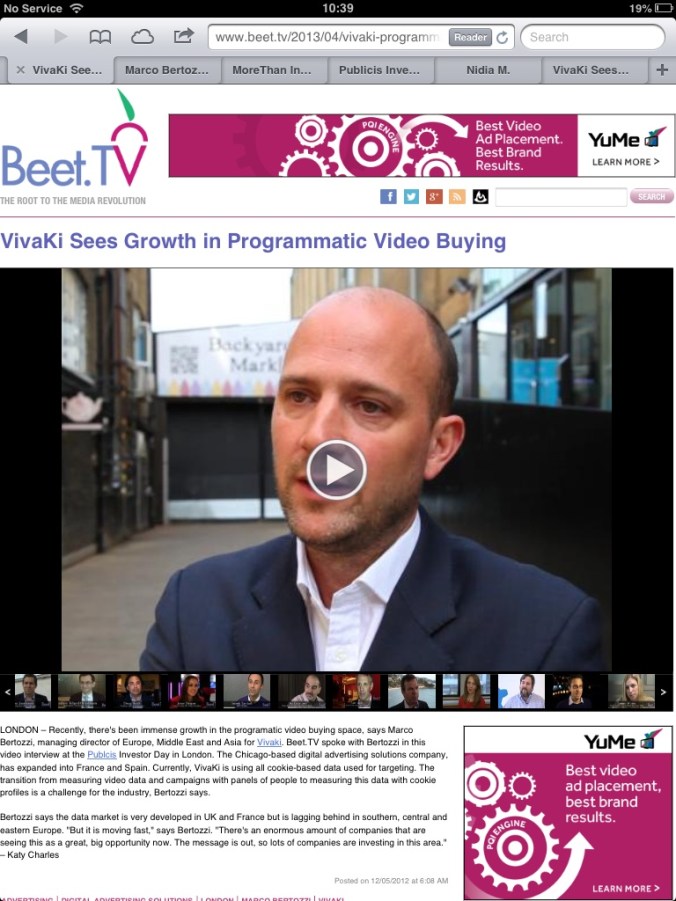
Post PublicisInvestorDay I speak with Andy at Beet.tv on Audience On Demand Video.
 Bertozzi's Bytesize