Data: The new Wild West

I have invited Paul Silver – Head of Product, AOD UK to comment on the world of data – here is his first post and the first guest post on my blog. Enjoy.

By the one and only: @thepaulsilver

The 3rd party data space right now reminds me to some degree of The Wild West. As a result of that mad gold rush era, the legacies created were: hastily erected housing, mob rule, vigilante justice, hyper inflated prices….sound famililar?

There has for sometime now been a lot of discussion around 3rd party data for audience targeting. ExchangeWire hosted the first EMEA Data Economy Event in March 2011. The hype seems to be lessening, but the appetite is as strong as ever.

The recent announcement of Xaxis developing a global audience profiling database reaffirms my belief about the synergy between the current data space and The Wild West. Agency Groups, Ad Networks, Data Exchanges, Aggregators – everyone is trying to get a piece of audience data, acquire it if you will (directly or indirectly) to fuel more precisely targeted audience based campaigns. And like the Wild West, I fear this rush for data is creating more confusion, execution of some bad practices whilst fundamentally the core foundations remain sub standard at best.

The upside of this ‘demand rush’ means publishers have more distribution points than ever, that can only be a good thing right? Or does it mean in fact that the more points that data is sold to, the more commoditized it becomes? Is that inevitable?

Some publishers that I have spoken to do not know where to begin when it comes to data monetisation. There is also so much data kicking around that advertisers do not know what to do with it, what to buy in terms of un-deduplicated reach and access, or even begin to understand the complexity around different taxonomies for what could essentially be the same user in the same type of segment. There is also the case of advertisers (and publishers for that matter) not knowing the difference between the types of data: inferred or explicit, lifestyle, interest, intent, social graphs(?), lookalike. The lack of standards and transparency exasperates the problem.

Like the mob rule affect created by the Gold Rush, publishers are increasingly becoming vulnerable too. Large agency groups are starting to wield certain influence in trying to bake data into trading deals. On one hand, publishing groups with limited scale are never really going to make a fortune from selling their data, but its the principle of how that proprietary data exits their businesses that should raise concerns. There is also the case of publishing groups still unaware of what data is being collected on their users from third parties. It is still very common practice for ad networks and certain agency groups to cookie from a creative. It might be pretty high level data in some cases but it’s still data being used to build out data repositories, leveraged for campaign targeting elsewhere.

Co-mingling of client data is an old argument; some of which believe to be mythical (one network told me it was not technically possible) whilst some believe it’s still an operational practice today. Either way it’s a practice that carries many sensitivities. An example is outlined below. I recently applied for an AMEX BA Card. I have since been served ads for BT following some recent site visitation. Nothing wrong with that. However what I found odd was the cookie information, that is being directly or indirectly leveraged, includes details of the Amex transaction. I may be wide of the mark of here and as the technology is based on exclusion and inclusion pixelling, maybe it ‘needs’ to know I am an AMEX customer so the rules can be defined to say “dont serve AMEX to this user, serve another ad from the pool”. Or it could be simply using the data they have on me to enrich the targeting parameters of the BT campaign?
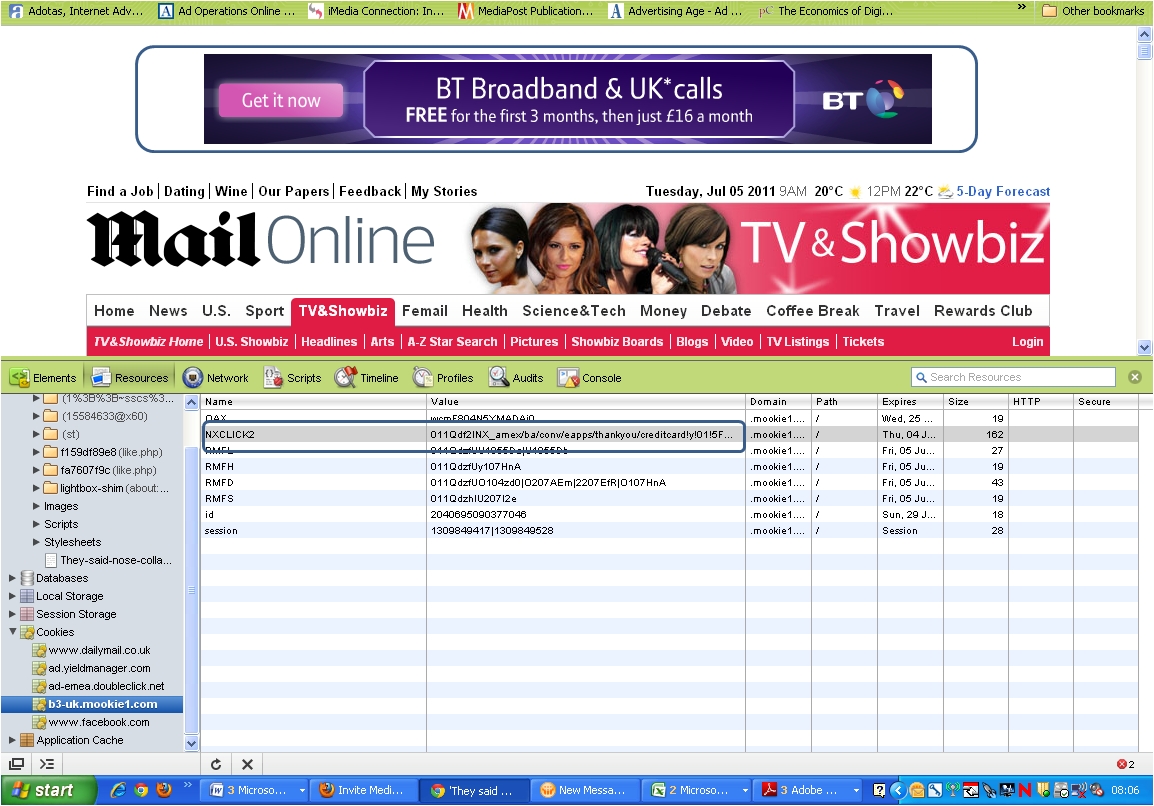
As far as the publishers are concerned, yes there are companies such as Krux who exist to protect the publisher’s data, but there’s a cost to everything. The cost to protect your data could outweigh the amount it will sell on in an open market – a difficult business case to make.

But how are advertisers being remunerated? More importantly, being protected? Data networks are built by certain businesses off the back of advertiser funded campaigns / creatives. Publishers may well be remunerated for this, but are the actual advertisers? Their ads are running across ad networks and are the principle facilitator of data collection. Surely they deserve some of this rev share?

Lastly, but by no means least, why is there not more discussion and focus on how to better measure and evaluate the use of audience data? Without this, the rush for data is simply a race to the bottom – either data becomes less qualified (to make it more scalable) and therefore less expensive to deliver against a CPA or the data investment remains minimal because a scaled use of it does not cost in against a KPI.* We should be nailing this first and foremost.

All in all, there are some murky practices still happening with regards to 3rd party data. I think industry needs to clean up the data space somewhat before anyone starts cashing in on the latest Gold Rush…

*(Fortunately for our partners, we are developing a solution within VivaKi that aims to address this challenge, identify the real value of data and reward partners appropriately. We believe there is certainly value to delivering against your target audience and we hope to be able to scientifically measure this value).

Follow Paul @thepaulsilver

The Trouble with Trading Desks is that..

They threaten a nice and cosy Ad network world where the networks manage to co exist by all buying the same inventory in exchanges, using client data and passing it back to agencies at a nice margin. Let me ask a few questions:

1. Does the average client / buyer realise the Ad networks that all have nice individual sounding names are all down shopping at the same auction, forcing up the prices for our clients and making delectable margins.
2. Why is it so bad that the agencies are bringing transparency back out of the black boxes of the performance networks, so we all learn?
3.. When did an Ad network last tell you how they achieved their results? They wont as they have to expose their exchange buying techniques. Agencies can now show the workings not just the answer.
4. Why would a client be happy to spray their data around like its going out of fashion – it’s a valuable commodity that is being used by networks to power the individual client results as well as who knows what else?
5. Is the client absolutely sure that their data is not being used by an ad network to power one of the clients competitors?
6. Why are the publishers fighting tooth and nail to protect their data whilst advertisers are giving it away?

Lets balance off this debate a little and ask who the main protagonists are in the debate, perhaps there are people out to protect their business models. I will say that our clients are getting better results, more transparency and better control of their data. Does not sound too bad to me.

Finally can we stop building cases on the back of a couple of media buyers who we don’t know the identity of, who have probably not got a pay rise this year. If this was a court of law it would all be thrown out. If I were a client, I would trust the agency as we have a lot more to lose, the networks win some lose some.

In case this annoys anyone, these are my views, not the views of my organisation.

Exchangewire coverage of the expansion of Audience on Demand

Last week Performics announced the launch of its ATS in France. Here Marco Bertozzi, Managing Director, EMEA at VivaKi Nerve Center, gives some overview on the announcement and how Performics’ clients in France will benefit from the new buying strategy.

Can you give some details on the launch of the Performics trading desk in France?

MB: Vivaki Nerve Center has a consistent approach to Audience on Demand in every market. We adjust in terms of data partners and inventory but the approach is the same and we are excited that we are now live in France. Performics is a central performance team in France and will be a centre of excellence for Audience on Demand in that country. It is still a nascent market, although growing very rapidly. Its a sign of the team over there that they have created the proposition and have started to grow the client base aggressively.

Will we see significant budget being passed through the platform. What benefits will it have for Performic’s clients?

MB: Already we are excited by the number of clients who want to go live in the market and how many are getting involved in Audience on Demand. Assuming we continue to see the excellent results in France that we have seen elsewhere, I would expect a consistent increase in spend away from the network proposition to the exchange space. I would imagine this is ahead of the market place for the agency groups.

Can you give some details on the partnership with Weborama? How will the new trading desk use Weborama’s data to trade across dynamic supply?

MB: Weborama is a good example of Audience on Demand reacting to the local market needs. Although we have a consistent approach in terms of strategy and technology we acknowledge there will always be important partners in every country and Weborama is one of those in France. It was therefore vital that they were an integral part of getting AOD off the ground in that country and we are working on some exciting audience segments and custom solutions for our clients.

You are the first ATS to market in France – but how evolved is the exchange eco-system there? Is there enough supply available in the market?

MB: I think people underestimate supply in some of the main countries. If you add up the inventry from Adex, Orange, Admeld and others there is a good volume to be able to supply our campaigns. This space is only going in one direction. Better to be in now and learning than follow the crowds. I think very quickly the supposed lack of audience will disappear and I hope the team at Performics will have a clear view of how to make the most of the new inventory as it comes online.

Are we likely to see more roll-outs across Europe? What country is next on the road map?

MB: Yes, yes, yes. Spain is already live and we are hopeful the Netherlands will be shortly after that. Of course Germany and Italy will help complete a Western European approach – but as fast as possible I would like to get a Nordics and CEE offering up and running. That comes with more technical and infrastructure issues but its already well underway. Its vital for our clients that we have an International offering in EMEA. The US is flying with China live and Australia being fully scoped, its exciting times for Audience on Demand.

Data accuracy, not data privacy

OK it is a little black and white and overly simplistic but there is something in this phrase. After working with Evidon, formerly Better Advertising, I realised that we are spending so much time talking about data privacy when in reality part of the game is data accuracy.

Evidon are one of the first companies in the US and soon to be EMEA that overlay a logo on each and every banner, allowing a consumer to learn a number of things about who is tracking them and what these databases hold on an individual user. Once you click through you are told about the company whose page you are on and anyone else who may be tracking you across over 300 data partners. Now it gets interesting, not only can you see this data but you can change it in real time to reflect you and your life more accurately OR you can opt out altogether.

The first and interesting learning was only a tiny, tiny percentage of the users clicked on the logo, we can forgive that as there has not been much coverage and education, that said against billions of impressions the actual number was high enough to learn lots about what they did next..they did not opt out, no they updated their profiles on the databases. They were happy to be tracked but only on their terms, they wanted to make sure they were rightly represented so they got the best advertising.

I dont think enough people talk about this, we are constantly assuming consumers / users want out, no they want accuracy and they want to see who and what is looking at them, after that in the main it appears they are happy to work with us nasty, media and data companies, they may even want to receive an advertising message!

So I think we should talk as much about data accuracy as we do data privacy..

Exchangewire Data Trading Summit

Yesterday saw Ciaran of Exchangewire fame organise his second major event. The focus of the event was the wonderful world of data trading, particularly within the exchange space. As is the way with Ciaran’s events they are less stuffy and formal and I always find the social and networking element to them very productive, as with the last trading summit the great and the good were there and it’s the quickest way to catch up with all your contacts.

The event was opened with a suitably non data introduction from Collective’s Steven Filler. Might have just been me but it felt like he realised that he had a room full of so called experts and the usual presentation would not quite wash and so swapped to more of an opening introduction to the whole event. Interestingly his opening chart was one of the most revealing of the day. Attendance was 45% ad networks, 10% agency and NO clients. A strange set of numbers when you think most people in the room were colluding on how to get rid of the ad networks. The agency figure looked low but actually there are a relatively few people in agencies fueling the exchange machines so that does not surprise, although you could argue that more people beyond that should show interest.

The Data panel was a demonstration on theory. We have one huge White elephant in the room, true attribution. Most sophisticated strategies seem to fail without this analysis and yet it was generally acknowledged that we don’t do it well enough.  So we end up asking whether data works in a performance world, again the answer was more a no than a yes. The panel worked hard to try and give some texture and real examples but let’s face it, if you have the answer you ain’t telling, if you don’t you will pretend and in fact most people are doing something more simple than they are discussing.

Andy Mitchell from AN&Y then gave a far more realistic view on how publishers could use the exchange space and a little data understanding. It was a refreshingly open presentation and was quite a juxtaposition to the slightly vapour driven data panel. It’s clear from Andy’s presentation though that if you have large inventory you can get in quicker and test more. I have some sympathy with the Tim Gentry’s of this world with a smaller more precious audience to protect.

I really enjoyed talking with a number of people at lunch, especially around European expansion, with Audience on Demand live in France and Spain with other countries close behind establishing the right data, tech and inventory partnerships is important, it’s clear everyone is marching into Europe which is great as far as I am concerned. That was the best bit about lunch, the sandwiches that Ciaran’s mum made were average.

Next up Audience Science. Stuart set out to stir debate, always an admirable approach but I think in places misguided. It was the first time in the day I was glad no clients were there, too many of his inconvenient truths were in fact convenient non-truths for Audience Science new business machine. Stuart has told me this was not his intention but I am not so sure. Worse than that was on a couple of the points I believe that he did believe what he was saying, especially around our debate on RTB but he was just not right as myself and Andy Cocker could not resist telling him. I am all for debate but you have to be careful not to leave people with the wrong impression.

The buyside panel was handled quietly but eloquently by Paul Silver. Some big revelations were that data was one big bubble and that Alain from Excelate was a regular buyer of women 18-34, both created quite stir. Ciaran got into his stride and managed to pull out some quality Specific Media gags, for them it feels like gallows humour, still all good fun of course!

I have to apologise to Nick from the IAB I had to leave but I know this is a serious topic and one VivaKi are taking very seriously and being as proactive as possible. In the US we have started to work with Evidon on using user initiated icons that allow consumers to opt in or out and to change their data footprint with the data collectors. It’s one of those areas where you can keep talking or start doing. As Andy says better to be at the game than watch on telly.

Overall it was a good day, as someone commented it is a state of the nation that there were no clients and that no case studies or examples could be demonstrated. I think for the next event Ciaran should create an incentive pricing scheme for clients, let’s get them involved. I would like to see less paid for performances ( we have been guilty in the past) and more genuine speakers which may end up being one in the same but I guess that’s what we will find out.

A big thanks Ciaran for making us all feel like we have friends and getting us in one room, I look forward to the Autumn summit and what I am sure will be an even bigger turn out.

Why Ad networks can’t become agencies but the reverse is not true.

The latest debate in the display space is whether or not ad networks are going to have to become agencies and go direct to clients to sustain their business. It’s a fair assumption, the likes of Specific and others will hire agency people, create better strategies and approach clients. The latest article can be found here on exchangewire.

It’s a believable concept but one that is out of sync with the way the industry is heading. Although there is a lot of hype around ad exchanges and targeting / data opportunities, within an agency, exchange trading remains a line on a schedule, albeit a complicated one. The exchange space asks many questions of agencies but that is around change and adapting, once its all settled down, it will revert to being an important channel like search and crucially will be integrated into all the other channels.

Over the last few years clients have been on a journey where in the main they have consolidated channels, first digital overall and then they have dragged search in where specialists have held on for some time. It’s not only channels but they are integrating their media agencies both within countries and between countries with more and more international pitches. Anyone in a major agency will have lived that in the last few years. So after all of this integration I think it is unlikely they will want to start farming individual channels out again, especially when it may be big news in the exchange world but within agencies, it’s just another new channel. Time and time again through research, better coordination and integration has shown better results for the advertiser so there is no reason to split out exchange trading.

There is also some realistic areas to take into account. Clients spend 80% of their budgets on offline, 60% of their digital budgets on search, the rest is split all over. So its fine for an adnetwork to go direct but they will never fill the roll of an agency. The agency roll is more than buying and is across all media channels, its events, experiential, etc etc, it’s also highly people heavy and Ad networks have been used to high margins, low headcount.

So direct is fine but will struggle in the UK marketplace, however I think with time the agencies could start to deliver an ad network experience and product within the context of their huge global corporations. Of course there is middle ground, some chameleon organisations that act as an agency or a network, but their offer only goes so far to be a real threat.

I dont think we need to start a war between agency groups and ad networks, I am sure we will all find a way, but I know what side I would want to be on.

Back to the future in biddable media

There is one area of digital that changes at an unbelievable rate and yet seems strangely familiar. Anything to do with addressable / biddable media and all the companies involved in it are now populated by all those faces from the past. All these new companies that could have come along and worked really hard to get in the front door are now using the brightest and best from the old ‘display and search’ industry to speed the process up.

Lets list a few

Stephanie Carr – Joined Marin recently
Phil Macauley – Quantcast
Chris Ward – Kenshoo
Michael Steckler – Criteo
Nigel Gilbert – Launching the Orange marketplace

There are many others , but its fascinating to see the faces now popping up in an area of the business that a few years ago would have been considered a little dull or geeky. Its happening on the agency side too though. Of course Andy Cocker and Martin Kelly are pushing data driven display, Adam Pace is heading things up in this area at OMD, your truely focused on it at Vivaki again, there are others that I am missing out but its a quite a shift and I hope it will represent where the spends follow as well.

Our business has always adapted well and its great to still be working with some of these fantastic people many years later, I look forward to 2011 and all it brings for me and all those people listed above!

My 2010 review for Exchangewire on Exchange trading, an agency perspective

End Of Year Review: Marco Bertozzi, Managing Director EMEA at Vivaki, Gives The Agency Perspective On 2010

Posted: December 9th, 2010 | Author: admin | Filed under: Online Advertising | Comments

Exchangewire story here

I first talked about ad exchanges in a pitch in 2008. The DoubleClick ad exchange was either recently launched or due to be. Either way it seemed like the answer everyone in the industry had been looking for: namely, the chance to only buy audience you wanted and move away from buying in the thousands. That principle stands true today and overall the ad exchange trading approach is a successful formula.

The market place has remained pretty static since the late nineties. The industry traded in the same way as every other media channel and it worked quite nicely. When ad exchange trading emerged and became a serious proposition it asked many questions of the roles of agencies, ad networks and brought to life the data practices that had become so prevalent in recent years. 2010 has been an amazing year. The companies and technology on the lips of the media industry now – Invite Media, Turn, BlueKai, DSPs – were not even on the radar here in Europe twelve months ago. It’s incredible how quickly our industry can adapt and I have enjoyed being in thick of it in 2010.

A year in developing an ad exchange proposition

One of the hardest parts of a role such as the development of a new way of trading is gaining trust and buy-in from agency teams. It is actually harder to get traction with a proprietary approach than introducing a third party – see how Group M has struggled with the purchase of 24/7. There has to be proof that something like Audience on Demand can work and beat the competition. Client teams are rightly very defensive of their clients.

In every group you also have of course different agencies with their own approaches and ethos to digital. My challenge with Audience on Demand was to create an offering that worked for each agency and one they felt they could make their own. You have to work with many different opinions but in the case of Vivaki we did that and through that due diligence has come a unified view on how Audience on Demand could look and one of the reasons we have made so much progress. It is great that we have Starcom Mediavest, Zenthoptimedia and Razorfish all involved through consensual means rather than command.

Unique in this arena is the level of attention that needs to be given to data ownership and making sure that we are not buying unsuitable inventory. It’s important that contracts reflect the new world we are living and trading in. Outside of that we need to manage some people’s concerns that ad trading will be the death of the buyer and lead to an automated buying environment. Those concerns are mainly unfounded. Of course as more media is traded in this way it will make agencies more efficient – but take a look at search where we still have teams of people bringing the strategies to life.

The challenges we face in an agency

In considering the challenges we face I have chosen to break up the ad exchange trading proposition into four core areas, people, technology, marketplace and data. Each area has had its own areas of positives and negatives.

People

The challenge with ad trading is that it sits in the display camp. But the execution needs to be with those who are more direct response or search focused – namely those people who enjoy numbers and optimisation. This is not a ‘display’ buy. At the end of the day someone needs to have the skills to make this work and finding those people will be the next battle ground in this market. I fear a repeat of the search market where we competed for talent to the extent that search planners were getting large pay rises after 6 months in the job. We need to avoid a repeat of that by spreading the skill set as much as we can rather than concentrate on a select group of people.

I think there will be a new breed of buyers in this space but they could work across different elements of the same principle – biddable media. Some agencies claim to be employing NASA trained graduates, who could unpick the meaning of life in an instant. I don’t believe this is not a viable strategy for all. Some middle ground is needed here. What skills will be required by agencies? There should be heavy data knowledge, and more analytical than perhaps in the past – but this new breed of buyer shouldn’t be a complete departure. After all, the ad networks have been doing this for years without recruiting from MIT.

Technology

That’s easy! Why do I say it’s easy, well because it is all the same. I can already hear the howls from the baying crowds of technology companies, but fundamentally it’s true. Let’s not hide behind technology. It’s hugely important and exceptionally scientific but unless you have the people to make it work, it’s effectively useless. We work with Invite in the main and they are the leading player in the space now with the backing of Google – and hopefully they will continue to drive innovation. That said we have not won a single piece of business on the back of our technology sell. It’s all about the people and strategy. The most important thing any agency can do is work on the overall integration of the data provided by these systems into the agency’s data warehousing infrastructure. That’s where the value is created not in the individual system itself – and that’s where NASA knowhow comes in!

Ciaran asked me about developments in this space. I think we have been seeing the morphing of companies with a technical core into DSP offerings. That for me is the biggest shift. Real-time-bidding capabilities have also driven this development. As we have seen from results, it really makes a difference to performance and the margins publishers are able to take.

As I mentioned earlier its fascinating watching all the new players come to market. Dataxu, Turn, Mediamath, Appnexus and many others all staking their claims in this space and that battle with continue unabated. On the back of that I hope we will see product improvements to benefit our clients, especially around video and mobile.

Marketplace

Is there inventory or not? There is a lot of exchange inventory that needs to be supplemented with more mainstream inventory, Yahoo already do this. Microsoft has just signed up with Appnexus and there is a ground swell of larger publishers that are starting to hear the whispers that they can make more revenue through exchanges than going to ad networks. Critical mass is key and it is coming fast.

If you were to ask me what has changed in this area I would say that publishers are now considering putting more inventory through exchanges and dipping their toe in the water. Many people talk about the threat to ad networks from agencies – in terms of replicating their model. I am more inclined to believe that publishers are less willing to forsake their remnant and unsold to ad networks, preferring to move inventory into open exchanges.

Scale to compete is another topic of intense debate. Anyone who has run an attribution model on one of their campaigns will see that a number of sites can feature heavily across a number of exposures on a campaign but the last click will often fall to a small list of companies that effectively buy up the web. These networks buy at huge scale and therefore often win the last click battle. That’s not strategy or skill – it is sheer bulk. But it works in our current basic last-click-wins approach to digital. It’s no surprise to find that the ad networks are the largest buyers off the exchanges!

Data

Come back to me next year. There’s been so much talk but little action over the past twelve months. The area of most interest is of course retargeted inventory – first party data rather than third. For the last few years agencies and advertisers have been giving it away to ad networks to make their own campaigns work better. Ad networks were thus able to create greater insights on competing brands. The battle is now on to retrieve that data usage from third parties and keep it between agency and client. One thing that is blatantly clear is the need for a huge shift in data contracts. Client contracts and media owner contracts are going to change as everyone wakes up to the reality of how data is being used.

As for third party data, we are not there yet in Europe. There is little to no decent data on the market. A couple of companies are starting to shape their offerings. Obviously there are those who will sell data but on the back of their media networks. I think we will see some developments in 2011 as US companies come to town but we have some way to go. The greatest challenge is managing the price and value. Up to this point data has been too expensive and has invariably underperformed – so we should see some big improvements next year.

European ad exchange trading

I think that the idea of a group offering across Europe is more than possible, but it remains very complex. I spend much of my time investigating the developments in European markets and trying to understand their individual nuances. Each country has different marketplaces – with some more ready than others. Germany is a particularly entrenched market with some very established publisher relationships and a low use of ad networks. There are big companies in the space such as Weborama, Adjug, Adscale all looking at establishing opportunities. The importance of working with local partners cannot be underestimated if you are to make a success in these different markets – a one-size-fits-all approach will not work.

Conclusions

It’s been a fascinating and exciting year. I have met with some extremely bright companies and people – and I believe that this ad exchange trading tide will change our business more than any other single development. As we move into 2011 – and we see the addition of video and mobile to the automated ad trading mix – the ad exchange space will become even more complete.

As I discussed it will ask questions of many company structures and approaches, people skills and data capabilities but that is the interesting area for me. It will make us all re-evaluate how we work and what our structures and people skill sets should be. I work with great teams in the VivaKi agencies and am fortunate to be able to push on an open door. This innovation requires some elements of trial and error, and we all need to learn together. I would also say we should encourage each other in this space. The more we work together, the better the traction from publishers and data companies, the more we will grow as an industry.

Google and Publicis/Vivaki renew partnership

Oh yes there will be those who start to pick away and question this partnership, some ask what this partnership is about, but you need to start at the start. Maurice Levy set out a strategy for the Groupe to be the leading digital group in the marketplace. He has achieved that ambition, but how do you get a huge organisation to move in one direction? Well firstly you show them you mean business and invest. Look back at what he has done. Maurice bought up Phonevalley in mobile, Performics in search and SEO, the big one was Razorfish and others, this has created no doubt about his intentions. So what else would a digital organisation of this size do?

Well you should have some close friends that are themselves giants of the digital business. Enter Google partnership in 2008 and Microsoft a little later on, both significant relationships, both the first partnerships of their kind and both giving an insight and opportunity to the clients of Vivaki that noone else could offer. This approach make so much sense and cannot be open to criticism.

Now the thing with friendships, the longer they are the more fruitful they are, the partnership with Google is now into its second term and third year. The senior teams in the VNC and digital teams of the group have been working with product and commercial guys from Google in a more integrated and collaborative way for some time and it’s this that drives the value and the reason, you cant undo a long friendship.

The announcement today of the renewal is significant a) because it has been renewed! We have worked well together and we want that relationship to continue and b) our renewal comes at a time when others are just creating their first deals and they are basing them on very spend related terms rather than strategic and product led. These deals are designed to create opportunity for the clients, not deliver a low cpm. Its an exciting space and the VNC will be working closely with Google on creating some of the most advanced strategies around exchange technology in video and mobile so this can only be a good thing.

Read the announcement here

I look forward to working with Google over the next two years and can proudly say that Vivaki really does have a couple of great BFs.

Exchangewire Ad summit 2010

So how do I feel after the largest gathering of Ad exchange professionals ever collated? I feel like we collected the largest group of ad exchange professionals all together and generally made ourselves feel better that we are part of something big and we made some great contacts. What I don’t feel is that we extended our reach beyond that room, and actually that would have been the best outcome of today. it’s a small thing but there were virtually no tweets, no coverage, nothing that seemed to extend beyond the room which is a shame, lets hope the attendees talk about the day.

Today was the inner sanctum, you could use all the phrases and acronyms that you liked today – DSP / SSP / Adexchange / Adnetwork / data etc without feeling like someone would not understand, and I think that’s fine, but what we need is amplification and understanding. I would have liked to have seen some more clients there, where were they? The agency folk were slim on the ground a smattering from Vivaki, Carat, Infectious, Mediacom but not many and none brought clients. It was a technology / supplyside gathering in the main.

What I wanted to see was a few clients and more mainstream agency folk to come and see what it was all about, see what it all meant and how it would affect them. I was asked to come up and co present with the Global CEO of Vivaki Nerve Center and I talked about my disappointment that the NMA had hardly bothered to talk about exchange trading in a recent issue and thats how I feel the industry is in general. It’s interesting because it appears no one has learned anything from the birth of search, ie we should have all embraced it quicker and we should have wanted to know more sooner, it feels like it’s happening again.

Of the content Admeld, Quantcast, Vivaki, Infectious, Google, Rubicon all contributed amongst others to an interesting session, the discussions around data and the demand side seemed to raise the most passions as people grapple with who owns what, who does what and who is going lose the most in the new world. Overall it was strong content, perhaps needed more direction and linkage but strong nevertheless, as I say, it was like preaching Catholicism to the Vatican, I would rather be in front of a crowd of non believers!

Credit to Ciaran for organising this, it takes some balls to get these things going and he did a great job, I hope for the next one there is a push to bring people from outside of the Lodge and bring in non believers, clients, broader agency people so we can spread the word. Today we established a real crop of experts in one room and that is a great start, on to the next..well done Ciaran.