Exchangewire Ad summit 2010

So how do I feel after the largest gathering of Ad exchange professionals ever collated? I feel like we collected the largest group of ad exchange professionals all together and generally made ourselves feel better that we are part of something big and we made some great contacts. What I don’t feel is that we extended our reach beyond that room, and actually that would have been the best outcome of today. it’s a small thing but there were virtually no tweets, no coverage, nothing that seemed to extend beyond the room which is a shame, lets hope the attendees talk about the day.

Today was the inner sanctum, you could use all the phrases and acronyms that you liked today – DSP / SSP / Adexchange / Adnetwork / data etc without feeling like someone would not understand, and I think that’s fine, but what we need is amplification and understanding. I would have liked to have seen some more clients there, where were they? The agency folk were slim on the ground a smattering from Vivaki, Carat, Infectious, Mediacom but not many and none brought clients. It was a technology / supplyside gathering in the main.

What I wanted to see was a few clients and more mainstream agency folk to come and see what it was all about, see what it all meant and how it would affect them. I was asked to come up and co present with the Global CEO of Vivaki Nerve Center and I talked about my disappointment that the NMA had hardly bothered to talk about exchange trading in a recent issue and thats how I feel the industry is in general. It’s interesting because it appears no one has learned anything from the birth of search, ie we should have all embraced it quicker and we should have wanted to know more sooner, it feels like it’s happening again.

Of the content Admeld, Quantcast, Vivaki, Infectious, Google, Rubicon all contributed amongst others to an interesting session, the discussions around data and the demand side seemed to raise the most passions as people grapple with who owns what, who does what and who is going lose the most in the new world. Overall it was strong content, perhaps needed more direction and linkage but strong nevertheless, as I say, it was like preaching Catholicism to the Vatican, I would rather be in front of a crowd of non believers!

Credit to Ciaran for organising this, it takes some balls to get these things going and he did a great job, I hope for the next one there is a push to bring people from outside of the Lodge and bring in non believers, clients, broader agency people so we can spread the word. Today we established a real crop of experts in one room and that is a great start, on to the next..well done Ciaran.

NMA piece I contributed to, small coverage for a big subject.

As the online display ad ecosystem continues to evolve, this map of the status quo highlights the essential cogs and major players

Comparing the UK online display ad marketplace of ten years ago with today’s shows how rapidly it has changed, from an exchange of media and money through an ad server to a technologically complex and multi-layered ecosystem. And it’s about to change again.

One of the most talked about developments of the last six months has been Google’s acquisition of Invite Media, a technology firm with a demand-side platform that lets advertisers buy from multiple ad exchanges through one interface, while providing people support services.

While automated buying through ad exchanges has been heralded as a way for advertisers to cherry-pick the most targeted impressions in real time, with publishers avoiding the wastage of bulk buys and getting the highest value for inventory, its success depends on an abundance of buyers and inventory, plus knowing how to define bids.

Infectious Media founder Andy Cocker, highlighting the complexity of what’s currently on offer, warns, “There are around ten companies to which agencies could go to license DSP technology. But unless they know how to bid in a safe and controlled way, and how to use data to buy, they won’t have a good experience.”

For these reasons, development of automated trading has been hesitant. But some media players expect Google’s acquisition to change this. They argue it’s an endorsement of how display trading will develop and that it will help pave the way for much-needed standardisation in an area of technology that’s hugely disparate.

“This space needs to develop as a marketplace. Google buying Invite will only bring sophistication,” says Marco Bertozzi, EMEA MD of Vivaki. “Because it’s so dominant in search, there are a lot of people who start wailing and pulling their hair out, but everyone’s still using DoubleClick. The natural reaction is that it’s a bad thing, but any investment in the space is a good thing.”

Google’s latest acquisition gives it end-to-end capability within the online display ecosystem. It now offers an ad server, ad network, ad exchange and DSP technology. The impact this will have is hotly debated by industry players.

“We’re investing significantly in technologies that are helping to grow the display advertising ecosystem for publishers, agencies and advertisers,” said a Google spokeswoman. “Like our partners, we see enormous potential in this space. Real-time display ad buying, in particular, is delivering significant benefits for all players.”

Yet Jay Stevens, international VP and general manager for The Rubicon Project, which works with publishers to optimise inventory yield, is worried. “Google’s acquisition of Invite represents the last link in that value chain,” he says. “It already controls a digital market through search. If it owns the display landscape as well, it’s monopolisation which will hurt agencies and publishers.”

Full article here http://www.nma.co.uk/features/online-display-map/3018213.article

Google Zeitgeist, inspiration in a day.

There was more passion from the speakers and less from the audience compared to the EMEA version, that was my overriding impression. I expected more whooping but instead found a very reserved audience.

So I missed the first day, by all accounts a roller coaster of a day where the economists depressed everyone and Ted Turner inspired everyone. I arrived in time for dinner and Cirque de Soleil. I was surprised how little enthusiasm there was for the show, people were clapping politely when they should have been going crazy, the Europeans were far more excitable, I thought it was meant to be the other way round! That theme of restraint continued into the next day except for Geoffrey Canada – anyone heard of this guy? No probably not in EMEA, he is a US inspiration, he is a social activist and educator who campaigns for better education for the ethnic minorities with a focus on Harlem.

Geoffrey was one of the best speakers, most entertaining, intelligent and passionate speakers I have seen for some time. I have been to 5 zeitgeist and it was the first time there was a standing ovation, it felt strange for me, a bit like the judges getting up and down for X factor but he deserved it, look him up, there are not many presenters like him.

The crowd did not ask questions, there were limited interactions, in europe they are queuing up, to be fair mainly spanish, Italian opinionated people happy to tackle anything, perhaps the Americans are more respectful and don’t want to challenge everything, the Europeans love it! This was what surprised me the most.

Geoffrey was great. Later in the day Lance Armstrong was on stage, he clearly is an inspiration, I found him a little dull if I am honest, he sparked up when he talked about cycling, part from that it all felt a little emotionless for me, it’s a personal thing but I can’t help but feel when i see famous sportsmen that i want to hear about amazing anecdotes about their sport not their website, albeit a worthy cause. By the way he reconfirmed that he never took performance enhancing drugs, I believe him.

One man who was very impressive was the CEO of Verizon. He runs a company of 120billion dollars and employs 220k people! That is a staggering number of people to be responsible for, he was impressive, very impressive. The shame of the session was he was subjected to banal questions that came from a very subjective perspective. One man stood up and recounted how his wife waded through bills and would it not be easier to simplify the process? To be fair to him, he answered diligently. He was clearly a man who ran a serious business, he joked with Eric Schmidt of Google with a kind of ‘ I know you are big and powerful and Google, but my company is big stuff even against your operation, kind of way.’ That session ended with one man banging on about his contract and how T-mobile did it differently. At last his patience ran out and he tersely replied – we are not T-mobile and shut him down like the annoying man that he was. There is only so much of that shit you need to listen to. I was amazed at how low level, subjective, experience led the questions were, there was not a single weighty question asked of him..strange. By the way 4g is coming in a serious way for Verizon by end of year.

Will.I.am was brilliant. Simply brilliant, these musicians are now so talented in so many other ways, business people, innovators, entrepreneurs. He was very funny, but clearly was leading the way in how to change the music industry. This is a guy who would be happy to shut out the music label industry. He was joined on stage by the CMO from coke which made it feel a little more dirty to me, he was talking a very purist story, it felt diluted by her intervention.

I have gone on for a while now. I want to end on a more serious note. The CEO of Canter Fitzgerald, Howard Lutnick was invited to talk about he coped with 9/11 and the impact it had on his business. Let’s hear the facts. Honestly I can’t remember them all it was too shocking but roughly it was something like this..650 of 900 members of his team were killed. Because he had always encouraged family and friends to be employed by existing employees it was something like 17 sets of brothers and sisters were killed, he lost his own brother..9 years after the event he was still struggling to deliver his speech without tears. The story was unbelievable, his clients rallied to them, the LA office gave up profits to pay for the families of the dead, he ran the business at cost and gave the rest to the families of the dead. It brought tears to everyone’s eyes, it was incredible. I am glad I was there just for that. Read more here

There were no questions after that session.

I found the content and speakers far more inspirational and interesting than the UK this year, they appeared to come with more passion than in the UK and I found myself addicted to what was going on, the only thing that let things down was the audience.

Finally I found the relentless and ruthless networking quite distasteful, the thousand mile stare as they try to see your badge and decide if you are important or not. One thing you realise is just say you have a UK or EMEA role and they switch off, oh, that little island , no, you are not worth anything to me..it’s painfully transparent.

Google Zeitgeist – US experience.

I think I am one of a few people lucky enough to go to both Zeitgeist conferences. I always enjoy the UK experience but to get to go to the US version is a treat. I was only let into the holy experience because I was in the same hotel anyway for a Board meeting of The Vivaki Nerve Center but it does mean I intend to follow very carefully what goes on.

I find myself working with the US more and more in my role, we do truly live in a global world and in many areas they do indeed lead the digital world, not by far but they do, the sheer number of companies operating means there will be faster development in all things technology. Look at the data space, the number of companies that saw the opportunity in the US vs the UK or Europe is significant, even now EMEA is playing a huge catch up game in that space.

So it is with this background that I am excited to be in the heart of thought leadership in the US and will be tweeting and writing up what I see, albeit just one of the two days. Come back for more as I go through the day.

Priority inbox from Gmail. Saves me up to 2 minutes a day

I like it, I do! I like Gmail, I have used it for years, an early adopter, its the home of all of my phone contacts with my iphone and BB synched to it so I never lose another contact. It is so much better than hotmail in keeping out the nasty little virus people. I have a great email address as I got in early.

Priority inbox is also a likeable invention but I am not sure I entirely get it. They list the emails that are important at the top, the less important ones underneath. If you are a serial checker of your email whether it’s work or play then what that usually means is I have 1 email as priority and 2 less so, the end result being I can see all three in one view and its easy to filter out the good from the bad. I also still have to delete / archive / report as spam the less important so again, I have to go grubbing about in those less important emails anyway. I just dont think it saves time or makes life easier?

I think this is designed for someone who has no more than 1 minute available between meetings, has 1000 emails landing between the check ins and has loads of important emails. If that is the case then I think this product is perfect. For me I waste as much time accidently clicking on normal inbox and going back to priority as it saves me in the reading of them! Its a small gripe, otherwise I like it, dont strike me off beta!!

Hard work being a technology company at the moment

I would not want to be in this space at the moment. It is fiercely competitive and every man and his dog has a new angle on targeting, tracking, bidding and the like. Digital has always been like that, a constant stream of questions from clients, planners and other agencies along the line of – ‘you heard of x company, apparently amazing, can you have a look at it for me?’ Being on the inside of a technology company must feel like that at the moment, especially big ones like Google and Microsoft.

The energy at the moment is focused on biddable media whether that be ad exchanges, search of Facebook API and therefore companies have come along like Marin and Kenshoo to challenge the elite. They are new and shiny and fast and they produce product roadmaps about 6 months ahead of the slightly larger more sluggish rivals.

Teams in Doubleclick now are constantly being asked about what can be integrated into their systems like DART search, it’s a fair question because the market is moving so quickly the agencies are having to adapt rapidly and therefore they need their suppliers to do the same. Deep integrations that are hard to move is not a good enough reason to stay with a supplier. It’s not however as simple as doing the usual Google bashing or Atlas bashing, I have some sympathy for them. When they change one thing it has to deliver against all their other systems and make sure that nothing falls over. With great volumes and large customer bases comes a big responsibility to not mess up. Some start up with 5 clients can afford to mess about a bit and change things as it pleases with little or no impact, Google can’t do that.

I would like to see what happened if an agency said to one of these new companies – OK I will move all our spend to you, we want 24.7 customer service, technical support, migration in weeks, nothing to go wrong, we want to check all your contracts and privacy set ups and all the rest. Simply, they would not cope. So on that basis I think we have to understand that there are many pretenders to the crown but they could not all make it and its easy to bash the big boys.

Nevertheless it must be hard work right now and I don’t envy them. Sometimes things just do not work, today we saw the end of Google Wave. Of course we did, it was a nightmare. A small part of me does think though that those resources could be redirected into services that meet the real needs of customers rather than so many experiments. How is Buzz doing?

Outside of that particular field there are so many companies selling data, targeting and tracking. They all want a piece of our client’s websites, they all want a test, it is a minefield out there and sorting the wheat from the chaf for agency digital planners is extremely hard and often hard for the companies to differentiate themselves. I have not seen so many new companies selling their wares since 2000, they wont all make it and as agencies we need to somehow back the right horses..

My piece in Mediaweek

This was a piece done in Mediaweek which I have transferred onto my blog so as to keep records of what people have been saying..

Mediaweek 01.04.2010 Marco Bertozzi hits a nerve at VivaKi. Article here

Marco Bertozzi, back in the media world after a two-and-a-half-year absence, tells Media Week about his new role as EMEA managing director of VivaKi’s Nerve Centre and what will happen when the lunatics take over the asylum

Marco Bertozzi, managing director EMEA, VivaKi Nerve Centre
Marco Bertozzi doesn’t like being away from his pregnant wife Angelina, global brand manager at Unilever, so he got up at 3.30am to fly to a meeting in Madrid and back within a day. But there are no signs of tiredness when he meets Media Week the following day; the only glitch is the fact he hasn’t been warned he will have his picture taken. “I would have worn a suit,” he grumbles.

But then, as Media Week points out, he would look like a City boy, and that isn’t his style. A City boy wouldn’t order a pint of lager just the wrong side of midday, as Bertozzi does as he sits down to talk about his new role at VivaKi, nor would he have staked his career on an intuition that the internet would one day dominate the media landscape, at a time when everyone thought he was “mad and would fail”.

Bertozzi [pronounced Ber-tott-zee] is back in the media world after “ticking some useful career boxes” during a two-and-a-half-year spell at recruitment firm TMP, enticed back to the agency group he first joined in 1996 thanks to an encounter with ZenithOptimedia’s global chief digital officer Fred Joseph, who offered him the role of managing director EMEA of VivaKi’s Nerve Centre division.

The move to “a new job in an old home” felt right, Bertozzi says, because he wanted to pick up the digital thread again, working with leading online publishers – VivaKi has partnerships with Microsoft and Google – and the latest technologies. The basic function of the Nerve Centre is to act as “the Intel chip” inside VivaKi, a future-facing unit that helps the Publicis agencies add value to their clients’ businesses.

The Nerve Centre is more established in the United States, and Bertozzi’s job is to ramp up its presence and investment in the UK, working with digital and management heads across all the Publicis Groupe agencies: Starcom, MediaVest, ZenithOptimedia, Digitas, Denuo and new addition Razorfish. But it is not an agency-within-an-agency; Bertozzi is the Nerve Centre’s only full-time member of staff in the UK, reporting to Curt Hecht, the US-based global president of the Nerve Centre.

Bertozzi explains: “The Nerve Centre is not about creating its own fiefdom; it is about thought leadership. The exciting part of the job for me is working with all the different agencies and people within the group, being in the middle of everything. When people know you they don’t tiptoe around and you get to the root of the issues they are facing far quicker.”

After a “whirlwind” four weeks in the role, Bertozzi has identified two areas to focus on: the US-led Audience on Demand service, which engages with ad exchanges to buy the right type of audience impression in real-time, and VivaKi’s research initiative called The Pool, which works with media owners and clients on “high-end, market-changing research”, such as online video and mobile. Bertozzi says: “The point is to create research that will end up changing the market in response to the answers of that research.”

Early adopter
Bertozzi got into digital as an “instinctive move” back in 1999, when digital was so far off the radar that colleagues emailed Zenith Interactive Solutions, the division founded by Damian Blackden, now EMEA president of digital at OMG, to ask if they could fix their computers. He recalls: “Anyone who got involved in [digital] back then had no knowledge it would be the big thing of the future. TV was the power-base of the agency and I was being promoted, but I couldn’t see myself staying in television.”

Now, of course, Google’s ad revenue has outstripped ITV, and the challenge is to keep up with how technology evolves. Bertozzi started his own blog last autumn, Bertozzi’s Bytesize, purely to understand the digital ecosystem: its viral effect, how people communicate and where the traffic is coming from. He says: “The audience is fragmenting and there are more and more ways of communicating with consumers. The way we plan and buy media, particularly digital media, has to change, because it is so fragmented and there are so many sites.”

The solution, Bertozzi says, is to solve the “big battleground” around data and how it relates to ad exchanges and targeting. He says: “The right audience delivers the best sales. So the future is about technology that allows you to target people in a more sophisticated way, taking into account previous behaviours and overlaying other data sources. I like to think there isn’t a digital buyer in town who isn’t excited by ad exchanges and that side of the business.”

Meanwhile, mobile has had so many false dawns it remains “strangely unresolved”, says Bertozzi, although he believes it will gain momentum over the next year. And social media is coming out of its box to evolve beyond direct response ads on Facebook to a “more refined” art involving blogging, seeding, generating pools of fans and responding to customer issues. “The purer end of social media – when you properly restructure a client’s communications plan around all the social media channels – is still a challenge and that will continue.”

Coming back to the industry following a tough two years, Bertozzi has observed how the recession has “woken people up” to the fact that everything is business critical. “In tough times like recession, people definitely grow up,” he says. In keeping with the new mood of seriousness, Bertozzi is no longer tempted by lavish industry jollies, preferring to drink in low-key haunts with agency colleagues he has known for years, such as the pre-Christmas reunion of Zenith alumni at the Dudley Arms near Paddington.

So, as someone whose career has grown alongside the internet, going from off-the-radar to the central nerve within 10 years, does he now consider himself the elder statesman of digital? Bertozzi, who turned 38 in January, laughs. “No. But there is some pride in the fact that I got involved in digital before the market had confidence in it, as opposed to all the people who joined when they could see it was not going to go away.”

Later, Bertozzi speaks of the day when “the lunatics run the asylum” – when those people who have grown up with digital take the top media agency roles. Bertozzi, with his 12-year pedigree at Zenith, has the credentials to be an agency chief executive, and if his career continues on the same trajectory, the big promotion could come sooner than he thinks. Publicis bosses would be mad not to consider him

Vivaki Nerve Center launches The Pool video lane

When I started in the Vivaki Nerve Center I had quite a few things on my to do list. One of the most exciting was getting ‘The Pool’ live.

The Pool is a vehicle through which we would bring together advertisers and publishers to participate in a project that would shape the market in whatever field it is concerned with, drive future facing ad formats and hopefully drive revenue on both sides. It was designed to be objective, a consensus approach but based in consumer insight. The Pool started in the US with fantastic results, if you want to read more about it, click here

Video advertising is the subject of choice. Why is that? Well there are some fundamental factors that lead video to be an ideal Lane in any country. Firstly we all know its growing hugely, unstoppable and more and more quality content is migrating to the web which is not being followed by advertising pounds. That leads to the next couple of issues. The ability of publishers to monetise has been difficult due to the constant erosion of pricing and lack of research to prove it works and secondly it’s a chaotic ad market in terms of formats. If you work on the basis of 50-60% of TV ad pounds go against a 30sec Ad it’s easy to ramp up investment rapidly. Anyone who has done video advertising knows there are too many formats, too many creative approaches and publishers all have their own model. The Pool aims to solve that.

Tomorrow sees the launch to all the major publishers in the UK of The Pool Lane 1 in the UK, Long form video. Vivaki Nerve Center with close collaboration from ZenithOptimedia and Starcom will be aiming to get publishers on board with the project to find the single best Ad format for video across a range of categories of results. Once on board we will work through field research and with the help of clients to identify the winning Ad format.

It’s an exciting project and I hope very high profile, the end result should be a win for the publishers, a win for the advertisers and a win for the agencies in the Vivaki groupe. I hope by the end of this there will be a model that becomes second nature to planners and allows scalable spend in video which has to be a good thing.

I will then be turning my spotlight on mobile. Mobile suffers similar issues if not worse and needs to have a greater industry focus put upon it. The levels of spend in mobile display are appalling when compared with the time spent on mobile devices so I hope in 2011 The Pool approach will drive some great new learnings for mobile.

Pitching has become so time sensitive, there is no time for good ideas.

Pitching is all part of being in an agency, to some extent its the best part, the thrill of the chase, the battleground of the pitch itself and then the exhilaration and pride of a win or the dejection of loss. I am sure the more enlightened clients understand what goes on behind the scenes, but i have a feeling many don’t understand the true reality of the labour that goes on. A large pitch can use up a team of 30+ people, working night and day for three weeks to deliver the final product – do all clients understand that?

What has changed over time has been the length of the pitch presentations, some even very large pitches have now fallen to a time scale of 1 hour for even a large account. Many people will tell you that if you can’t get your good idea across in that time then it can’t be that good an idea, I disagree. Some ideas need explaining as do some concepts, especially around the new battle grounds in digital and 40 slides is not enough to bring that to life. I think a major pitch should afford the competing agencies the time to genuinely deliver ideas, if more time was spent, I think more would come out of the pitches, more questions asked and therefore more of a sense of the agency.

The problem comes when often the advertiser cant seem to be able to knock people out of the process at different stages, I have been in processes where there were still 5 or 6 agencies in at the end, that strikes of a complete lack of decision-making from a clients perspective and is not the right way to approach things – have less people in at the final stage and give them longer to present, that’s a good model.

If you have to cover, buying, digital, strategies, responses to briefs, creds and many other areas you will not get enough time in, I think they should get down to 2 for a final stage and then do a Boot camp process where the clients get to spend some decent time with the teams, after all we could be talking about a 100m budget, spend some time and get to know the agency strategies and ideas in detail, then make a decision.

I should add though, agencies on the whole do a great job of these situations, I would like to see them get a better chance to shine.

Cannes Lions Festival – You dream it, we deliver it

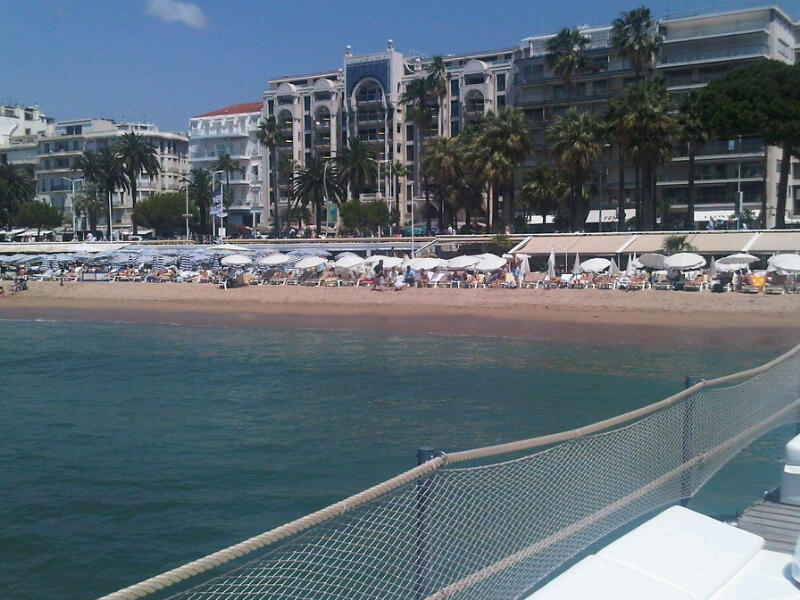
Monday to Thursday was the plan, but then work got in the way! So instead we went for a Tuesday afternoon flight, one that I of course missed by one minute, one minute that cost me 8 hours! I eventually arrived via Amsterdam and immediately got out into the thick of the event, it’s an impressive set up, there are not many places where you can meet up with all of your work colleagues from across the industry in one single city which is buzzing with both work and play conversations.

Down at the Gala event it was heaving with people from across the business, the business being very varied. Media groups, advertising groups, content companies, digital, film, music you name it, all here. A lot of drunken idiots as well to be fair, in fact some people were such imbeciles I was amazed they had been let in the country!

It was a fantastic evening, I met with Christian and Kate from AOL at their own party on a roof top, very civilized and a great ease into the evening, obviously as a reciprocal arrangement from zeitgeist, who should I see there but Damian Burns, Global Head of Agency Relations and Ben Faes from Google. Later in the evening there was Tom George from MEC, Stephen Haines from Facebook and a few other golden oldies. Although of course most of the talk is social, there is some interesting conversations about what has been seen and heard during the day. Apparently the Ben Stiller/Yahoo event was a little weird and did not entirely work, that said by then we outside the cleverly Yahoo sponsored ‘gutter bar’ which was the end destination most evenings and stayed open until way beyond you should have been in bed, luckily it was next to the Martinez where I was staying, so that worked!

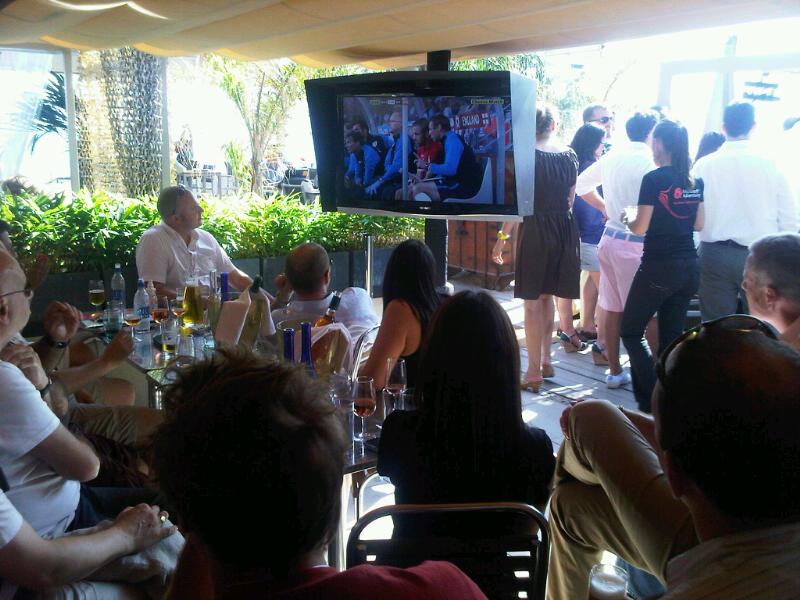
The next morning after 2.5hrs of sleep Vivaki and Microsoft had their ‘steering committee’ meeting which lasted for some hours and covered the state of the nation between our two companies, an interesting meeting with some grand ambition which I am looking forward to working on in the coming months. After a lovely lunch a couple of meetings around ad exchanges (my topic of choice at the moment) and then on to the football. Microsoft hosted a great event with all of the UK people seemingly choosing their beach club to watch, great atmosphere not least as the US were playing and the Americans were getting very excited about their game too, we exchanged cheers through the afternoon, although i suspect they were less sure what they were cheering for!

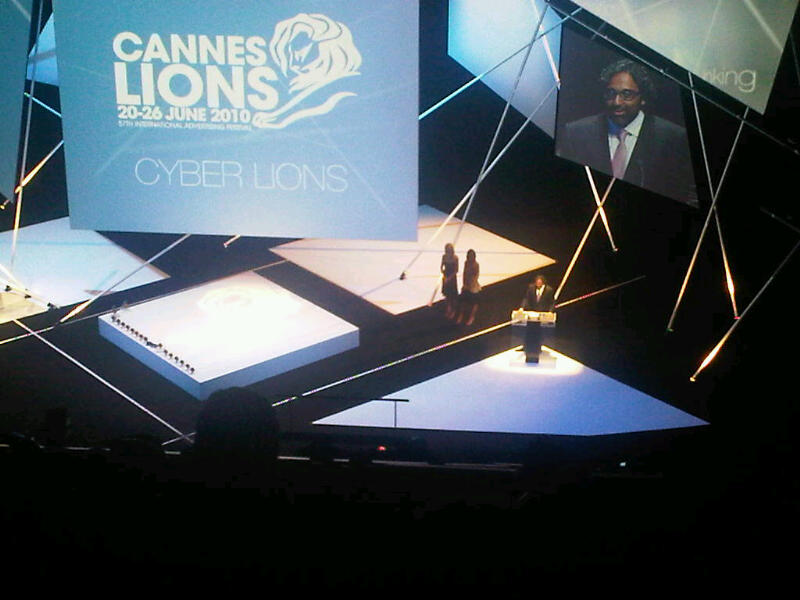
Later at the awards I took my seat, waiting to see what award winning work looked like, there was some great stuff, I loved the recruitment work from one agency that distributed a calendar with a resignation letter for each day, waiting for the day you had had enough. The Aides campaign from TBWA France was also the rudest thing I have seen on the web, a willy chasing a vagina round a homepage and eventually having sex once safely inside a condom was pretty risqué, but brilliantly done.

All the winners can be seen here

An evening spent with Google was very entertaining and good to be on the inside when they win a big lawsuit with CBS! It also appears that I was sat down to one of the men who has contributed most to the uk digital scene, our own Bruce Daisley, winner the next night at the NMA awards for the accolade. I am very pleased, if disbelieving for the lad, he is a great practitioner and a great guy, he is just no good at hosting jollies as he reminded me of our jaunt to Germany for the football.

The next morning I got the chance to see the Microsoft Experience centre, packed full of their three screens, windows 7 phone, Xbox and Kinect. All of them looked amazing and full of potential for an advertiser. As I went round though It just reminded me of how little of this stuff the average planner or advertiser has seen or experienced. There is a gap between the possibility and the reality, I don’t think advertisers see how a touch sensitive table could drive their crm or sales. The Xbox is a home entertainment system with connectivity, content and games, do advertisers see this? I don’t think so and even worse I don’t think the agency folk are much better. If you get a chance go experience it!

As my trip came to an end and I got a chance to catch up with some other agency friends on the way home I thought to myself what a fantastic event, yes there is a lot of fun and drink and socializing but it’s a chance to bring a lot of very interesting people together and the opportunity to see some great work and technology.

A 4 hour delay on the way back, rounded the whole trip off. Thanks to Microsoft, sorry I did not make it on your video blog, I must have been as dull as my blog. When I got home I had an iPhone 4 waiting for me, that’s my next post..

Au Revoir