Digital parenting

24th May, 2011 will be Alexander’s first birthday, I last mentioned him on my blog about two days after his birth, since then I have been working away in the digital world which by it’s nature means you become one of the early adopters and users of all technology and social media offerings. I got to thinking about the impact of this at home and how I have used it over the last year in relation to my son.

Well let’s start with the scariest part of all, the first few days or months when you get home from the hospital. Christ it’s scary, so many questions, so much advice needed at 2,3,4 am in the morning..without the Internet I think I would have gone mad. When you are up at 4am, shattered, doubting everything you are doing the web was the most reassuring thing, not least it’s always on! You need a reminder that you are not alone in what you were going through, that is the most important thing. All those advertisers who only run search campaigns during the waking hours should rethink, it was the middle of the night I was searching as a new dad.

Facebook was the other interesting source of reassurance, all those people up late with kids or even just partying, I did more Facebook chat in the middle of the night than ever before, it makes you feel connected, not just the witching hours but when you are locked down at home, it has the capacity to make you smile a lot..

I have battered our computer with questions about parenting, reviews, advice, locations, things to do, you name it, where would we be without it? As I write this I am on a plane back from Cyprus,my son asleep on my wife after 3 hours of fighting sleep and a number of plays of the ‘nighty night’ App (I recommend it, fantastic graphics), interesting how quickly he is getting used to the iPad, he lights up when he sees it – should I worry?

My more basic mates are against all this digital. They don’t like photos going on line, status updates, they don’t like to see the babies reaching for the iPad at 2. I kind of agree on one level, on another I think this is it, this is our future as parents. Schools will all use computers, their friends will all have gadgets, communication as they get older will be electronic so what’s the point of fighting it? Do I want my son being the one kid who is restricted in this area and I don’t want to be the dad who knows nothing aout what my son is talking about, so I guess it’s a balance.

Advertisers I think do realise now the importance of digital, though perhaps not quite to the extent they should. My son will not watch TV on a schedule, listen to music he bought in HMV, he won’t pop down the library, he won’t read many papers, he probably will hardly send a letter, except of course when he buys a house with the backward solicitors! He won’t see a blackboard or read books as an adult from a shop, or at least he is unlikely to buy them there. This chap sitting next to me will be an expert user of an iPad by the time he is 4. That won’t be because I told him, but because that’s how the world will be so I think I am going to thank the web and technology for all the help it has given me in the last 12 months and enjoy using the best bits of it to educate and stimulate my son.

Drop him a line @alexanderJB (joke)
Exchangewire coverage of the expansion of Audience on Demand

Last week Performics announced the launch of its ATS in France. Here Marco Bertozzi, Managing Director, EMEA at VivaKi Nerve Center, gives some overview on the announcement and how Performics’ clients in France will benefit from the new buying strategy.

Can you give some details on the launch of the Performics trading desk in France?

MB: Vivaki Nerve Center has a consistent approach to Audience on Demand in every market. We adjust in terms of data partners and inventory but the approach is the same and we are excited that we are now live in France. Performics is a central performance team in France and will be a centre of excellence for Audience on Demand in that country. It is still a nascent market, although growing very rapidly. Its a sign of the team over there that they have created the proposition and have started to grow the client base aggressively.

Will we see significant budget being passed through the platform. What benefits will it have for Performic’s clients?

MB: Already we are excited by the number of clients who want to go live in the market and how many are getting involved in Audience on Demand. Assuming we continue to see the excellent results in France that we have seen elsewhere, I would expect a consistent increase in spend away from the network proposition to the exchange space. I would imagine this is ahead of the market place for the agency groups.

Can you give some details on the partnership with Weborama? How will the new trading desk use Weborama’s data to trade across dynamic supply?

MB: Weborama is a good example of Audience on Demand reacting to the local market needs. Although we have a consistent approach in terms of strategy and technology we acknowledge there will always be important partners in every country and Weborama is one of those in France. It was therefore vital that they were an integral part of getting AOD off the ground in that country and we are working on some exciting audience segments and custom solutions for our clients.

You are the first ATS to market in France – but how evolved is the exchange eco-system there? Is there enough supply available in the market?

MB: I think people underestimate supply in some of the main countries. If you add up the inventry from Adex, Orange, Admeld and others there is a good volume to be able to supply our campaigns. This space is only going in one direction. Better to be in now and learning than follow the crowds. I think very quickly the supposed lack of audience will disappear and I hope the team at Performics will have a clear view of how to make the most of the new inventory as it comes online.

Are we likely to see more roll-outs across Europe? What country is next on the road map?

MB: Yes, yes, yes. Spain is already live and we are hopeful the Netherlands will be shortly after that. Of course Germany and Italy will help complete a Western European approach – but as fast as possible I would like to get a Nordics and CEE offering up and running. That comes with more technical and infrastructure issues but its already well underway. Its vital for our clients that we have an International offering in EMEA. The US is flying with China live and Australia being fully scoped, its exciting times for Audience on Demand.

Data accuracy, not data privacy

OK it is a little black and white and overly simplistic but there is something in this phrase. After working with Evidon, formerly Better Advertising, I realised that we are spending so much time talking about data privacy when in reality part of the game is data accuracy.

Evidon are one of the first companies in the US and soon to be EMEA that overlay a logo on each and every banner, allowing a consumer to learn a number of things about who is tracking them and what these databases hold on an individual user. Once you click through you are told about the company whose page you are on and anyone else who may be tracking you across over 300 data partners. Now it gets interesting, not only can you see this data but you can change it in real time to reflect you and your life more accurately OR you can opt out altogether.

The first and interesting learning was only a tiny, tiny percentage of the users clicked on the logo, we can forgive that as there has not been much coverage and education, that said against billions of impressions the actual number was high enough to learn lots about what they did next..they did not opt out, no they updated their profiles on the databases. They were happy to be tracked but only on their terms, they wanted to make sure they were rightly represented so they got the best advertising.

I dont think enough people talk about this, we are constantly assuming consumers / users want out, no they want accuracy and they want to see who and what is looking at them, after that in the main it appears they are happy to work with us nasty, media and data companies, they may even want to receive an advertising message!

So I think we should talk as much about data accuracy as we do data privacy..

Exchangewire Data Trading Summit

Yesterday saw Ciaran of Exchangewire fame organise his second major event. The focus of the event was the wonderful world of data trading, particularly within the exchange space. As is the way with Ciaran’s events they are less stuffy and formal and I always find the social and networking element to them very productive, as with the last trading summit the great and the good were there and it’s the quickest way to catch up with all your contacts.

The event was opened with a suitably non data introduction from Collective’s Steven Filler. Might have just been me but it felt like he realised that he had a room full of so called experts and the usual presentation would not quite wash and so swapped to more of an opening introduction to the whole event. Interestingly his opening chart was one of the most revealing of the day. Attendance was 45% ad networks, 10% agency and NO clients. A strange set of numbers when you think most people in the room were colluding on how to get rid of the ad networks. The agency figure looked low but actually there are a relatively few people in agencies fueling the exchange machines so that does not surprise, although you could argue that more people beyond that should show interest.

The Data panel was a demonstration on theory. We have one huge White elephant in the room, true attribution. Most sophisticated strategies seem to fail without this analysis and yet it was generally acknowledged that we don’t do it well enough.  So we end up asking whether data works in a performance world, again the answer was more a no than a yes. The panel worked hard to try and give some texture and real examples but let’s face it, if you have the answer you ain’t telling, if you don’t you will pretend and in fact most people are doing something more simple than they are discussing.

Andy Mitchell from AN&Y then gave a far more realistic view on how publishers could use the exchange space and a little data understanding. It was a refreshingly open presentation and was quite a juxtaposition to the slightly vapour driven data panel. It’s clear from Andy’s presentation though that if you have large inventory you can get in quicker and test more. I have some sympathy with the Tim Gentry’s of this world with a smaller more precious audience to protect.

I really enjoyed talking with a number of people at lunch, especially around European expansion, with Audience on Demand live in France and Spain with other countries close behind establishing the right data, tech and inventory partnerships is important, it’s clear everyone is marching into Europe which is great as far as I am concerned. That was the best bit about lunch, the sandwiches that Ciaran’s mum made were average.

Next up Audience Science. Stuart set out to stir debate, always an admirable approach but I think in places misguided. It was the first time in the day I was glad no clients were there, too many of his inconvenient truths were in fact convenient non-truths for Audience Science new business machine. Stuart has told me this was not his intention but I am not so sure. Worse than that was on a couple of the points I believe that he did believe what he was saying, especially around our debate on RTB but he was just not right as myself and Andy Cocker could not resist telling him. I am all for debate but you have to be careful not to leave people with the wrong impression.

The buyside panel was handled quietly but eloquently by Paul Silver. Some big revelations were that data was one big bubble and that Alain from Excelate was a regular buyer of women 18-34, both created quite stir. Ciaran got into his stride and managed to pull out some quality Specific Media gags, for them it feels like gallows humour, still all good fun of course!

I have to apologise to Nick from the IAB I had to leave but I know this is a serious topic and one VivaKi are taking very seriously and being as proactive as possible. In the US we have started to work with Evidon on using user initiated icons that allow consumers to opt in or out and to change their data footprint with the data collectors. It’s one of those areas where you can keep talking or start doing. As Andy says better to be at the game than watch on telly.

Overall it was a good day, as someone commented it is a state of the nation that there were no clients and that no case studies or examples could be demonstrated. I think for the next event Ciaran should create an incentive pricing scheme for clients, let’s get them involved. I would like to see less paid for performances ( we have been guilty in the past) and more genuine speakers which may end up being one in the same but I guess that’s what we will find out.

A big thanks Ciaran for making us all feel like we have friends and getting us in one room, I look forward to the Autumn summit and what I am sure will be an even bigger turn out.

Apple iAds need to deliver with a punch

I can’t remember the last time a new launch created so much discussion, and not all positive! It’s like Apple have used the same marketing people for their hardware on their advertising solutions. I can hear them now..it’s Apple, people pay for that name they always pay a premium for our glossy products..those conversations are likely to be happening in the US as well.

Well hello Apple, meet the UK trading Director, he is less interested in the gloss, or meet the average client, they want results as well as gloss. There are some lucky advertiser who may pay the huge rates but on the whole they want some results, some proof before they hand over £1m or no £500K or no £325K and on and on…I have read a lot of headlines in this area and none of them discuss how well they work, what they deliver, how they can help a client on its objectives. The headlines are all about the price which is not a great start for Apple.

I have met some of the team and I can say from personal experience the approach was one full of ‘self confidence’ shall we say, this needs to be mixed with some real world understanding and some great metrics to deliver against the price tag. I shall watch the debate with interest as I find it amusing to see the reality hit the marketing / sales people at Apple.

Good luck

What is the definition of a tablet?

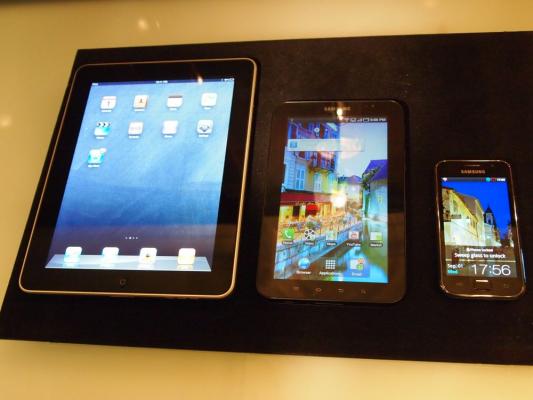
It’s not the Samsung. When the iPad was being launched and everyone was discussing whether or not there was a place in the world for such a device (I think we have the answer to that!) the most common phrase in reviews was..’if I have an iPhone and a Mac, why do I need one?’ At the time people were not sure of the answer, in the Apple way, the iPad created the need rather than answering one.

Since then the competition has fired its responses and some of them I think have missed the point. Lets take the Samsung example:

The fact is the Samsung is just too small, it’s as close to a phone as an iPad and that is the issue for me, that is where I am left asking – where does this fit? I have seen them in the flesh, they are oversized phones, the screens neither big enough to enjoy gaming, reading, web pages or apps but too big to be convenient like a phone.

The iPad has succeeded because it is big enough to have an experience, it did not set out to be a phone with a slightly larger screen, its build quality and slickness all add to this experience, something else that the competition seem incapable of replicating. I suspect the Blackberry offering will be nice, they are quickly realising that quality of finish both technically and physically is important and I have no doubt it will be a market winning execution, next to the iPad. Here is an example of some people’s interpretation of it

Oh come on publishers..build a decent app

So disappointing. All the major newspaper groups sat down in locked rooms and worked for days and nights to establish what to do with this new tablet world. After many hours they decided that it would be amazing if they scanned in their papers and you could click on the pictures to be taken to another page with a picture and some text. Genius!

There are so many options, independants like Flipboard have created a beautifully slick proposition, very visual, intuitive, interactive etc the newspaper apps are depressing in their lack of creativity, lets see what Murdoch comes up with. There was a moment there when my view that paid for content could actually win out but I have a set of apps now from the publishers that have been a massive let down and if they dont improve then they will get some one hit wonder payments and then thats it.

It annoys me that they have not done more in this exciting area, next we will be encouraging advertisers to create full page iPad ads that dont move, arent clickable and seem to be as dull as the content they are in..doh. Sorry Audi and the like.

Innovation is no longer having an ad in these environments, innovation is creating for the environment, there is a big difference, and too many award entries will be based on the very fact that they stuck an ad on the iPad..#fail. The only innovation on the iPad is the iPad, most of the other stuff is failing.

Why Ad networks can’t become agencies but the reverse is not true.

The latest debate in the display space is whether or not ad networks are going to have to become agencies and go direct to clients to sustain their business. It’s a fair assumption, the likes of Specific and others will hire agency people, create better strategies and approach clients. The latest article can be found here on exchangewire.

It’s a believable concept but one that is out of sync with the way the industry is heading. Although there is a lot of hype around ad exchanges and targeting / data opportunities, within an agency, exchange trading remains a line on a schedule, albeit a complicated one. The exchange space asks many questions of agencies but that is around change and adapting, once its all settled down, it will revert to being an important channel like search and crucially will be integrated into all the other channels.

Over the last few years clients have been on a journey where in the main they have consolidated channels, first digital overall and then they have dragged search in where specialists have held on for some time. It’s not only channels but they are integrating their media agencies both within countries and between countries with more and more international pitches. Anyone in a major agency will have lived that in the last few years. So after all of this integration I think it is unlikely they will want to start farming individual channels out again, especially when it may be big news in the exchange world but within agencies, it’s just another new channel. Time and time again through research, better coordination and integration has shown better results for the advertiser so there is no reason to split out exchange trading.

There is also some realistic areas to take into account. Clients spend 80% of their budgets on offline, 60% of their digital budgets on search, the rest is split all over. So its fine for an adnetwork to go direct but they will never fill the roll of an agency. The agency roll is more than buying and is across all media channels, its events, experiential, etc etc, it’s also highly people heavy and Ad networks have been used to high margins, low headcount.

So direct is fine but will struggle in the UK marketplace, however I think with time the agencies could start to deliver an ad network experience and product within the context of their huge global corporations. Of course there is middle ground, some chameleon organisations that act as an agency or a network, but their offer only goes so far to be a real threat.

I dont think we need to start a war between agency groups and ad networks, I am sure we will all find a way, but I know what side I would want to be on.

2010 in review – Bertozzibytesize

The stats helper monkeys at WordPress.com mulled over how this blog did in 2010, and here’s a high level summary of its overall blog health:

Healthy blog!

The Blog-Health-o-Meter™ reads Fresher than ever.

Crunchy numbers

Featured image

A Boeing 747-400 passenger jet can hold 416 passengers. This blog was viewed about 3,600 times in 2010. That’s about 9 full 747s.

In 2010, there were 59 new posts, growing the total archive of this blog to 79 posts. There were 24 pictures uploaded, taking up a total of 2mb. That’s about 2 pictures per month.

The busiest day of the year was April 6th with 63 views. The most popular post that day was Loving the Heineken Inter vs Milan event.

Where did they come from?

The top referring sites in 2010 were linkedin.com, twitter.com, lmodules.com, vivaki.com, and mediaweek.co.uk.

Some visitors came searching, mostly for ebay charges, marco bertozzi, vivaki nerve center, google zeitgeist conference, and bertozzi shoes.

Attractions in 2010

These are the posts and pages that got the most views in 2010.

1

Loving the Heineken Inter vs Milan event March 2010
3 comments

2

My new role at Vivaki Nerve Center , EMEA March 2010
1 comment

3

Vivaki Nerve Center launches The Pool video lane July 2010

4

This is the ASq. The most researched and successful video format in the US. October 2010
1 comment

5

Google and Publicis/Vivaki renew partnership November 2010
1 comment

Back to the future in biddable media

There is one area of digital that changes at an unbelievable rate and yet seems strangely familiar. Anything to do with addressable / biddable media and all the companies involved in it are now populated by all those faces from the past. All these new companies that could have come along and worked really hard to get in the front door are now using the brightest and best from the old ‘display and search’ industry to speed the process up.

Lets list a few

Stephanie Carr – Joined Marin recently
Phil Macauley – Quantcast
Chris Ward – Kenshoo
Michael Steckler – Criteo
Nigel Gilbert – Launching the Orange marketplace

There are many others , but its fascinating to see the faces now popping up in an area of the business that a few years ago would have been considered a little dull or geeky. Its happening on the agency side too though. Of course Andy Cocker and Martin Kelly are pushing data driven display, Adam Pace is heading things up in this area at OMD, your truely focused on it at Vivaki again, there are others that I am missing out but its a quite a shift and I hope it will represent where the spends follow as well.

Our business has always adapted well and its great to still be working with some of these fantastic people many years later, I look forward to 2011 and all it brings for me and all those people listed above!